Product Overview
Functional Definition
The JSJW-3, JSJW-6, and JSJW-10 series are three-phase, oil-immersed inductive voltage transformers designed for accurate voltage measurement, energy metering, insulation monitoring (residual voltage), and relay protection in indoor medium-voltage AC power systems (50 Hz / 60 Hz). The transformer provides galvanically isolated secondary voltages proportional to the primary voltage, supplying standardized low-voltage signals to meters, protection relays, and SCADA/monitoring devices.
Key Ratings
| Item | Specification (per order / nameplate) |
|---|---|
| System voltage class | 3 kV / 6 kV / 10 kV class (indoor distribution and switchgear applications) |
| Rated frequency | 50 Hz or 60 Hz |
| Transformer type | Three-phase oil-immersed, five-limb core (typ.) with sealed tank construction |
| Typical rated voltage ratio (kV) | JSJW-3: 3/√3 / 0.1/√3 / 0.1/3; JSJW-6: 6/√3 / 0.1/√3 / 0.1/3; JSJW-10: 10/√3 / 0.1/√3 / 0.1/3 (other ratios available upon request) |
| Typical secondary voltages | 0.1 kV (100 V) phase voltage (0.1/√3 kV) for metering; 0.1/3 kV (33.3 V) as open-delta residual voltage winding input (3U0) where provided |
| Accuracy classes (typ.) | Metering: 0.2 / 0.5 / 1; Protection: 3P or 6P (as specified) |
| Rated burden | Per secondary winding as specified (VA) |
| Burden power factor | cosφ = 0.8 (lagging) unless otherwise specified |
| Pollution degree | Class II (typ.) for indoor industrial environment |
| Seismic withstand | 0.4 g horizontal acceleration (typ.) |
| Applicable standards | IEC 61869-1 / IEC 61869-3; GB/T 20840.1 / GB/T 20840.3; GB 1207 (legacy where required); JB/T 5277 (where applicable) |
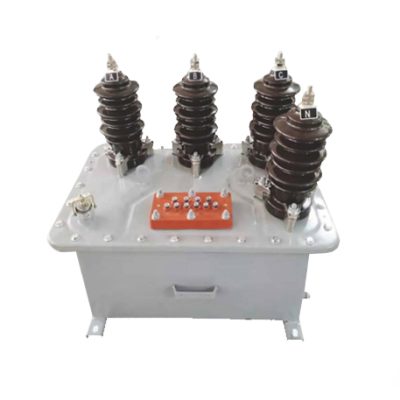
Product Shows
Working Principle
The JSJW series operates on Faraday’s law of electromagnetic induction. A laminated silicon steel five-limb magnetic core carries the primary and multiple secondary windings. When the primary winding is energized by system voltage, alternating magnetic flux is established in the core and induces proportional voltages in the secondary windings according to the turns ratio. The oil-immersed insulation system provides dielectric strength and heat dissipation, while the sealed tank reduces moisture ingress and slows oil aging for long-term indoor service.
System Application Position
- Medium Voltage Distribution: 3–10 kV indoor switchgear and distribution panels
- Energy Metering: Metering voltage supply for billing and monitoring circuits
- Protection Circuits: Voltage-based protection (over/under-voltage) and directional schemes where applicable
- Insulation Monitoring: Open-delta residual voltage (3U0) for earth-fault / insulation supervision (when equipped)
- SCADA Integration: Voltage input for RTU/IED monitoring and recording
Structural Overview
Oil-immersed construction with a sealed steel tank and porcelain bushings provides reliable insulation coordination and stable thermal performance. The internal active part consists of the core-and-coil assembly mounted inside the oil tank. Primary terminals are routed through bushings for three-phase connection, while secondary terminals are arranged for metering, protection, and residual voltage functions per configuration. The floor-mounted base allows secure indoor installation with adequate clearances and convenient maintenance access.
Model Designation
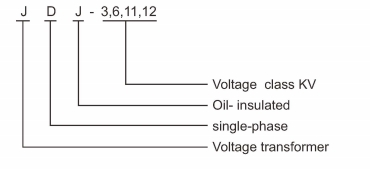
Model Code Explanation
- J — Voltage transformer (VT/PT)
- S — Three-phase configuration
- J — Oil-immersed insulation
- W — Indoor installation (室内)
- 3 / 6 / 10 — Rated voltage class (kV)
Service Conditions
The JSJW series is designed for indoor operation under normal service conditions in medium-voltage power systems.
- Installation environment: Indoor installation only
- Altitude: ≤ 1000 m (higher altitude requires engineering confirmation and potential insulation derating)
- Ambient temperature: −5 °C to +40 °C
- Relative humidity: ≤ 85% at +20 °C reference; avoid condensation
- Seismic capability: 0.4 g horizontal acceleration (typ.)
- Environmental conditions: Free from corrosive gases/vapors; free from explosive or flammable media; no severe vibration, shock, or impact
Construction
Construction Design
- Structure: Three-phase oil-immersed voltage transformer, floor-mounted
- Insulation: Mineral insulating oil in sealed tank; porcelain bushings for primary terminals
- Core: Cold-rolled silicon steel laminations, five-limb core (typ.)
- Tank: Sealed steel tank with grounding terminal and oil service provisions
- Mounting: Base plate with mounting holes for secure indoor installation
The sealed oil tank construction minimizes moisture ingress and slows insulation aging. Core-and-coil assembly is fully immersed in oil to improve dielectric strength and thermal stability under continuous operation.
Windings & Terminal Marking
- Primary terminals: A, B, C (three-phase high-voltage)
- Secondary terminals (Metering winding): a, b, c, n (phase voltage output for metering)
- Secondary terminals (Protection winding, if provided): ax, bx, cx, nx (as specified)
- Residual voltage (open-delta) terminals: da, dn (3U0 output, where provided)
- Grounding: Tank grounding terminal for protective earthing
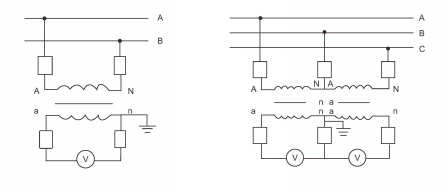
Terminal markings follow standard VT polarity and phase conventions. Correct phasing and single-point grounding of the secondary circuit shall be implemented according to applicable standards and the project wiring diagram.
Technical Data
This section provides selection-oriented technical data for JSJW-3 / JSJW-6 / JSJW-10 three-phase oil-immersed voltage transformers used in 3–10 kV class AC systems (50 Hz / 60 Hz). Data below supports preliminary selection of voltage ratio, secondary winding combination, accuracy class combination, rated output, and insulation level. Final data shall follow the nameplate and factory test report for the delivered unit.
Definitions: 0.1 kV corresponds to 100 V secondary voltage. Open-delta residual winding is expressed as 0.1/3 kV and is typically used for residual voltage (3U0) indication/protection. Insulation level is expressed as Um/Ud/Up (maximum system voltage / power-frequency withstand / lightning impulse withstand), in kV.
Technical Parameters
| Type | Rated Voltage Ratio (kV) |
Accuracy Class Combination |
Rated Output (VA) |
Limit Output (VA) |
Rated insulation Level (kV) Um / Ud / Up |
|---|---|---|---|---|---|
| Configuration A: Two secondary windings + residual (open-delta) winding | |||||
| JSJW-3 | 3/√3 / 0.1/√3 / 0.1/3 | 0.2 / 6P (3P) | 30 / 100 | 800 | 3.6 / 25 / 40 |
| JSJW-6 | 6/√3 / 0.1/√3 / 0.1/3 | 0.5 / 6P (3P) | 60 / 100 | 7.2 / 32 / 60 | |
| JSJW-10 | 10/√3 / 0.1/√3 / 0.1/3 | 1 / 6P (3P) | 120 / 100 | 12 / 42 / 75 | |
| Configuration B: Three secondary windings + residual (open-delta) winding | |||||
| JSJW-3 | 3/√3 / 0.1/√3 / 0.1/√3 / 0.1/3 | 0.2 / 0.2 / 6P (3P) | 15 / 20 / 100 | 800 | 3.6 / 25 / 40 |
| JSJW-6 | 6/√3 / 0.1/√3 / 0.1/√3 / 0.1/3 | 0.2 / 0.5 / 6P (3P) | 15 / 25 / 100 | 7.2 / 32 / 60 | |
| JSJW-10 | 10/√3 / 0.1/√3 / 0.1/√3 / 0.1/3 | 0.5 / 0.5 / 6P (3P) | 30 / 30 / 100 | 12 / 42 / 75 | |
Connection Diagram
Standards & Normative References
| Standard | Title | Application |
|---|---|---|
| IEC 61869-1 | Instrument Transformers – Part 1: General Requirements | General requirements |
| IEC 61869-3 | Instrument Transformers – Part 3: Additional Requirements for Inductive Voltage Transformers | VT/PT specific requirements |
| GB/T 20840.1 | Instrument Transformers – Part 1: General Requirements | National standard aligned with IEC framework |
| GB/T 20840.3 | Instrument Transformers – Part 3: Voltage Transformers | National VT/PT technical requirements |
| GB 1207 | Inductive Voltage Transformers (legacy, where required) | Project/utility legacy reference |
| JB/T 5277 | Technical Specification for Voltage Transformers (where applicable) | Industry reference |
| GB 311.1 | Insulation Coordination for High-Voltage AC Systems | Insulation coordination reference |
Factory Test Compliance
- Routine tests including polarity/terminal marking verification, ratio verification, and accuracy verification at specified burden and power factor
- Dielectric tests including power-frequency withstand and insulation resistance measurement per insulation level
- Residual winding check for open-delta output (3U0) function (where provided)
- Visual and dimensional inspection including tank integrity, oil tightness, bushing condition, and nameplate conformity
- Type and special tests as required by project specification (e.g., impulse withstand, temperature rise, seismic qualification)
Installation & Dimensions
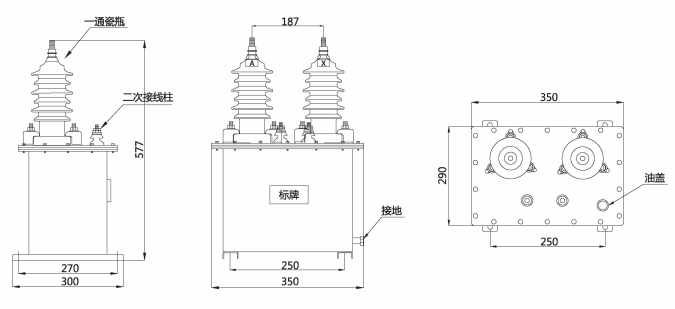
- Mount the transformer on a stable, level indoor foundation using the base mounting holes and appropriate anchor bolts.
- Maintain adequate electrical clearances and creepage distances per applicable standards and the project insulation coordination design.
- Connect primary terminals A/B/C according to the wiring scheme; route secondary circuits with clear identification to metering/protection panels.
- Ground the tank grounding terminal to the station grounding system; implement single-point grounding on the secondary circuit as required.
- Verify oil level (if equipped with indicator) and check for leakage before commissioning; ensure bushings are clean and intact.
Outline & Installation Dimensions
Ordering Information
When placing an order, specify the configuration according to the project electrical design, applicable standards, and technical specification. The following parameters shall be stated for technical confirmation and production release:
- Model designation: JSJW-3 / JSJW-6 / JSJW-10
- Rated voltage ratio: primary and secondary ratios (including residual open-delta ratio where required)
- Secondary winding configuration: Configuration A or Configuration B (number of windings and functions)
- Accuracy class combination: metering accuracy + protection accuracy (e.g., 0.2/6P(3P))
- Rated output (VA): per secondary winding
- Insulation level: Um/Ud/Up per system insulation coordination (standard or enhanced)
- Documentation and tests: required certificates, language, special tests (if any)
Selection Guidance: Choose the model by system voltage class (3/6/10 kV). Confirm whether residual voltage (3U0) is required; if yes, specify open-delta winding and its rated output. Determine metering and protection accuracy requirements per utility/project specification, then calculate the total burden per winding (device VA + wiring loss) and select the rated output with suitable margin. Verify insulation level against the project insulation coordination design and installation environment.