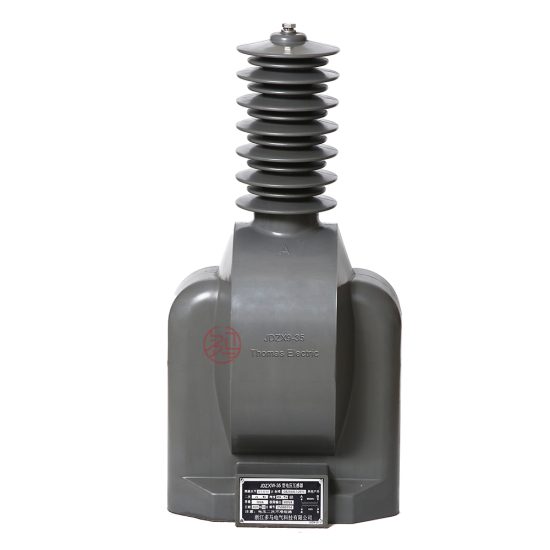
Article Content
Introduction
The JDZW-35 33kV voltage transformer is a cast-resin insulated instrument transformer designed for accurate voltage measurement and reliable protective relay operation in medium-voltage power systems. While designated with “35” in its model number—a reference to the nominal system voltage per Chinese domestic standards (GB/T 20840)—the device is engineered to operate at a primary system voltage of 33 kV, consistent with international practice under IEC 61869-3. This dual alignment enables seamless integration into both domestic Chinese infrastructure and international installations adhering to IEC standards.
Cast-resin construction provides robust mechanical integrity, excellent dielectric performance, and resistance to environmental stressors such as moisture, pollution, and thermal cycling. The transformer supports both indoor and outdoor deployment, making it suitable for substations, switchgear assemblies, and industrial power distribution networks. Its design prioritizes long-term stability, minimal phase error, and precise ratio accuracy—critical attributes for revenue metering and dependable protection coordination. Compliance with IEC 61869-3 ensures standardized performance criteria for insulation levels, temperature rise, short-circuit withstand capability, and electromagnetic compatibility. This document provides a comprehensive technical overview of the JDZW-35 33kV voltage transformer, including specifications, features, application guidance, installation protocols, and maintenance procedures.
Technical Specifications
The JDZW-35 33kV voltage transformer conforms to the performance and test requirements outlined in IEC 61869-3:2011 (“Instrument transformers – Part 3: Additional requirements for inductive voltage transformers”) and GB/T 20840.3–2013 (the Chinese national standard equivalent). Key electrical and mechanical parameters are detailed below:
- Primary Voltage: 33 kV (IEC standard); nominal system voltage equivalent to 35 kV per GB/T 20840.
- Secondary Voltages: Typically 100 V or 100/√3 V (for phase-to-ground configurations); alternative secondary voltages may be specified per customer requirements but must comply with standard burden compatibility.
- Accuracy Classes:
- Metering: 0.2, 0.5, or 0.2S (as defined in IEC 61869-3, Clause 6.3)
- Protection: 3P or 6P (per IEC 61869-3, Clause 6.4)
- Burden Ratings: Standard burdens include 10 VA, 15 VA, 30 VA, and 50 VA at rated secondary voltage. The actual connected burden must not exceed the rated value to maintain specified accuracy.
- Insulation Level:
- Power frequency withstand voltage (1 min): 70 kV (rms) between primary and earth
- Lightning impulse withstand voltage (1.2/50 µs): 170 kV (peak)
- Rated Thermal Short-Time Current: 2 s duration, typically 1.0 kA (rms), though values may vary based on specific design variants.
- Frequency: 50 Hz (standard); 60 Hz operation requires verification of core saturation margins and thermal performance.
- Temperature Rise: Not exceeding 60 K for windings (measured by resistance method) under rated load and ambient conditions per IEC 61869-3, Clause 8.5.
- Polarity: Subtractive polarity; terminal markings follow IEC 61869-3 conventions (e.g., A, N for primary; a, n for secondary).
- Creepage Distance: Minimum 25 mm/kV (rated voltage) for outdoor service in light-to-medium pollution environments (IEC 60815).
All performance characteristics—including ratio error, phase displacement, and transient response—are validated through type tests per IEC 61869-3. Routine tests (e.g., turns ratio verification, insulation resistance, power frequency withstand) are conducted on every unit prior to shipment.
Key Features
The JDZW-35 33kV voltage transformer incorporates several engineering features that enhance reliability, safety, and operational longevity in demanding electrical environments:
- Cast-Resin Insulation System: The primary and secondary windings are encapsulated in cycloaliphatic epoxy resin under vacuum pressure impregnation (VPI). This process eliminates voids, minimizes partial discharge activity (< 10 pC at 1.2 × Ur), and provides superior tracking resistance. The resin formulation is UV-stabilized for outdoor use and exhibits low hygroscopicity.
- Dual Indoor/Outdoor Suitability: The housing includes integrated sheds and optimized creepage paths compliant with IEC 60815 pollution severity classes II–III. For indoor applications, the compact footprint allows direct mounting in metal-enclosed switchgear without additional weatherproofing.
- Thermal and Mechanical Stability: The core is constructed from grain-oriented silicon steel with low hysteresis loss. Windings employ copper conductors with Class F (155°C) insulation, enabling stable performance under continuous load and transient overvoltages.
- Integrated Protective Devices: Secondary terminals are typically equipped with short-circuit protection links or fuses (e.g., 5 A fast-acting) to prevent open-circuit conditions, which could induce hazardous overvoltages on the secondary side.
- Modular Terminal Design: Primary and secondary terminals conform to IEC 61869-3 dimensional standards, facilitating straightforward connection to busbars or cable lugs. Secondary terminals are recessed and labeled per IEC color codes (e.g., white for neutral, red for phase).
These features collectively ensure compliance with stringent international and domestic standards while minimizing lifecycle costs associated with failure, recalibration, or premature replacement.
Applications
The JDZW-35 33kV voltage transformer is engineered for two principal functions in medium-voltage power systems: revenue metering and protective relaying.
In metering applications, the transformer supplies scaled-down voltage signals to energy meters, demand recorders, and power quality analyzers. Accuracy classes of 0.2 or 0.2S are typically selected to meet regulatory requirements for billing-grade measurements. The low phase displacement (< 10 minutes at rated burden) ensures minimal reactive energy measurement error. Compatibility with modern digital metering systems is maintained through stable output impedance and low harmonic distortion.
For protection applications, the transformer feeds voltage inputs to distance relays, overvoltage/undervoltage relays, directional elements, and synchrocheck devices. Protection accuracy classes (3P or 6P) guarantee that ratio error remains within ±3% or ±6%, respectively, under fault conditions up to 1.9 × Ur. The transformer’s ability to maintain performance during system transients—such as switching surges or ferroresonance—is critical for reliable relay operation. Ferroresonance suppression may be achieved through proper grounding practices or the inclusion of damping resistors on open-delta secondaries in three-phase banks.
Typical installation sites include:
- Air-insulated substations (AIS)
- Metal-clad switchgear (indoor)
- Ring main units (RMUs)
- Industrial plant distribution systems
- Railway traction power networks (with appropriate frequency validation)
The transformer is generally deployed in grounded-neutral systems (effectively or resonant grounded), though ungrounded configurations require careful assessment of zero-sequence voltage behavior.
Installation Requirements
Proper installation of the JDZW-35 33kV voltage transformer is essential to ensure safety, performance, and compliance with IEC 61869-3. The following guidelines must be observed:
- Mounting: The transformer shall be securely bolted to a rigid support structure capable of withstanding mechanical loads during short circuits. Mounting surfaces must be level and free of sharp edges that could damage the resin housing. Outdoor installations require drainage provisions to prevent water pooling around the base.
- Clearances: Maintain minimum air clearances per local regulations and IEC 61936-1. For 33 kV systems, typical phase-to-phase clearance is ≥ 300 mm and phase-to-ground ≥ 250 mm. These distances may increase in high-altitude (>1000 m) or heavily polluted environments.
- Grounding: The transformer tank (if metallic) and primary neutral point (where applicable) must be connected to the substation grounding grid using a low-impedance conductor (≤ 0.1 Ω). Secondary windings must have one terminal (typically “n”) solidly grounded at a single point to prevent capacitive coupling and ensure personnel safety.
- Secondary Wiring: Use shielded, twisted-pair cables with a minimum cross-section of 2.5 mm² for metering circuits and 4.0 mm² for protection circuits. The shield must be grounded at one end only (usually at the relay/meter panel) to avoid ground loops. Total secondary loop impedance—including wiring resistance—must be accounted for when verifying burden compliance.
- Polarity Verification: Confirm correct polarity before energization using a low-voltage DC kick test or a portable ratio tester. Incorrect polarity can lead to metering errors or misoperation of directional protection schemes.
- Environmental Considerations: For outdoor use, orient the transformer so that the secondary terminal box faces downward or is shielded from direct precipitation. In coastal or chemical-industrial areas, consider applying hydrophobic coatings to enhance pollution performance.
All installation work must be performed by qualified personnel following national electrical codes and utility-specific practices.
Testing & Maintenance
Routine testing and periodic maintenance are critical to sustaining the operational integrity of the JDZW-35 33kV voltage transformer throughout its service life.
Pre-Commissioning Tests: Prior to energization, the following tests should be conducted:
- Insulation Resistance: Measure between primary-secondary and primary/secondary to ground using a 2500 V DC megohmmeter. Acceptable values typically exceed 1000 MΩ at 20°C.
- Turns Ratio and Polarity: Verify using an automatic ratio tester. Deviation from nameplate ratio must be within ±0.2% for 0.2-class units.
- Power Frequency Withstand: Apply 70 kV (rms) for 1 minute between primary and grounded parts (secondary shorted and grounded). No flashover or significant leakage current increase should occur.
- Burden Verification: Confirm that connected metering and protection burdens do not exceed the transformer’s rated VA.
Periodic Maintenance: Cast-resin transformers require minimal maintenance but should be inspected annually:
- Visually examine the housing for cracks, tracking, or surface contamination. Clean with deionized water if necessary; avoid abrasive cleaners.
- Check terminal tightness and corrosion at primary and secondary connections.
- Re-measure insulation resistance and compare with baseline values. A decline >50% may indicate moisture ingress or insulation degradation.
- For units in protection circuits, perform secondary injection tests on relays to validate overall system response.
Partial discharge (PD) measurements are recommended every 5–10 years or after severe system disturbances. PD levels consistently above 20 pC warrant further investigation.
No internal servicing is possible due to the monolithic resin construction. Units exhibiting irreversible performance degradation must be replaced.
FAQ
Q1: Why is the model designated “JDZW-35” if the primary voltage is 33 kV?
A: The “35” in JDZW-35 reflects the nominal system voltage per Chinese GB/T 20840 standards, where 35 kV is the conventional designation. Internationally, the same system is often referred to as 33 kV (IEC 60038). The transformer is designed for operation on a 33 kV system (Ur = 33 kV / √3 per phase), aligning with IEC 61869-3 voltage ratings.
Q2: Can the JDZW-35 be used in 60 Hz systems?
A: The standard design is optimized for 50 Hz. Operation at 60 Hz is possible but requires verification that core flux density remains below saturation levels and that thermal limits are not exceeded under continuous load. Consult the manufacturer for derating curves or modified designs.
Q3: What happens if the secondary circuit is left open?
A: An open secondary circuit can result in dangerously high voltages across the secondary terminals due to magnetizing current flow in the primary. This poses risks to personnel and connected equipment. Always ensure secondary circuits are closed through a burden or shorting link during maintenance.
Q4: Is ferroresonance a concern with this transformer?
A: Ferroresonance can occur in ungrounded or high-impedance grounded systems when capacitance (e.g., from cables) interacts with transformer nonlinearity. Mitigation measures include using transformers with inherent damping, installing resistive loading on open-delta secondaries, or ensuring system grounding complies with IEC 61869-3 Annex E recommendations.
Q5: How is accuracy affected by burden variation?
A: Ratio error and phase displacement are burden-dependent. Operating below the rated burden generally improves accuracy; exceeding it degrades performance beyond class limits. Always design secondary circuits to match or stay below the transformer’s rated VA.
Q6: Can multiple secondaries be provided?
A: Yes, the JDZW-35 can be manufactured with dual or triple secondary windings (e.g., one for metering at 0.2 class, another for protection at 3P). Each secondary must be independently rated for burden and accuracy, and total thermal loading must remain within design limits.