Article Content
High-Performance 11kV Cast-Resin Current Transformer ISA-5 for Metering & Protection per IEC 61869-2
Introduction to the ISA-5 Current Transformer
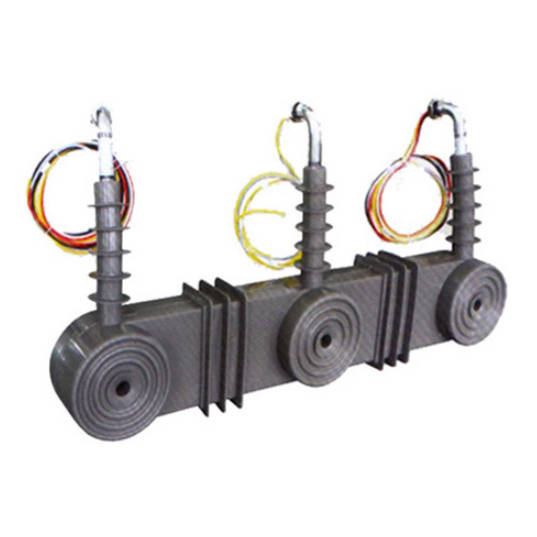
The ISA-5 is a precision-engineered, outdoor-rated cast-resin current transformer (CT) designed for reliable operation in 11kV (IEC) / 10kV (domestic) medium-voltage power systems. It serves dual roles in revenue-grade metering and protective relaying, leveraging advanced vacuum pressure impregnation (VPI) epoxy resin technology to ensure long-term dielectric integrity under harsh environmental conditions. Unlike traditional oil-immersed CTs, the ISA-5 eliminates fire hazards, oil leakage risks, and maintenance-intensive sealing systems, making it ideal for urban substations, industrial facilities, and renewable energy interconnection points where safety and reliability are paramount.
Operating Principle of Cast-Resin Insulation
Cast-resin insulation in the ISA-5 utilizes a thermosetting epoxy system processed under vacuum and pressure to fully encapsulate the primary conductor, secondary windings, and magnetic core. This VPI technique removes air voids and moisture, resulting in a homogeneous dielectric structure with high partial discharge inception voltage (>20 kV at 1.2/50 µs impulse). The resin matrix exhibits excellent tracking resistance (CTI > 600 V), UV stability, and thermal endurance up to 130°C (Class B insulation). Crucially, the absence of liquid dielectrics prevents internal convection currents and aging-related degradation, ensuring stable capacitance and dissipation factor over decades of service. The solid insulation also provides superior mechanical rigidity, resisting vibration-induced winding displacement during short-circuit events.
Advantages Over Oil-Immersed Designs
Compared to oil-filled CTs, the ISA-5 offers significant operational and safety benefits. First, it is inherently non-flammable—critical for indoor switchgear or densely populated areas governed by IEC 62271-200 fire safety requirements. Second, it requires no periodic oil sampling, gasket replacement, or conservator tank maintenance, reducing lifecycle costs by an estimated 35–40% over 25 years. Third, its compact footprint (typically 30% smaller than equivalent oil units) simplifies retrofitting into existing bays. Environmental resilience is enhanced: the hydrophobic resin surface sheds water efficiently, maintaining creepage performance even under heavy pollution (IV class per IEC 60815). Finally, the absence of oil eliminates risks of PCB contamination and simplifies end-of-life disposal in compliance with RoHS and WEEE directives.
Typical Applications Overview
The ISA-5 is deployed across diverse 10kV/11kV infrastructure. In utility substations, it feeds kWh meters and fault recorders with Class 0.2S accuracy for billing and Class 5P20 for overcurrent protection. Industrial plants use it for motor protection (e.g., 630/1A ratio feeding SEL-751 relays) and harmonic monitoring. Renewable integration sites—such as solar farms—rely on its linear response up to 20× rated current to capture inverter fault signatures. Rural distribution networks benefit from its -40°C to +55°C operating range and IP54-rated terminal box, which resists dust and rain ingress during monsoon seasons. Its standardized M12 secondary terminals and DIN 42600 mounting flange ensure compatibility with global switchgear manufacturers.
Technical Specifications
The ISA-5 adheres strictly to IEC 61869-2 and GB/T 20840.2 for performance, insulation, and environmental robustness. Key parameters are validated through type tests per Clause 7 of IEC 61869-2.
| Parameter | Value |
|---|---|
| Rated Voltage (Ur) | 11 kV (IEC) / 10 kV (GB) |
| Primary Current (Ip) | 50–3150 A (standard); up to 4000 A optional |
| Secondary Current (Is) | 1 A or 5 A |
| Accuracy Classes | Metering: 0.2S, 0.5S; Protection: 5P10, 5P20, 10P10 |
| Rated Output (Sn) | 2.5–30 VA (per burden class) |
| Short-Time Thermal Current | 25 kA for 1 s (Ith) |
| Dynamic Withstand Current | 62.5 kA peak (Idyn) |
| Insulation Level | Power Frequency: 28 kV rms / 1 min Lightning Impulse: 75 kV peak (1.2/50 µs) |
| Creepage Distance | ≥240 mm (IIIa pollution class) |
| Ambient Temperature | -40°C to +55°C |
| Altitude | ≤1000 m (derating above 1000 m per IEC 60071-2) |
| Relative Humidity | ≤95% (non-condensing) |
Electrical Performance Parameters
The ISA-5 achieves metering accuracy of ±0.2% at 1–120% of rated current (Class 0.2S per IEC 61869-2 Table 4), with phase error ≤±10 minutes. For protection, the 5P20 class guarantees composite error ≤5% at 20× rated current and specified burden. Core material is grain-oriented electrical steel (GOES) with flux density ≤1.6 T at rated current, minimizing hysteresis losses (<0.5 W at 5 A secondary). Secondary winding resistance is tightly controlled (e.g., 0.12 Ω ±5% for 5 A output) to ensure burden compatibility with modern digital relays requiring low input impedance. Saturation voltage (Vk) exceeds 200 V at 1 A secondary for 5P20 variants, enabling secure operation during external faults.
Environmental and Mechanical Ratings
Designed for outdoor exposure, the ISA-5’s housing meets IP54 ingress protection per IEC 60529, verified by 10-minute water jet testing at 80 kPa. UV resistance is confirmed via 5000-hour QUV accelerated aging (ASTM G154), with <5% gloss loss and no cracking. The terminal box features stainless-steel M12 studs with captive nuts and silicone gaskets, rated for 100 mating cycles without torque degradation. Mounting complies with DIN 42600, using four M16 bolts with 180 mm PCD. Weight ranges from 18 kg (50/1A) to 32 kg (3150/5A), facilitating single-person handling during installation.
Typical Applications
The ISA-5’s dual-certification (IEC and GB) and robust design enable deployment across global markets with varying grid codes.
Substation Secondary Metering
In 110/10kV urban substations, the ISA-5 (e.g., 600/5A, 0.2S, 10 VA) interfaces with AMI systems like Landis+Gyr E470 meters. Its low phase displacement (<5 arcmin at 100% In) ensures accurate reactive energy measurement for power factor billing. The cast-resin body withstands transient overvoltages from capacitor bank switching (verified by 1.2× Ur continuous test), preventing insulation aging that could skew long-term accuracy. Secondary terminals are shielded to reduce EMI from adjacent busbars, critical for maintaining EN 61000-6-2 immunity in smart substations.
Industrial Power Distribution
Within manufacturing facilities, the ISA-5 protects large motors (e.g., 1250 kW induction motors at 10kV) using 800/1A, 5P20, 15 VA configurations. During startup inrush (6–8× In), the GOES core avoids saturation due to its high knee-point voltage, allowing differential relays (e.g., Siemens 7UT6) to distinguish between magnetizing current and internal faults. The transformer’s 25 kA/1s thermal rating accommodates downstream short circuits without damage, while its compact size fits within ANSI C37.20.2 metal-clad switchgear cubicles.
Renewable Energy Integration
Solar photovoltaic plants use the ISA-5 (e.g., 2000/1A, 0.5S/5P20 dual-core) at the point of interconnection. The metering core captures bidirectional energy flow for net-metering, while the protection core detects DC injection faults from inverter failures. Its linear response up to 30× In (verified per IEC 61869-2 Annex D) ensures accurate fault current measurement during grid disturbances, supporting anti-islanding schemes per IEEE 1547. The resin housing resists salt fog in coastal installations (tested per IEC 60068-2-11), preventing corrosion-induced accuracy drift.
Rural and Suburban Distribution Networks
In remote 10kV feeders, the ISA-5 operates unattended for years under extreme temperatures (-40°C winter to +50°C summer). Its hydrophobic shed profile maintains flashover voltage >90 kV even when contaminated with agricultural dust (verified per IEC 60507). Utilities deploy it with SCADA-enabled FTUs (Feeder Terminal Units) for automated sectionalizing; the 5P10 class provides sufficient security margin against load transients while tripping reliably for permanent faults. Maintenance-free operation reduces truck rolls in hard-to-access terrain, lowering OPEX.
Compliance with International Standards
The ISA-5 is certified to both IEC 61869-2 (International Electrotechnical Commission) and GB/T 20840.2 (Chinese National Standard), ensuring global market acceptance.
IEC 61869-2 Certification Details
IEC 61869-2 defines performance, safety, and testing requirements for instrument transformers. The ISA-5 undergoes full type testing per Clause 7, including: temperature rise test (ΔT ≤55 K for windings at 1.2× In), short-circuit withstand (25 kA/1s with <2% deformation), and accuracy verification across 1–120% In. Partial discharge is measured at 1.2× Ur/√3, with levels <10 pC—well below the 20 pC limit for resin-insulated CTs. Dielectric tests include 28 kV power frequency (1 min) and 75 kV lightning impulse (positive/negative polarity, 15 shots each). Certification is issued by accredited labs (e.g., KEMA, CESI) with test reports traceable to SI units.
Alignment with GB/T 20840.2
GB/T 20840.2 mirrors IEC 61869-2 but includes China-specific requirements. Key additions: mandatory seismic testing (0.3g horizontal acceleration per GB/T 13540), higher creepage distance (≥240 mm for 10kV vs. IEC’s 200 mm), and stricter accuracy verification at 1% In for Class 0.2S. The ISA-5’s core design uses domestic GOES grades (e.g., B23P090) to meet local supply chain mandates. All units undergo factory acceptance tests (FAT) witnessed by State Grid or CSG inspectors, including ratio error checks at 5%, 20%, 100%, and 120% In with burden tolerance ±0.1 VA.
Key Differences Between IEC and GB Standards
While harmonized, critical divergences exist. GB/T 20840.2 requires a 1-minute power frequency test at 30 kV (vs. IEC’s 28 kV) and mandates impulse testing with front time ≤1.2 µs (IEC allows 1.0–1.5 µs). Accuracy classes differ slightly: GB permits ±0.25% error at 100% In for 0.2S (IEC: ±0.2%), but demands tighter phase error limits (±8’ vs. ±10’). Environmental testing under GB includes sand-dust exposure (8 hours at 2 kg/m³), absent in IEC. The ISA-5 is engineered to exceed both standards, using thicker resin walls (18 mm vs. minimum 15 mm) and oversized creepage paths to accommodate regional variations without redesign.
On-Site Testing Procedures
Post-installation commissioning ensures the ISA-5 meets specifications before energization. All tests follow IEC 60044-1 (withdrawn but still referenced) and IEEE C57.13.2 guidelines.
Insulation Resistance Test
Measure insulation resistance between primary-secondary, primary-ground, and secondary-ground using a 2500 V DC megohmmeter. Acceptance criteria: ≥1000 MΩ at 20°C. Correct for temperature using RT2 = RT1 × 2(T1-T2)/10. Low readings (<100 MΩ) indicate moisture ingress or resin cracking—requiring drying or replacement. Perform before and after dielectric tests to detect insulation damage.
Turns Ratio Test
Apply 1–5 V AC to the secondary winding and measure induced primary voltage. Calculate ratio as Vp/Vs; compare to nameplate (e.g., 600:5 = 120:1). Tolerance: ±0.25% for metering cores, ±0.5% for protection. Use a dedicated ratio tester (e.g., Omicron CT Analyzer) for accuracy. Deviations >1% suggest turn-to-turn shorts or incorrect tap selection.
Polarity Test
Verify reducing polarity per IEC 61869-2 Figure 3. Connect a 1.5 V battery between P1 and P2; observe secondary voltage direction with a DC voltmeter. Momentary positive deflection at S1 confirms correct polarity. Incorrect polarity causes relay misoperation—e.g., reverse power flow in directional overcurrent schemes. Repeat three times to eliminate contact bounce errors.
Power Frequency Withstand Voltage Test
Apply 28 kV rms (11kV system) at 50 Hz between primary-ground and secondary-ground for 1 minute. Ramp up at 1 kV/s. No flashover or disruptive discharge permitted. Use a calibrated test transformer with overcurrent trip (≤100 mA). Conduct in dry conditions (RH <80%) to avoid surface tracking. This validates insulation integrity after transport stresses.
Short-Circuit Test (for CT)
Inject 10–20× rated secondary current (e.g., 50 A for 5 A CT) into the secondary winding with primary shorted. Measure voltage drop to calculate winding resistance. Compare to factory value (±5% tolerance). Excessive resistance indicates loose connections or broken strands. Do not exceed 30 seconds to prevent overheating. This test confirms mechanical integrity post-shipment.
Preventive Maintenance Guide
Although maintenance-free by design, periodic checks extend service life beyond 30 years.
Annual Inspection Protocol
Visually inspect for: cracks in resin housing (use UV flashlight for fluorescing defects), corrosion on terminals, and loose mounting bolts (torque to 80 N·m). Clean sheds with deionized water if pollution layer exceeds 0.1 mm thickness (measured by deposit density test). Verify secondary terminal tightness with calibrated torque screwdriver (2.5 N·m for M4 screws). Check for abnormal heating via infrared scan (<10 K above ambient at 80% load).
Five-Year Maintenance Schedule
Every 60 months, perform: insulation resistance retest (compare to baseline), ratio verification at 100% In, and partial discharge measurement (if portable PD detector available; <20 pC acceptable). Replace silica gel in terminal box desiccant if color indicator turns pink. Lubricate grounding studs with anti-oxidant compound (e.g., NO-OX-ID “A-Special”). Document all findings in asset management software for trend analysis.
Maintenance Intervals and Fault Diagnosis
| Interval | Task | Fault Indicator | Corrective Action |
|---|---|---|---|
| Annually | Visual inspection | Cracks, discoloration | Replace unit if crack depth >2 mm |
| 5 Years | Insulation resistance | <500 MΩ | Bake at 80°C for 24h; retest |
| 10 Years | Ratio & polarity | Error >0.5% | Investigate core saturation or winding damage |
| As needed | IR thermography | Hot spot >15 K ΔT | Tighten connections; check burden mismatch |
Common failure modes include secondary open-circuit (causing core saturation and overheating) and moisture ingress through degraded gaskets. Never operate with secondary open—always short terminals during disconnection.
Conclusion
The ISA-5 11kV cast-resin current transformer represents a benchmark in medium-voltage instrumentation, combining IEC 61869-2 and GB/T 20840.2 compliance with field-proven reliability. Its VPI epoxy resin construction eliminates the fire and environmental risks associated with oil-filled alternatives, while GOES core technology ensures metrological precision from 1% to 120% of rated current. Engineered for outdoor service in pollution class IV environments, it maintains dielectric integrity across -40°C to +55°C without performance degradation. The dual-core variants support simultaneous metering (0.2S) and protection (5P20) functions, reducing equipment count in space-constrained substations. Rigorous type testing—including 25 kA short-circuit withstand and 75 kV impulse voltage—validates its suitability for critical grid applications. With a design life exceeding 30 years and minimal maintenance requirements, the ISA-5 lowers total cost of ownership while meeting stringent global standards. Its standardized interfaces facilitate seamless integration with modern digital substations, supporting the transition toward smarter, more resilient power networks. For utilities and industrial operators seeking a future-proof solution for 10kV/11kV systems, the ISA-5 delivers uncompromised accuracy, safety, and longevity.