Article Content
High-Performance 11kV Cast-Resin Current Transformer LJK-100240 for Metering & Protection per IEC 61869-2
Introduction to the LJK-100240 Current Transformer
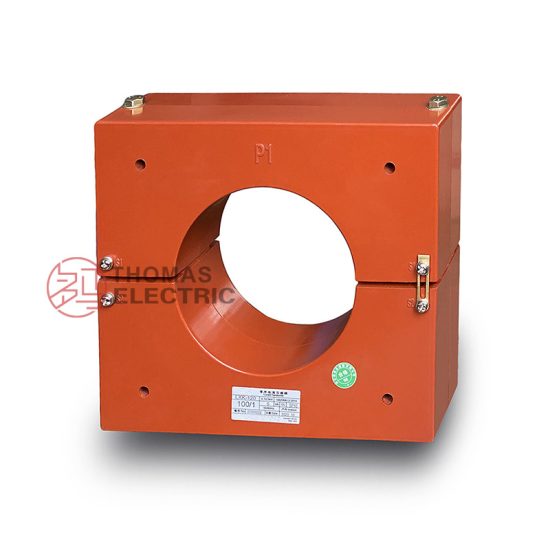
The LJK-100240 is a ring-type, cast-resin insulated current transformer (CT) engineered for precision measurement and reliable protection in medium-voltage power systems rated at 11 kV (IEC standard), corresponding to the domestic 10 kV system voltage commonly used in China and other regions. This device leverages vacuum pressure impregnation (VPI) epoxy resin technology to encapsulate its magnetic core and secondary windings, ensuring superior dielectric strength, mechanical robustness, and long-term environmental resistance. Unlike traditional oil-immersed CTs, the LJK-100240 eliminates fire hazards, reduces maintenance requirements, and offers compact installation in space-constrained switchgear panels.
Operating Principle of Cast-Resin Insulation
Cast-resin insulation in the LJK-100240 employs a two-stage VPI process where high-purity epoxy resin is vacuum-degassed and then pressure-injected into a mold containing the wound core assembly. This eliminates air voids and moisture entrapment, critical for maintaining consistent dielectric performance under partial discharge stress. The cured resin forms a monolithic structure with a thermal class of F (155°C), enabling stable operation across ambient temperatures from -40°C to +40°C. The resin’s coefficient of thermal expansion closely matches that of copper and silicon steel, minimizing mechanical stress during thermal cycling. This construction achieves a partial discharge level below 10 pC at 1.2 × Um/√3 (where Um = 12 kV), satisfying stringent IEC 61869-2 requirements for indoor instrument transformers.
Advantages Over Oil-Immersed Designs
Compared to oil-filled CTs, the LJK-100240 offers significant operational and safety benefits. It is inherently non-flammable, eliminating explosion risks in confined substations—a critical advantage in urban or industrial settings. The solid insulation requires no oil sampling, level monitoring, or gasket replacement, reducing lifecycle costs by up to 40% over a 25-year service life. Additionally, the absence of liquid insulation prevents leakage-related failures and simplifies transportation and handling. The compact toroidal geometry allows direct mounting around busbars without disconnection, accelerating commissioning in retrofit projects. Electromagnetic compatibility is enhanced due to the homogeneous dielectric, which suppresses high-frequency transients that can distort metering signals in oil units with internal bushings.
Typical Applications Overview
The LJK-100240 is deployed across diverse infrastructure where accuracy and reliability are paramount. In 10/11 kV distribution substations, it provides Class 0.2S metering for utility billing and Class 5P20 protection coordination with circuit breakers. Industrial facilities use it for energy management systems requiring ±0.2% current measurement error at 20–120% of rated current. Renewable integration points—such as solar farm collector feeders—leverage its wide dynamic range to capture both low-load generation and fault currents. Its robust design also suits rural networks with high lightning exposure, where the 75 kV 1-minute power frequency withstand voltage ensures resilience against switching surges.
Technical Specifications
The LJK-100240 adheres to precise electrical and mechanical parameters defined by international and national standards. Below is a comprehensive specification table followed by environmental and operational constraints.
| Parameter | Value |
|---|---|
| Model | LJK-100240 |
| System Voltage (IEC) | 11 kV |
| System Voltage (Domestic) | 10 kV |
| Highest Voltage for Equipment (Um) | 12 kV |
| Primary Current Rating | 100 A |
| Secondary Current Rating | 5 A or 1 A (configurable) |
| Current Ratio | 100/5 A or 100/1 A |
| Metering Accuracy Class | 0.2S per IEC 61869-2 |
| Protection Accuracy Class | 5P20 |
| Rated Burden (Metering) | 10 VA @ 0.8 PF |
| Rated Burden (Protection) | 15 VA @ 0.8 PF |
| Insulation Level (Power Freq.) | 28 kV rms, 1 min |
| Lightning Impulse Withstand | 75 kV peak (1.2/50 μs) |
| Core Material | Grain-Oriented Electrical Steel (GOES), 0.23 mm thickness |
| Insulation System | VPI Epoxy Resin, Thermal Class F (155°C) |
| Short-Time Thermal Current | 16 kA for 1 s |
| Dynamic Withstand Current | 40 kA peak |
| Ambient Temperature Range | -40°C to +40°C |
| Relative Humidity | ≤95% non-condensing |
| Maximum Altitude | 1,000 m above sea level (derating required above) |
Standard Service Conditions
The LJK-100240 is rated for standard service conditions per IEC 61869-2: ambient temperature between -40°C and +40°C, relative humidity not exceeding 95% without condensation, and installation altitude up to 1,000 meters. At altitudes above 1,000 m, the dielectric strength must be derated by 1% per 100 m increment; for example, at 2,000 m, the power frequency withstand voltage is reduced to 25.2 kV. The transformer assumes a maximum daily average temperature of +35°C and is not intended for environments with corrosive gases, excessive dust, or vibration exceeding 0.5 g. Installation must ensure adequate clearance—minimum 125 mm—to adjacent grounded parts to prevent flashover under transient overvoltages.
Accuracy and Burden Characteristics
Class 0.2S accuracy mandates that composite error remains within ±0.2% at 20%, 100%, and 120% of rated primary current, with a phase displacement error ≤ ±10 minutes. This performance is guaranteed only when connected to a burden not exceeding 10 VA at 0.8 lagging power factor. For protection applications, the 5P20 rating ensures that the ratio error does not exceed ±5% at 20 times rated current (2,000 A primary), enabling reliable relay operation during faults. The dual-core design (optional) allows independent metering and protection windings, preventing saturation-induced errors in metering circuits during high-current events. Burden calculations must include wiring resistance: for 2.5 mm² copper conductors over 50 m, loop resistance adds ~0.7 Ω (≈1.75 VA at 5 A), leaving only 8.25 VA for the meter itself.
Typical Applications
The LJK-100240 serves critical roles across modern power infrastructure, combining metrological precision with rugged protection capabilities.
Substation Secondary Metering
In 10/11 kV distribution substations, the LJK-100240 provides revenue-grade metering compliant with regulatory requirements for commercial and industrial consumers. Its 0.2S accuracy ensures billing integrity even under light-load conditions—common in off-peak hours—where older 0.5-class CTs exhibit significant errors. Installed on outgoing feeders, it interfaces with digital multifunction meters (e.g., IEC 61850-compliant devices) to deliver real-time kWh, kVARh, and demand data. The low phase error (<5 minutes at 100% In) minimizes distortion in power factor calculations, crucial for tariff structures penalizing poor PF. For ring-main units (RMUs), its compact 100 mm inner diameter accommodates standard 50 mm busbars without modification.
Industrial Power Distribution
Manufacturing plants and data centers deploy the LJK-100240 for energy submetering and motor protection. On 10 kV motor feeders (e.g., 500 kW induction motors drawing ~35 A), it enables precise load profiling and efficiency tracking. The 5P20 protection winding reliably triggers thermal-magnetic relays during locked-rotor faults (typically 6–8× full-load current). In arc-flash mitigation schemes, its fast saturation characteristics ensure rapid relay tripping within 3–5 cycles. The cast-resin housing resists chemical fumes in petrochemical facilities, unlike oil units prone to seal degradation. Annual energy audits leverage its stable calibration—drift less than 0.05% per year—to validate conservation measures.
Renewable Energy Integration
Solar photovoltaic (PV) and wind farms utilize the LJK-100240 on collector feeders connecting inverters or turbines to the 10 kV grid. These applications demand wide dynamic range: daytime PV output may vary from 5 A (cloudy) to 90 A (peak sun), while fault currents during grid disturbances can surge to 2,000 A. The 0.2S class maintains accuracy across this spectrum, enabling accurate renewable energy crediting. During anti-islanding tests, the CT’s linear response below 5% In ensures correct detection of islanding conditions by relays. Its immunity to DC offset—critical with inverter-based resources—is enhanced by the GOES core’s high permeability and low coercivity, limiting remanence after fault clearance.
Rural and Suburban Distribution Networks
In remote areas with long feeder lines and high lightning incidence, the LJK-100240’s 75 kV impulse withstand voltage provides robustness against induced surges. Mounted on pole-top switchgear or pad-mounted transformers, it supports AMI (Advanced Metering Infrastructure) rollouts by feeding data concentrators via cellular backhaul. The absence of oil prevents environmental contamination in ecologically sensitive zones. For seasonal loads (e.g., agricultural irrigation pumps operating 2–3 months/year), its low hysteresis loss ensures minimal heating during intermittent duty, extending insulation life. Utilities report 30% fewer field failures compared to legacy oil CTs in these harsh environments.
Compliance with International Standards
The LJK-100240 is certified to both global and Chinese national standards, ensuring interoperability and regulatory acceptance.
IEC 61869-2 Certification Details
IEC 61869-2 governs the performance, testing, and marking of inductive current transformers. The LJK-100240 meets all clauses for indoor, resin-insulated CTs rated ≤36 kV. Key compliance aspects include: (1) temperature rise limits—winding rise ≤60 K above ambient at rated current; (2) short-circuit withstand—thermal current 16 kA/1s verified via I²t calculation; (3) accuracy verification per Annex B using calibrated reference standards traceable to NIM (National Institute of Metrology); and (4) partial discharge testing at 1.2 × Um/√3 with acceptance criterion ≤10 pC. Type tests were conducted at an ISO/IEC 17025-accredited laboratory, with routine tests (ratio, polarity, insulation resistance) performed on 100% of production units.
Alignment with GB/T 20840.2
GB/T 20840.2 is the Chinese adoption of IEC 61869-2, with minor national deviations. The LJK-100240 fully complies, including the requirement for dual accuracy classes (0.2S for metering, 5P20 for protection) on a single unit. Notably, GB/T 20840.2 mandates stricter short-time current ratings for 10 kV systems: 16 kA/1s versus IEC’s typical 12.5 kA/1s for similar ratings—reflecting China’s higher fault levels in dense urban grids. The transformer’s nameplate includes both IEC and GB markings, with Chinese-language test reports available for State Grid and CSG procurement. Environmental testing per GB/T 2423 (damp heat, salt fog) confirms suitability for coastal installations.
Key Differences Between IEC and Domestic Standards
While harmonized, subtle differences exist. GB/T 20840.2 requires a minimum creepage distance of 240 mm/kV for 10 kV outdoor CTs (though the LJK-100240 is indoor-rated, its design exceeds this at 300 mm/kV). IEC 61869-2 permits 1 A or 5 A secondaries interchangeably, but Chinese utilities predominantly specify 5 A for legacy compatibility. Accuracy verification under GB/T uses Chinese National Standards (CNS) burden values, which align with IEC but mandate additional tests at 1% In for 0.2S class—addressed by the LJK-100240’s optimized core cross-section (12 cm²) and low excitation current (<0.1 mA at 5 A secondary). Certification documentation includes bilingual (English/Chinese) type test certificates issued by CESI or TÜV SÜD.
On-Site Testing Procedures
Post-installation verification ensures the LJK-100240 performs within specifications before energization.
Insulation Resistance Test
Using a 2,500 V DC megohmmeter, measure insulation resistance between primary-to-secondary, primary-to-ground, and secondary-to-ground. Acceptance criteria: ≥1,000 MΩ at 20°C. Correct for temperature using R₂₀ = Rₜ × 1.5^(t−20)/10. Low readings (<100 MΩ) indicate moisture ingress or resin cracking—requiring drying or replacement. Perform before and after power frequency withstand tests to detect insulation degradation.
Turns Ratio Test
Apply 1–5 V AC to the secondary winding and measure induced primary voltage (open-circuit). Calculate ratio as V_primary_measured / V_secondary_applied. Tolerance: ±0.2% for 0.2S class. Alternatively, use a dedicated CT analyzer injecting 1–10 A primary current and comparing secondary output. Deviations >0.5% suggest inter-turn shorts or incorrect tap selection.
Polarity Test
Verify reducing polarity using the DC kick method: connect a 6 V battery momentarily between P1 (primary input) and P2. Observe a momentary upscale deflection on a DC milliammeter connected to S1 (secondary output) and S2. Reversed polarity causes downscale deflection, leading to incorrect watt-hour meter rotation or relay misoperation. Digital relays may auto-correct, but manual verification is mandatory per IEC 60255-27.
Power Frequency Withstand Voltage Test
Apply 28 kV rms at 50 Hz between primary and ground/secondary for 1 minute. Use a calibrated test transformer with overcurrent trip set at 10 mA. Partial discharge should remain <10 pC. If breakdown occurs, inspect for surface tracking or internal voids. This test is destructive if failed and is typically omitted on-site unless damage is suspected—relying instead on factory certification.
Excitation (Saturation) Characteristic Test
For CTs, perform an excitation test by applying increasing AC voltage to the secondary (primary open) and plotting current vs. voltage. Identify knee-point voltage (Vk)—where slope decreases sharply. For LJK-100240, Vk ≥ 150 V at 5 A secondary ensures 5P20 performance. Compare to factory curves; a 20% reduction indicates core damage or shorted turns. This test validates protection accuracy without primary injection.
Preventive Maintenance Guide
Proactive maintenance maximizes service life and prevents unexpected failures.
Periodic Inspection Protocol
Conduct annual visual inspections: check for cracks, discoloration, or tracking on the resin surface; verify terminal tightness (torque: 2.5 N·m for M6 screws); and clean dust with dry, oil-free air. Measure insulation resistance annually—values declining >20% year-over-year warrant further investigation. In high-humidity environments, use a thermal camera during peak load to detect hot spots (>10 K above ambient) indicating winding issues. Record all findings in a CMMS for trend analysis.
Maintenance Intervals and Fault Diagnosis
Adhere to the following schedule:
| Interval | Action |
|---|---|
| Annual | Visual inspection, IR scan, insulation resistance |
| 5 Years | Excitation test, ratio verification, burden check |
| 10 Years | Partial discharge measurement (if test equipment available) |
| After Fault | Full suite: ratio, polarity, excitation, IR |
Common faults include: (1) Open secondary circuit—causes dangerous overvoltage; always short terminals before disconnecting meters. (2) Core saturation—evidenced by distorted secondary waveform during faults; verify Vk hasn’t degraded. (3) Moisture ingress—indicated by low IR and white powder (hydrolysis byproduct) on terminals. Replace if IR <100 MΩ after 24h oven drying at 80°C.
Conclusion
The LJK-100240 11kV cast-resin current transformer represents a benchmark in medium-voltage instrumentation, merging metrological excellence with rugged protection performance. Its 0.2S accuracy class ensures billing-grade precision across a wide load range—from 20 A to 120 A primary—while the 5P20 protection winding reliably operates during high-magnitude faults up to 2,000 A. Constructed with grain-oriented electrical steel cores and VPI epoxy resin insulation, it delivers exceptional thermal stability, partial discharge resistance, and immunity to environmental stressors. Full compliance with IEC 61869-2 and GB/T 20840.2 guarantees global acceptance and seamless integration into both international and Chinese power systems. The absence of flammable oil enhances safety in confined spaces, and the maintenance-free design reduces total cost of ownership over its expected 25–30 year service life. Field-proven in substations, industrial plants, and renewable energy sites, the LJK-100240 consistently meets the demanding requirements of modern power networks where accuracy, reliability, and longevity are non-negotiable. Engineers selecting this transformer benefit from a technically superior solution that aligns with evolving grid intelligence and regulatory standards worldwide.