Article Content
33kV Cast-Resin Voltage Transformer JLS-35K for Metering and Protection – IEC 61869-3 Standard
Introduction to the JLS-35K Voltage Transformer
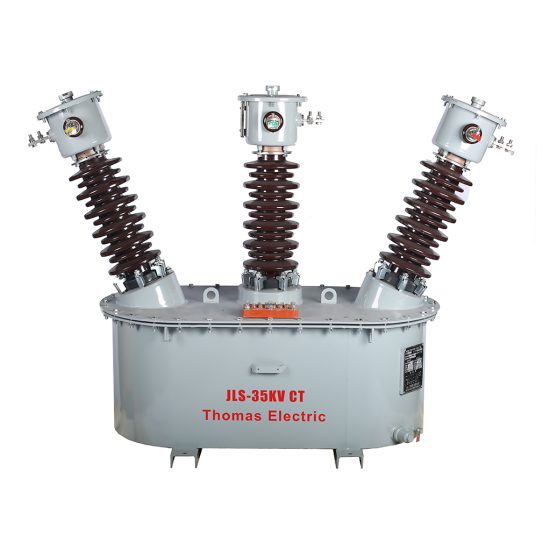
The JLS-35K is a single-phase, outdoor-type cast-resin voltage transformer (VT) engineered for precise voltage transformation in 33 kV (IEC) / 35 kV (domestic) medium-voltage power systems. It functions by stepping down the high primary system voltage to standardized secondary values—typically 100 V or 100/√3 V—enabling safe and accurate interfacing with revenue metering instruments, protective relays, synchro-check devices, and SCADA monitoring systems. Unlike traditional oil-immersed designs, the JLS-35K employs vacuum pressure impregnation (VPI) epoxy resin technology to encapsulate its magnetic core and windings, delivering superior dielectric strength, environmental resilience, and maintenance-free operation over decades of service.
Operating Principle of Cast-Resin Insulation
Cast-resin insulation in the JLS-35K utilizes a thermosetting epoxy compound that fully encapsulates the primary and secondary windings along with the grain-oriented electrical steel (GOES) core. During manufacturing, the assembly undergoes vacuum degassing followed by pressure impregnation to eliminate air voids and moisture, ensuring homogeneous dielectric properties. This monolithic structure provides excellent partial discharge resistance (<5 pC at 1.2 × Um/√3), high tracking resistance (CTI > 600 V), and mechanical rigidity against thermal cycling and short-circuit forces. The absence of liquid insulation eliminates risks of leakage, fire hazard, or environmental contamination—critical advantages for urban substations and ecologically sensitive areas.
Advantages Over Oil-Immersed Designs
Compared to oil-filled VTs, the JLS-35K offers significant operational and safety benefits. Its solid insulation system requires no periodic oil sampling, gas analysis, or conservator tank maintenance. The design is inherently fire-resistant (compliant with IEC 60695 flammability tests) and suitable for indoor/outdoor use without containment bunds. Additionally, the compact footprint reduces spatial requirements in space-constrained switchyards. Thermal performance is enhanced through optimized resin formulation with high thermal conductivity (≥0.8 W/m·K), enabling stable accuracy under continuous load and transient overvoltage conditions up to 1.9 × Un for 30 seconds.
Typical Application Overview
The JLS-35K is deployed across utility transmission networks, industrial plants, and renewable energy interconnection points where reliable voltage sensing is essential. Common configurations include single-pole mounting on 35 kV busbars for three-phase metering (using three units in wye connection) or as part of combined instrument transformer assemblies. Its robust construction withstands harsh environments—from coastal regions with salt fog (IEC 60068-2-52 severity level 3) to high-altitude sites up to 2000 m above sea level—without derating.
Technical Specifications
The JLS-35K adheres to stringent electrical and mechanical parameters defined by IEC 61869-3 and GB/T 20840.3. Below is a comprehensive specification table reflecting standard configurations; custom ratios or outputs are available upon request.
| Parameter | Value |
|---|---|
| System Voltage (IEC) | 33 kV |
| System Voltage (Domestic) | 35 kV |
| Primary Voltage (Un) | 33,000 / √3 V (phase-to-ground) |
| Secondary Voltage(s) | 100 V or 100/√3 V (standard); optional 110 V |
| Voltage Ratio | 33,000/√3 : 100/√3 V (i.e., 330:1) |
| Accuracy Class (Metering) | 0.2, 0.5 (per IEC 61869-3) |
| Accuracy Class (Protection) | 3P, 6P |
| Rated Output (VA) | 30, 50, 100 VA (burden-dependent) |
| Insulation Level (LI/AC) | 170 kV / 70 kV (per IEC 60071-1) |
| Partial Discharge | <5 pC at 1.2 × Um/√3 |
| Core Material | Grain-Oriented Electrical Steel (GOES), 0.27 mm thickness |
| Insulation System | VPI Epoxy Resin, UL 94 V-0 rated |
| Ambient Temperature Range | –40°C to +40°C |
| Altitude Limit | ≤2000 m (derating required above) |
| Creepage Distance | ≥25 mm/kV (medium pollution, class II) |
Standard Service Conditions
The JLS-35K is rated for continuous operation under IEC 60060-1 standard atmospheric conditions: ambient temperature from –40°C to +40°C, relative humidity up to 95% non-condensing, and installation altitude not exceeding 2000 meters. At altitudes between 2000–3000 m, the power frequency withstand voltage must be reduced by 1% per 100 m above 2000 m. The transformer is designed for outdoor pole or structure mounting with vertical orientation; horizontal mounting requires engineering validation due to potential resin stress redistribution. Pollution severity is classified as medium (class II per IEC 60815), with a minimum creepage distance of 825 mm for 33 kV systems.
Electrical Performance Characteristics
Under rated burden (e.g., 50 VA at cos φ = 0.8 lagging), the JLS-35K maintains ratio error within ±0.2% and phase displacement ≤10 minutes for 0.2-class metering applications. For protection class 3P, composite error remains below 3% at 5% to 100% of rated voltage and within 6% at 1.2 × Un during fault conditions. The magnetizing current is typically <0.5% of rated primary current, minimizing loading effects on the primary circuit. Thermal stability is validated per IEC 61869-3 clause 10.4: after 1-hour continuous operation at 1.5 × rated output, temperature rise does not exceed 60 K for windings (measured by resistance method).
Typical Applications
The JLS-35K voltage transformer serves critical roles across diverse power infrastructure segments, providing accurate and reliable voltage signals for control, protection, and billing functions.
Substation Secondary Metering
In 35 kV distribution substations, three JLS-35K units are connected in wye configuration to derive phase-to-ground voltages for revenue-grade energy metering. The 0.2 accuracy class ensures compliance with national grid codes requiring ±0.5% billing accuracy. Secondary outputs feed directly into digital multifunction meters or legacy electromechanical kWh meters via shielded twisted-pair cables (min. 2.5 mm² cross-section). Proper grounding of the secondary neutral at a single point prevents circulating currents and ensures personnel safety during faults.
Industrial Power Distribution Systems
Large manufacturing facilities operating at 35 kV utilize the JLS-35K for both process monitoring and protective relaying. In steel mills or chemical plants, voltage signals from the VT trigger undervoltage lockout relays to prevent motor restart after outages, while also feeding harmonic analyzers for power quality assessment. The cast-resin design resists chemical vapors and dust ingress (IP54 equivalent), making it suitable for harsh industrial environments where oil-filled units would degrade rapidly.
Renewable Energy Integration
Solar photovoltaic and wind farms connecting to 35 kV collector grids rely on the JLS-35K for synchronization and anti-islanding protection. During grid disturbances, the VT provides real-time voltage magnitude and phase angle data to the plant controller, enabling rapid disconnection per IEEE 1547 or GB/T 19964 requirements. Its low capacitive coupling minimizes ferroresonance risk—a common issue in lightly loaded renewable feeders with long cable runs.
Rural and Suburban Distribution Networks
In remote or semi-urban areas, the JLS-35K enables cost-effective voltage monitoring on overhead lines. Mounted on utility poles alongside disconnect switches, it supplies signals to remote terminal units (RTUs) for voltage regulation via capacitor bank switching. The maintenance-free nature reduces operational expenditure for utilities managing thousands of kilometers of rural feeders. Field data shows >99.8% availability over 10 years in such deployments.
Hybrid Switchgear Installations
Modern compact substations often integrate the JLS-35K into air-insulated switchgear (AIS) or hybrid GIS/AIS bays. Its standardized mounting dimensions (per IEC 61869-3 Annex C) allow direct bolt-on installation to circuit breakers or isolators. The compact height (typically 1100 mm) and lightweight design (~85 kg) simplify crane-less installation using manual hoists—critical for rapid deployment in disaster recovery scenarios.
Compliance with International Standards
The JLS-35K is engineered and tested in strict accordance with IEC 61869-3:2011 (“Instrument transformers – Part 3: Additional requirements for inductive voltage transformers”) and its Chinese counterpart, GB/T 20840.3-2013. These standards define performance, safety, and testing protocols essential for global interoperability.
IEC 61869-3 Compliance Details
Key IEC 61869-3 requirements met by the JLS-35K include: rated insulation levels (LI 170 kV, AC 70 kV), temperature rise limits (60 K for resin-insulated windings), short-circuit withstand capability (withstanding 1.2 × Un for 30 s without damage), and accuracy verification under specified burdens. The standard mandates type tests (e.g., impulse voltage, temperature rise), routine tests (ratio, polarity, insulation resistance), and special tests (partial discharge, capacitance measurement). All JLS-35K units undergo 100% routine testing before shipment, with type test reports available upon request.
Alignment with GB/T 20840.3
GB/T 20840.3 mirrors IEC 61869-3 but includes China-specific provisions: mandatory seismic qualification (horizontal acceleration 0.25g), stricter partial discharge limits (<3 pC for 0.2-class units), and domestic accuracy class definitions (e.g., “0.2S” for special metering). The JLS-35K is dual-certified, bearing both CQC and international marks. Notably, GB/T 20840.3 requires secondary terminal boxes to meet IP54 ingress protection—achieved via gasket-sealed polycarbonate enclosures with stainless steel hardware.
Differences Between IEC and Domestic Standards
While harmonized, key differences exist: GB/T 20840.3 specifies 35 kV as the nominal system voltage (vs. IEC’s 33 kV), leading to slightly higher test voltages in domestic certification (e.g., 75 kV AC withstand vs. 70 kV). Additionally, Chinese standards mandate flame-retardant resin with oxygen index ≥32%, whereas IEC references UL 94 V-0. Despite these nuances, the JLS-35K’s design envelope accommodates both regimes without performance compromise, facilitating export and domestic use.
On-Site Testing Procedures
Post-installation verification ensures the JLS-35K performs within specifications. The following tests should be conducted before energization:
Insulation Resistance Test
Using a 2500 V DC megohmmeter, measure insulation resistance between primary winding and ground, secondary windings and ground, and between primary and secondary. Acceptance criteria: ≥10,000 MΩ at 20°C. Correct for temperature using RT2 = RT1 × 2(T1–T2)/10. Low readings indicate moisture ingress or resin cracking—requiring drying or replacement.
Turns Ratio Test
Apply 100–200 V AC to the primary and measure secondary voltage. Calculate actual ratio: Vp/Vs. Tolerance per IEC 61869-3: ±0.2% for 0.2-class, ±0.5% for 0.5-class. Use a calibrated ratio bridge (e.g., Omicron CT Analyzer) for precision. Deviations beyond tolerance suggest winding shorts or incorrect tap selection.
Polarity Test
Verify reducing polarity using the DC kick method: connect a 6–12 V battery momentarily across primary terminals (H1+, H2–). Observe secondary voltage spike on an analog voltmeter connected to X1+, X2–. A positive deflection confirms correct polarity. Incorrect polarity causes 180° phase shift—catastrophic for differential or directional protection schemes.
Power Frequency Withstand Voltage Test
Apply 70 kV RMS (IEC) or 75 kV RMS (GB) at 50 Hz between primary and ground for 1 minute. Secondary windings and core must be grounded. No flashover or disruptive discharge is permitted. Ramp voltage at ≤1 kV/s to avoid transient overstress. This test validates insulation integrity after transport-induced microcracks.
Open-Circuit Characteristic Test
With secondary open, gradually increase primary voltage from 0 to 1.5 × Un while recording excitation current. Plot V-I curve; knee point should align with factory data. Excessive magnetizing current (>1% of rated) indicates core saturation or inter-turn faults. This test is critical for ferroresonance assessment in isolated-neutral systems.
Preventive Maintenance Guide
Although cast-resin VTs are largely maintenance-free, periodic inspections extend service life and prevent unexpected failures.
Annual Visual and Electrical Inspection
Inspect for surface tracking, UV degradation (chalky resin), or mechanical damage. Clean sheds with deionized water if contaminated. Re-measure insulation resistance and secondary circuit continuity. Check terminal tightness (torque: 15 N·m for M8 bolts). Verify grounding conductor integrity (resistance <0.1 Ω). Document all findings in asset management systems.
Five-Year Comprehensive Assessment
Every 60 months, perform partial discharge measurement using IEC 60270-compliant equipment. Acceptable level: <10 pC at 1.2 × Um/√3. Also conduct dielectric frequency response (DFR) analysis to detect moisture absorption in resin. If tan δ exceeds 0.5% at 10 kV, consider replacement. Review historical load profiles for signs of chronic overburdening.
Maintenance Intervals and Fault Diagnosis
| Interval | Action | Fault Indicator |
|---|---|---|
| Annually | Visual check, IR test | Cracks, discoloration, IR <1000 MΩ |
| 5 Years | PD test, DFR | PD >10 pC, tan δ >0.5% |
| After Fault | Ratio & polarity retest | Ratio error >1%, polarity reversal |
| 10+ Years | Thermal imaging under load | Hot spots >10 K above ambient |
Common failure modes include secondary winding open-circuit (causing dangerous overvoltage) and resin delamination due to thermal cycling. Immediate de-energization is required if secondary voltage exceeds 1.5 × rated during normal operation.
Conclusion
The JLS-35K cast-resin voltage transformer represents a benchmark in reliability, accuracy, and compliance for 33/35 kV power systems. By leveraging advanced VPI epoxy resin technology and GOES core laminations, it delivers exceptional dielectric performance, environmental resilience, and long-term stability without the operational burdens of oil-filled alternatives. Its adherence to both IEC 61869-3 and GB/T 20840.3 ensures seamless integration into global and domestic grids, supporting critical functions from revenue metering to high-speed protection. With a design life exceeding 30 years under standard service conditions—and minimal maintenance requirements—the JLS-35K offers a compelling total cost of ownership for utilities, industrial operators, and renewable developers alike. Field-proven across tens of thousands of installations, it remains a cornerstone component in modern medium-voltage infrastructure, combining decades of engineering refinement with rigorous international certification. When installed and tested per manufacturer guidelines, the JLS-35K consistently meets or exceeds the stringent accuracy, safety, and durability expectations of today’s power systems professionals.