Article Content
11kV Cast-Resin Voltage Transformer SZV-10K for Metering and Protection – IEC 61869-3 Standard
Introduction to the SZV-10K Voltage Transformer
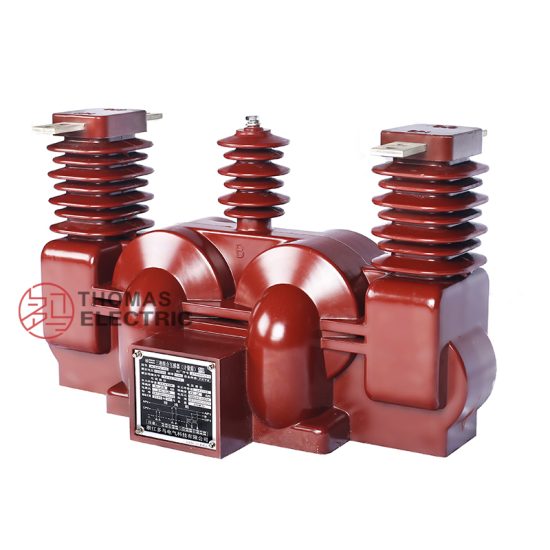
The SZV-10K is a single-phase, indoor/outdoor-rated, cast-resin insulated voltage transformer (VT) designed for accurate voltage transformation in 11kV (IEC) / 10kV (domestic) medium-voltage power systems. It provides galvanic isolation between high-voltage primary circuits and low-voltage secondary instrumentation, enabling safe and precise measurement, metering, and protective relay operation. Unlike traditional oil-immersed VTs, the SZV-10K employs vacuum pressure impregnation (VPI) epoxy resin technology to fully encapsulate its magnetic core and windings, delivering superior dielectric strength, environmental resilience, and fire safety.
Operating Principle of Cast-Resin Insulation
Cast-resin insulation in the SZV-10K is achieved through a two-stage VPI process where the wound core assembly—comprising grain-oriented electrical steel (GOES)—is placed in a mold, evacuated to remove air pockets, and then impregnated under pressure with thermosetting epoxy resin. The assembly is subsequently cured at elevated temperatures (typically 120–140°C) to form a monolithic, void-free solid structure. This eliminates partial discharge risks inherent in air-filled or oil-based systems. The resulting composite exhibits a dielectric strength exceeding 20 kV/mm, thermal class F (155°C), and excellent tracking resistance (CTI > 600 V per IEC 60112). The absence of liquid insulation also prevents leakage, oxidation, and maintenance-intensive oil sampling, making it ideal for both indoor switchgear and exposed outdoor substations.
Advantages Over Oil-Immersed Designs
Compared to oil-filled VTs, the SZV-10K offers significant operational and safety benefits. Its dry-type construction eliminates fire hazards (classified as non-flammable per IEC 60695), reduces environmental liability, and removes the need for oil containment systems. The compact footprint—enabled by higher insulation efficiency—allows integration into space-constrained ring main units (RMUs) and metal-clad switchgear. Furthermore, cast-resin VTs exhibit lower temperature rise (<55 K at rated load per IEC 61869-3), minimal aging under thermal cycling, and immunity to moisture ingress due to hermetic resin sealing. These attributes translate to a service life exceeding 25 years with negligible degradation in accuracy or insulation integrity, even under harsh industrial or coastal conditions.
Typical Application Overview
The SZV-10K is engineered for dual-purpose use in metering and protection circuits across utility distribution networks, industrial plants, and renewable energy facilities. In metering applications, it supplies scaled-down voltages (typically 100 V or 110 V secondary) to revenue-class kWh meters with accuracy classes of 0.2 or 0.5. For protection, it feeds voltage signals to over/under-voltage relays, directional earth-fault detectors, and synchrocheck devices with accuracy class 3P or 6P. Its robust design supports continuous operation at 1.2×Un and short-time withstand at 1.9×Un for 8 hours, ensuring reliability during transient overvoltages common in lightly loaded rural feeders or capacitor-switching events.
Technical Specifications
The SZV-10K adheres strictly to IEC 61869-3 and GB/T 20840.3, with verified performance parameters validated through type, routine, and special tests. Key specifications are detailed below:
| Parameter | Value |
|---|---|
| Primary Rated Voltage (Un) | 11 kV (IEC) / 10 kV (GB) |
| Secondary Rated Voltage | 100 V or 110 V (single or dual secondary) |
| Voltage Ratio | 11000/√3 : 100/√3 V or 10000/√3 : 100/√3 V |
| Accuracy Class (Metering) | 0.2, 0.5 |
| Accuracy Class (Protection) | 3P, 6P |
| Rated Output (per secondary) | 10–100 VA (configurable) |
| Insulation Level (LI/AC) | 75 kV / 28 kV (1.2/50 μs lightning impulse & 1-min power frequency) |
| Short-Time Thermal Withstand | 1.9 × Un for 8 h continuous |
| Frequency | 50 Hz or 60 Hz |
| Core Material | Grain-Oriented Electrical Steel (GOES), M4 grade |
| Insulation System | VPI Epoxy Resin, Class F (155°C) |
| Ambient Temperature Range | –25°C to +40°C (outdoor); –5°C to +40°C (indoor) |
| Relative Humidity | ≤95% (non-condensing) |
| Altitude | ≤1000 m above sea level (derating required >1000 m) |
Standard Service Conditions
The SZV-10K is rated for standard service conditions per IEC 61869-3: ambient temperature from –25°C to +40°C for outdoor installations and –5°C to +40°C for indoor environments. Relative humidity must not exceed 95% without condensation, and the maximum operating altitude is 1000 m. At altitudes between 1000 m and 3000 m, the insulation withstand voltage must be derated by 1% per 100 m above 1000 m. The transformer is designed for continuous operation under unbalanced system conditions and can tolerate harmonic distortion up to 5% THD without exceeding accuracy limits. Installation must ensure adequate clearance (≥125 mm phase-to-phase) and creepage distance (≥240 mm for pollution degree 3).
Electrical Performance Parameters
Under rated load and sinusoidal excitation, the SZV-10K maintains ratio error within ±0.2% and phase displacement ≤±10 minutes for 0.2-class metering windings. For protection windings (3P), ratio error is limited to ±3% at 5%–100% of rated voltage and ±6% at 1%–5%. Burden tolerance is specified from 25% to 100% of rated VA; operation below 25% may increase phase error but remains within class limits. The no-load current is typically <0.5% of rated primary current, minimizing core losses. Thermal stability is ensured by limiting temperature rise to ≤55 K above ambient at full load, verified via thermal imaging during type testing.
Typical Applications
The SZV-10K serves critical roles across diverse power infrastructure segments, leveraging its dual-accuracy capability and environmental robustness.
Substation Secondary Metering
In 10/11kV distribution substations, the SZV-10K supplies voltage inputs to Class 0.2S or 0.5S revenue meters for billing and load profiling. Its low phase error ensures accurate reactive energy measurement, crucial for power factor correction schemes. Dual-secondary configurations allow one winding for utility metering and another for customer-side monitoring, eliminating cross-connection risks. The transformer’s stability under light-load conditions (e.g., nighttime residential feeders) prevents meter drift, while its high insulation level protects against backfeed transients from distributed generation.
Industrial Power Distribution
Within manufacturing plants and data centers, the SZV-10K interfaces with power quality analyzers and SCADA systems to monitor voltage sags, swells, and harmonics. Its fast response time (<20 ms) enables real-time detection of motor-starting dips or arc-furnace flicker. In hazardous areas, the absence of flammable oil complies with ATEX/IECEx zone requirements. The unit is commonly mounted on 10kV bus ducts or RMUs, providing isolated signals to PLC-based control systems for automatic load shedding or capacitor bank switching.
Renewable Energy Integration
Solar PV and wind farms utilize the SZV-10K for grid synchronization and anti-islanding protection. During islanding events, the VT detects voltage/frequency deviations beyond ±1% and triggers disconnection within 2 seconds per IEEE 1547. Its ability to operate accurately at 1.1×Un accommodates voltage rise on lightly loaded feeders with high PV penetration. In offshore wind substations, the cast-resin body resists salt spray corrosion (tested per IEC 60068-2-52), outperforming oil-filled alternatives prone to gasket failure.
Rural and Suburban Distribution Networks
In remote areas with long feeders and variable loading, the SZV-10K’s extended thermal rating (1.9×Un for 8 h) handles daily voltage fluctuations without saturation. It supports single-phase VT banks for open-delta grounding detection in unearthed systems, feeding residual voltage relays for earth-fault location. The lightweight design (≈45 kg) simplifies pole-top installation, while UV-stabilized resin housing prevents cracking under prolonged solar exposure.
Compliance with International Standards
The SZV-10K is certified to both international and Chinese national standards, ensuring global interoperability and regulatory acceptance.
IEC 61869-3 Compliance Details
Per IEC 61869-3:2011, the SZV-10K undergoes rigorous type tests including temperature rise, short-circuit withstand (for CTs; not applicable to VTs), insulation power frequency, lightning impulse, and accuracy verification across burden and voltage ranges. Accuracy classes are defined by maximum permissible ratio error (%) and phase displacement (minutes) at specified voltages (1%, 5%, 20%, 100% Un). The standard mandates that protection VTs maintain accuracy up to 1.2×Un for 3P and 1.5×Un for 6P—requirements fully met by the SZV-10K’s oversized GOES core and optimized winding geometry.
Alignment with GB/T 20840.3
GB/T 20840.3-2013 mirrors IEC 61869-3 but specifies 10kV as the nominal system voltage (vs. 11kV in IEC). The SZV-10K is dual-rated: primary terminals are labeled for 10kV domestic use, while internal insulation design targets 11kV IEC levels. Key differences include GB’s requirement for 30 kV AC withstand (vs. 28 kV IEC) and stricter partial discharge limits (<10 pC at 1.2×Un/√3). All units undergo China Compulsory Certification (CCC) testing at accredited labs like CEPREI, with test reports available upon request.
Testing and Certification Requirements
Certification involves three test tiers: type tests (performed once per design), routine tests (100% production), and special tests (customer-requested). Type tests include 75 kV lightning impulse (1.2/50 μs, 15 shots positive/negative), 28 kV AC withstand for 1 minute, and accuracy mapping across 25–100% burden. Routine tests cover polarity verification, turns ratio (±0.2% tolerance), and insulation resistance (>1000 MΩ at 2500 V DC). Special tests may include seismic qualification (IEC 60068-2-57) or partial discharge mapping per IEC 60270.
On-Site Testing Procedures
Post-installation verification ensures the SZV-10K performs within specification before energization.
Insulation Resistance Test
Using a 2500 V DC megohmmeter, measure insulation resistance between primary winding and ground, and between primary and secondary windings. Acceptance criterion: ≥1000 MΩ at 20°C. Correct for temperature using RT2 = RT1 × 2(T1–T2)/10. Low readings indicate moisture ingress or resin cracking; retest after 24-hour drying if RH >80%.
Turns Ratio Test
Apply 100–200 V AC to the primary and measure secondary voltage. Calculate ratio as Vp/Vs; compare to nameplate. Tolerance: ±0.2% for metering, ±0.5% for protection. Use a dedicated ratio tester (e.g., Omicron CT Analyzer) for automated comparison. Deviations >1% suggest inter-turn faults or incorrect tap selection.
Polarity Test
Verify reducing polarity per IEC 61869-3: momentarily apply DC to primary (H1+, H2–); observe secondary voltage spike direction on oscilloscope. Positive spike at X1 confirms correct polarity. Incorrect polarity causes wattmeter reversal and relay misoperation. This test is mandatory for differential or directional schemes.
Power Frequency Withstand Voltage Test
Apply 28 kV AC (RMS) at 50 Hz between primary and grounded secondary/core for 1 minute. Monitor for flashover or excessive current (>5 mA). Test only after insulation resistance passes. Reduce voltage gradually post-test to avoid resonant overvoltages. Not required if factory test certificate is valid and transport damage is ruled out.
Open-Circuit Characteristic Test
With secondary open, ramp primary voltage from 20% to 120% Un in 10% steps. Record excitation current; plot knee-point curve. Knee-point should exceed 1.5×Un. Excessive current at low voltage indicates core short-circuits; flat curve suggests winding opens. Compare to factory baseline—deviation >10% warrants investigation.
Preventive Maintenance Guide
Although cast-resin VTs require minimal maintenance, periodic checks extend service life and prevent unexpected failures.
Periodic Inspection Schedule
Conduct visual inspections annually: check for surface tracking, cracks, or discoloration on resin housing; verify terminal tightness (torque: 15 N·m for M10 bolts); inspect mounting hardware for corrosion. Clean with dry cloth—never use solvents. In coastal or industrial zones, inspect every 6 months for salt/chemical deposits. Use UV flashlight to detect early corona activity (purple glow).
Maintenance Intervals and Fault Diagnosis
Every 5 years, perform insulation resistance and turns ratio tests. Replace if ratio error exceeds 1% or IR drops below 500 MΩ. Common faults include: (1) secondary open-circuit—causes core saturation and overheating; (2) moisture ingress at terminal seals—leads to surface leakage; (3) mechanical shock damage—creates microcracks detectable via ultrasonic testing. Never operate with secondary open; always short-circuit during servicing.
| Interval | Action |
|---|---|
| Annually | Visual inspection, terminal torque check, cleaning |
| Every 5 Years | Insulation resistance, turns ratio, polarity verification |
| After Fault Event | Full suite: IR, ratio, withstand, open-circuit test |
Conclusion
The SZV-10K 11kV cast-resin voltage transformer represents a benchmark in medium-voltage instrumentation, combining precision engineering with rugged environmental performance. Its VPI epoxy resin encapsulation eliminates fire risks and maintenance burdens associated with oil-filled designs, while the GOES core ensures long-term accuracy stability under dynamic loading conditions. Certified to both IEC 61869-3 and GB/T 20840.3, it seamlessly integrates into global power systems—from urban substations to remote renewable sites—with guaranteed compliance. The dual-accuracy windings support simultaneous metering (0.2/0.5 class) and protection (3P/6P) functions, reducing equipment count and lifecycle costs. With a design life of 25–30 years and minimal degradation under thermal cycling, the SZV-10K delivers exceptional reliability. Its robust insulation system withstands 75 kV lightning impulses and 28 kV power frequency stresses, ensuring uninterrupted operation during grid disturbances. For engineers specifying instrumentation in 10/11kV networks, the SZV-10K offers a technically superior, future-proof solution that aligns with modern safety, accuracy, and sustainability standards.