Article Content
Introduction
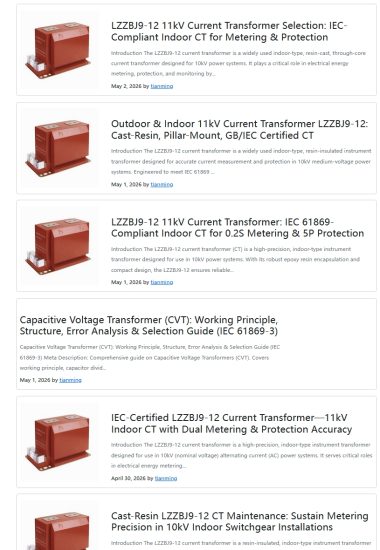
The LZZBJ9-12 current transformer is a widely used indoor-type, resin-insulated instrument transformer designed for accurate current measurement and protection in 10kV medium-voltage power systems. Engineered to meet IEC 61869 and GB standards, this CT features a robust epoxy resin casting that ensures excellent dielectric strength, mechanical durability, and resistance to environmental factors such as humidity and pollution. Its compact design and standardized dimensions facilitate easy installation in switchgear panels, ring main units (RMUs), and other enclosed distribution equipment. The “LZZBJ9-12” designation follows Chinese nomenclature: “L” denotes current transformer, “Z” indicates resin-cast, “Z” again signifies pillar-type mounting, “B” stands for protection class availability, and “J” refers to the enhanced accuracy for metering applications, with “12” representing the highest system voltage rating of 12kV (suitable for 10kV nominal systems). This selection guide provides essential technical considerations to ensure proper specification, safe operation, and optimal performance of the LZZBJ9-12 in various electrical infrastructure applications.
System Voltage
Selecting the correct current transformer for a 10kV power system requires careful attention to voltage ratings to ensure both safety and compliance with insulation requirements. The LZZBJ9-12 is specifically rated for systems with a maximum operating voltage of 12kV, making it suitable for standard 10kV networks commonly found in industrial plants, commercial buildings, and utility substations. The rated insulation level of the transformer must withstand not only normal operating voltages but also transient overvoltages caused by switching operations or lightning surges. According to IEC 61869-2 and GB 20840.2, the LZZBJ9-12 typically meets a power frequency withstand voltage of 42kV (rms, 1-minute) and a lightning impulse withstand voltage of 75kV (peak). These values guarantee reliable insulation performance under fault conditions and during maintenance testing.
It is critical to match the CT’s voltage rating with the system’s highest voltage for equipment (Um). Using a CT rated below the system’s Um can lead to insulation breakdown, while over-specifying may result in unnecessary cost and size. The LZZBJ9-12’s 12kV rating aligns precisely with the 10kV system category where Um = 12kV, as defined in IEC 60038. Additionally, the transformer’s creepage distance and internal clearances are optimized for indoor environments with pollution degree 2 or 3, ensuring long-term reliability without external contamination-related flashovers.
| Parameter | Value | Standard Reference |
|---|---|---|
| Rated System Voltage (Un) | 10 kV | IEC 60038 |
| Highest Voltage for Equipment (Um) | 12 kV | IEC 61869-2 |
| Power Frequency Withstand Voltage (1 min) | 42 kV (rms) | GB 20840.2 |
| Lightning Impulse Withstand Voltage | 75 kV (peak) | IEC 61869-2 |
| Application Environment | Indoor, Pollution Degree 2–3 | IEC 60664-1 |
Transformation Ratio
The transformation ratio—also known as the current ratio—is one of the most critical parameters when selecting an LZZBJ9-12 current transformer. It defines the relationship between the primary current (Ip) flowing through the main conductor and the secondary current (Is) delivered to connected instruments or relays, typically standardized at 1A or 5A. Common ratios for the LZZBJ9-12 include 50/5, 100/5, 200/5, 300/5, 400/5, 600/5, and up to 2000/5, with dual-ratio or multi-tap options available for flexible configuration. Selecting the appropriate ratio depends on the expected load current, short-circuit levels, and the requirements of downstream devices.
For metering applications, the ratio should be chosen so that the normal operating current falls within 20% to 100% of the rated primary current to maintain measurement accuracy. For example, if a feeder typically carries 180A, a 200/5 ratio would be ideal, whereas a 600/5 ratio might result in poor accuracy at low loads. In protection applications, the ratio must accommodate both normal load currents and potential fault currents without saturating the core. Core saturation during high-current faults can distort the secondary waveform, leading to incorrect relay operation. Therefore, protection-class CTs often require higher knee-point voltages and larger cores, which the LZZBJ9-12 supports through dedicated protection windings (e.g., 5P10, 5P20).
Multi-ratio versions of the LZZBJ9-12 feature multiple secondary taps on a single winding (e.g., 400–600–800/5), allowing field adjustment without replacing the unit. This is particularly useful in systems where load growth is anticipated. When specifying the ratio, engineers must also consider the burden imposed by connected devices. A higher ratio does not inherently reduce burden; rather, the secondary current magnitude affects voltage drop across the burden impedance. For instance, a 1A secondary system (e.g., 400/1) reduces copper losses and allows longer cable runs compared to 5A systems but requires compatible instrumentation.
Incorrect ratio selection can lead to several issues: undersized ratios may cause overheating or insulation failure under overload conditions, while oversized ratios compromise metering precision and protection sensitivity. Always verify the maximum continuous current and prospective fault current at the installation point before finalizing the transformation ratio.
| Primary Current (A) | Secondary Current (A) | Typical Application | Notes |
|---|---|---|---|
| 50 – 150 | 1 or 5 | Light industrial feeders, small transformers | Use 5A for compatibility with legacy meters |
| 200 – 600 | 1 or 5 | Main distribution, motor circuits | Most common range; dual-ratio options available |
| 800 – 1200 | 1 or 5 | Large motors, substation incomers | Prefer 1A secondary for reduced burden |
| 1500 – 2000 | 1 or 5 | Utility feeders, heavy industrial | Verify thermal and dynamic withstand capability |
| Custom (e.g., 300/1) | 1 | Modern digital relays, SCADA systems | Requires 1A-rated protection/metering devices |
Accuracy Class
Accuracy class defines the permissible error limits in current transformation under specified conditions and is fundamental to ensuring reliable metering and dependable protection. The LZZBJ9-12 current transformer is available in multiple accuracy classes tailored for distinct functions: metering (e.g., 0.2, 0.5, 1) and protection (e.g., 5P10, 5P20, 10P10). Metering classes indicate the maximum composite error (%) at rated current under sinusoidal steady-state conditions. For instance, a 0.5-class CT guarantees that the measured current will deviate by no more than ±0.5% from the true value at 100% rated current and specified burden. Higher precision classes like 0.2S or 0.5S are available for revenue metering and comply with IEC 61869-1/-2, offering improved accuracy at low loads (down to 1% or 5% of rated current).
Protection accuracy classes follow a different convention. The notation “5P10” means the CT maintains a composite error of ≤5% at 10 times the rated primary current, provided the burden does not exceed the rated value. Similarly, “5P20” ensures ≤5% error at 20× rated current. These ratings are crucial for protective relays that must operate correctly during high-magnitude fault conditions. The “P” denotes protection, and the number after it represents the accuracy limit factor (ALF). Selecting an insufficient ALF may cause core saturation during faults, leading to under-reach or failure to trip. Conversely, excessive ALF increases cost and physical size unnecessarily.
It is essential to match the CT’s accuracy class with the application’s requirements. Revenue metering typically demands 0.2S or 0.5S, while general monitoring may use 1.0 class. Protection circuits for overcurrent relays commonly use 5P10 or 5P20, depending on the fault current level and relay sensitivity. Note that a single LZZBJ9-12 unit can incorporate dual windings—one for metering (e.g., 0.5) and one for protection (e.g., 5P10)—enabling both functions in one device. Always confirm the connected burden (in VA) matches the CT’s rated burden; exceeding it degrades accuracy even if the class is correctly selected.
| Accuracy Class | Max Composite Error | Application | Key Standard |
|---|---|---|---|
| 0.2S | ±0.2% at 20–120% In; ±0.75% at 1% In | Revenue metering, high-precision billing | IEC 61869-2 |
| 0.5 | ±0.5% at 100% In | Sub-metering, energy management | GB/T 20840.2 |
| 1.0 | ±1.0% at 100% In | General monitoring, non-critical loads | IEC 61869-1 |
| 5P10 | ≤5% error at 10× In | Overcurrent protection, standard relays | IEC 61869-2 |
| 5P20 | ≤5% error at 20× In | High-fault-level systems, sensitive relays | GB 20840.2 |
5. Burden Calculation
The burden of a current transformer (CT) is the total impedance presented to its secondary winding, comprising the connected relay(s), wiring resistance, and any other components in the secondary circuit. Accurate burden calculation is essential to ensure the CT operates within its accuracy class and does not saturate under normal or fault conditions.
The total burden \( Z_b \) is calculated as:
\[
Z_b = Z_{relay} + Z_{wire} + Z_{connections}
\]
Where:
- \( Z_{relay} \): Impedance of the protective relay or metering device (typically provided by the manufacturer in VA or ohms).
- \( Z_{wire} \): Total resistance of the secondary wiring loop (go and return paths).
- \( Z_{connections} \): Resistance due to terminal blocks, splices, and contact points (often estimated at 0.1–0.2 Ω).
Wire resistance is determined using:
\[
R_{wire} = \frac{2 \cdot L \cdot \rho}{A}
\]
Where \( L \) = one-way cable length (m), \( \rho \) = resistivity of copper (≈0.01724 Ω·mm²/m at 20°C), and \( A \) = cross-sectional area (mm²).
| Parameter | Symbol | Typical Value | Unit |
|---|---|---|---|
| Relay Burden | \( Z_{relay} \) | 0.2 – 2.0 | Ω |
| Wire Length (one way) | \( L \) | 10 – 100 | m |
| Cable Cross-Section | \( A \) | 2.5, 4, 6 | mm² |
| Connection Resistance | \( Z_{conn} \) | 0.1 – 0.2 | Ω |
| Maximum Allowable Burden (Class C) | \( Z_{max} \) | Specified per ANSI/IEEE C57.13 | Ω |
Example: For a 50 m run with 4 mm² copper cable, \( R_{wire} = \frac{2 \cdot 50 \cdot 0.01724}{4} = 0.431 \, \Omega \). Adding a relay burden of 0.5 Ω and 0.15 Ω for connections yields a total burden of 1.081 Ω. This must be less than the CT’s rated burden (e.g., 1.5 Ω for a C800 CT at 5 A secondary).
6. Short-Circuit Considerations
Current transformers must withstand high short-circuit currents without mechanical damage or performance degradation. During a fault, primary currents can exceed 20–40 times the nominal rating, inducing significant forces and thermal stress in the CT windings.
Key short-circuit parameters include:
- Symmetrical short-circuit current (\( I_{sc} \)): RMS value of the AC component during a fault.
- Asymmetrical (peak) current: Includes DC offset; peak value ≈ \( \sqrt{2} \cdot I_{sc} \cdot (1 + e^{-t/\tau}) \), where \( \tau \) is the system time constant.
- Duration: Typically 0.1–3 seconds, depending on protection coordination.
CTs are rated for short-time thermal withstand (e.g., 1 sec or 3 sec ratings) and dynamic (mechanical) withstand. Exceeding these ratings may cause insulation failure or winding deformation.
| Short-Circuit Rating | Description | Typical Values |
|---|---|---|
| Thermal Withstand | RMS current for specified duration without exceeding temperature limits | 20 kA for 1 sec, 12 kA for 3 sec |
| Dynamic Withstand | Peak current the CT can endure mechanically | 50–100 kA peak |
| X/R Ratio | System reactance-to-resistance ratio affecting DC offset | 10–20 (transmission), 5–10 (distribution) |
| Time Constant (\( \tau \)) | \( L/R \) of the faulted circuit | 45–150 ms |
Designers must verify that the maximum expected fault current at the CT location—considering system configuration and future growth—does not exceed the CT’s short-circuit ratings. Additionally, CT saturation during high-magnitude faults can distort secondary current, potentially causing misoperation of protective relays. Use of high-accuracy class CTs (e.g., C800) or air-core CTs may be necessary in critical applications.
7. Environmental Factors
Environmental conditions significantly impact CT performance, longevity, and safety. CTs installed outdoors or in harsh industrial environments must be rated for temperature extremes, humidity, pollution, and altitude.
Key environmental considerations include:
- Ambient Temperature: Standard operating range is typically –25°C to +55°C. Beyond this, derating or special designs (e.g., extended temperature insulation) are required.
- Humidity and Condensation: High humidity can lead to moisture ingress, reducing insulation resistance. Sealed or gasketed enclosures with desiccants are recommended in tropical climates.
- Pollution Degree: Dust, salt, and chemical contaminants can cause tracking or corrosion. IP65 or higher enclosures are used in coastal or industrial zones.
- Altitude: Above 1000 m, reduced air density decreases dielectric strength and cooling efficiency. Derating factors apply per IEC 60076-1 (e.g., 1% reduction in voltage rating per 100 m above 1000 m).
| Factor | Standard Requirement | Mitigation Strategy |
|---|---|---|
| Temperature | IEC 61869-2: –25°C to +55°C | Use silicone oil or SF6 insulation for extreme temps |
| Humidity | Relative humidity ≤ 95% | Hermetic sealing, silica gel breathers |
| Ingress Protection | Minimum IP54 (indoor), IP65 (outdoor) | Stainless steel housings, sealed terminals |
| Altitude | Rated up to 1000 m ASL | Derate by 1% per 100 m above 1000 m |
UV exposure, vibration (e.g., near transformers or railways), and seismic activity must also be evaluated for outdoor installations. Compliance with local standards (e.g., NEMA, IEC, IEEE) ensures reliability under site-specific conditions.
8. CT Selection and Verification Checklist
Use the following checklist during design, procurement, and commissioning to ensure correct CT application:
| # | Check Item | Verified? (✓/✗) | Remarks |
|---|---|---|---|
| 1 | Primary current rating matches system load and fault levels | ||
| 2 | Secondary current (1 A or 5 A) compatible with relay inputs | ||
| 3 | Total burden ≤ CT-rated burden at specified accuracy class | Include wiring, relay, and connection impedance | |
| 4 | Short-circuit thermal and dynamic ratings exceed max fault current | Consider X/R ratio and fault duration | |
| 5 | Environmental rating suitable for installation location | Check IP, temperature, altitude, pollution | |
| 6 | Polarity markings correct for differential or directional schemes | Verify H1/X1 orientation | |
| 7 | Insulation level matches system BIL (Basic Impulse Level) | e.g., 150 kV BIL for 69 kV systems | |
| 8 | Secondary circuits grounded per code (typically at one point) | Prevents circulating currents and ensures safety |
This checklist should be completed during engineering review and updated during site acceptance testing (SAT). Any unchecked item requires corrective action before energization.