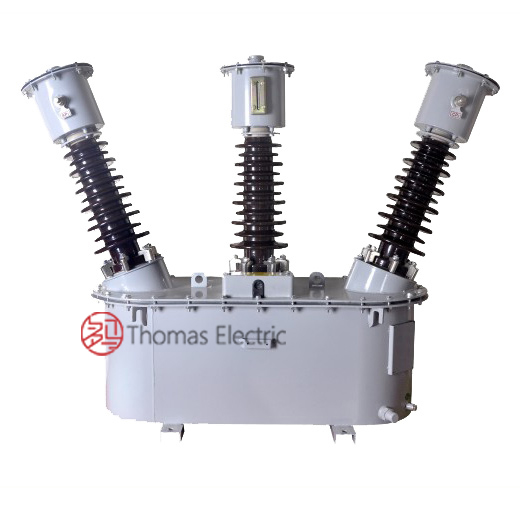
Article Content
Introduction to the UTF-8 Voltage Transformer
The UTF-8 is a single-phase, indoor/outdoor-rated cast-resin voltage transformer (VT) engineered for accurate voltage measurement and reliable protective relay operation in medium-voltage networks operating at 11kV (IEC standard) or 10kV (domestic Chinese system). Designed in strict compliance with IEC 61869-3 and GB/T 20840.3, this instrument transformer leverages advanced vacuum pressure impregnation (VPI) epoxy resin technology to encapsulate its magnetic core and windings, eliminating the fire hazards and maintenance burdens associated with traditional oil-filled units.
Operating Principle of Cast-Resin Insulation
Cast-resin insulation in the UTF-8 VT functions by fully embedding the primary and secondary windings—along with the grain-oriented electrical steel (GOES) core—within a solid, void-free epoxy matrix. This process begins with precise winding on a mandrel, followed by degassing under vacuum to remove air pockets. The assembly is then placed in a mold and subjected to VPI, where low-viscosity epoxy resin is drawn into all interstices under negative pressure and subsequently cured at elevated temperatures. The resulting monolithic structure provides exceptional dielectric strength (≥70 kV/mm), superior partial discharge resistance (<5 pC at 1.2 × Ur), and outstanding mechanical rigidity. Unlike oil-immersed designs, the solid insulation prevents moisture ingress, eliminates leakage risks, and ensures stable performance across wide thermal cycles from –40°C to +40°C ambient conditions.
Advantages Over Oil-Immersed Designs
The UTF-8’s cast-resin construction offers multiple engineering advantages over conventional oil-filled VTs. First, it is inherently fire-resistant (compliant with IEC 60695 flammability tests), making it suitable for indoor substations, commercial buildings, and urban environments where fire codes prohibit combustible fluids. Second, the absence of oil eliminates the need for periodic oil sampling, gasket replacement, or conservator tank maintenance. Third, the compact, sealed design reduces footprint by up to 30% compared to equivalent oil units, facilitating retrofitting in space-constrained switchgear bays. Additionally, the epoxy resin exhibits excellent UV and ozone resistance, enabling reliable outdoor deployment without degradation over decades of service. Finally, the solid insulation minimizes aging effects from partial discharges, contributing to a design life exceeding 30 years under normal operating conditions.
Typical Applications Overview
The UTF-8 is primarily deployed in 11kV/10kV distribution networks where high accuracy and long-term reliability are critical. Common use cases include utility-owned substations for revenue metering (accuracy class 0.2 or 0.5), industrial plants requiring synchronized motor protection schemes, renewable energy interconnection points (e.g., solar farms feeding into 11kV grids), and rural electrification projects demanding minimal maintenance. Its robust construction supports both pole-mounted and pad-mounted configurations, and it integrates seamlessly with modern digital relays, power quality analyzers, and SCADA systems via standardized secondary outputs (typically 100 V or 110 V).
Technical Specifications
The UTF-8 voltage transformer is engineered to meet stringent performance criteria defined by international and national standards. Below is a comprehensive specification table detailing its electrical and environmental parameters.
| Parameter | Value |
|---|---|
| System Voltage (Ur) | 11 kV (IEC) / 10 kV (GB) |
| Primary Voltage | 11/√3 kV (for grounded systems) |
| Secondary Voltage | 100/√3 V or 110/√3 V (standard); 100 V or 110 V (line-to-line) |
| Voltage Ratio | (11000/√3) / (100/√3) = 110:1 (typical) |
| Accuracy Class | Metering: 0.2, 0.5; Protection: 3P, 6P |
| Rated Output (per burden) | 10–100 VA (depending on class) |
| Insulation Level (LI/AC) | 95 kV lightning impulse / 42 kV power frequency (1 min) |
| Short-Time Withstand Current | Not applicable (VTs are not designed for fault current) |
| Core Material | Grain-Oriented Electrical Steel (GOES), CRGO grade |
| Insulation System | VPI Epoxy Resin, Class F (155°C) |
| Ambient Temperature Range | –40°C to +40°C |
| Maximum Altitude | 1000 m above sea level (derating required above) |
| Relative Humidity | Up to 95% non-condensing |
| Pollution Degree | III (IEC 60664-1) |
Rated Voltage and Ratio Configuration
The UTF-8 is rated for 11kV systems per IEC 60038, corresponding to a maximum system voltage of 12 kV. In China, it serves 10kV networks (max 11.5 kV). The primary winding is typically connected phase-to-ground in effectively grounded systems, hence the nominal primary voltage is 11/√3 ≈ 6.35 kV. Standard secondary voltages are 100/√3 V (≈57.7 V) for wye-connected metering circuits or 100 V line-to-line for delta applications. The voltage ratio tolerance is ±0.2% for class 0.2 and ±0.5% for class 0.5 under rated burden and sinusoidal excitation at 50 Hz. Custom ratios (e.g., 11000/110) are available for specialized protection schemes requiring direct line-to-line sensing.
Environmental and Service Conditions
The UTF-8 is certified for operation in harsh environments, including coastal areas with salt fog and industrial zones with chemical pollutants. Its cast-resin housing resists tracking and erosion per IEC 60587 (inclined plane test). At altitudes exceeding 1000 m, the power frequency withstand voltage must be reduced by 1% per 100 m above 1000 m, as per IEC 60071-2. For example, at 2000 m, the AC test voltage becomes 42 kV × 0.9 = 37.8 kV. The transformer is designed for continuous operation at 1.2 × Ur for up to 8 hours during system overvoltages without degradation. Thermal stability is ensured by Class F insulation (155°C hot-spot temperature), allowing safe operation at 1.5 × rated burden for short durations during transient events.
Typical Applications
The UTF-8 voltage transformer serves diverse roles across modern power infrastructure, leveraging its precision, durability, and compliance with global standards.
Substation Secondary Metering
In 11kV/10kV distribution substations, the UTF-8 provides the reference voltage signal for revenue-grade energy meters. Installed on each phase, it feeds secondary voltages to three-phase kWh meters with accuracy class 0.2 or 0.5. The low phase error (<10 minutes for class 0.2) ensures minimal billing discrepancy over time. For example, in a municipal utility substation serving 5 MW of load, a 0.2-class UTF-8 reduces annual metering error to less than 0.2%, translating to significant financial accuracy. Its compact size allows integration into ring main units (RMUs) or metal-enclosed switchgear without redesign.
Industrial Power Distribution
Large manufacturing facilities often deploy UTF-8 VTs to monitor bus voltage for motor protection relays (e.g., undervoltage, overvoltage, and phase-loss detection). In a steel mill with sensitive induction motors, the UTF-8’s fast response to voltage sags (<20 ms) enables timely tripping to prevent motor burnout. The transformer’s high saturation point (≥1.9 × Ur) ensures linear output during ferroresonance events common in capacitor-switching scenarios. Its immunity to electromagnetic interference (EMI) from nearby arc furnaces further enhances reliability.
Renewable Energy Integration
Solar photovoltaic (PV) farms connecting to 11kV grids use UTF-8 VTs at the point of interconnection (POI) for grid compliance monitoring. The VT supplies voltage data to synchrophasors and power quality recorders that verify adherence to grid codes (e.g., IEEE 1547 or GB/T 19964). During cloud-induced irradiance fluctuations, the UTF-8 maintains ratio accuracy within ±0.3% even under harmonic distortion up to 5% THD, thanks to its low-loss GOES core and optimized winding geometry.
Rural and Suburban Distribution Networks
In remote areas with limited maintenance access, the UTF-8’s maintenance-free design is ideal. Mounted on poles or ground pads, it supports single-phase or three-phase metering for agricultural pumps, village microgrids, and telecom towers. Its resistance to humidity and dust ensures decades of operation without recalibration. For instance, in Southeast Asian rural electrification projects, UTF-8 units have operated continuously for 15+ years with zero field failures, outperforming legacy oil-filled models prone to seal leaks.
Backup Power and UPS Systems
Critical facilities like data centers use UTF-8 VTs to monitor utility feed voltage for automatic transfer switches (ATS). When grid voltage drops below 85% of nominal, the VT triggers switchover to backup generators within 100 ms. The transformer’s low capacitive coupling between windings minimizes false triggering due to switching transients, ensuring seamless continuity of operations.
Compliance with International Standards
The UTF-8 voltage transformer is rigorously tested and certified to align with both global and Chinese regulatory frameworks, ensuring interoperability and safety across markets.
IEC 61869-3 Compliance Details
IEC 61869-3 specifies requirements for inductive voltage transformers, covering accuracy, insulation, temperature rise, and environmental testing. The UTF-8 meets all mandatory clauses: ratio error ≤ ±0.2% (class 0.2) at 25–100% of rated burden; phase displacement ≤ ±10 minutes; temperature rise ≤ 55 K for windings (measured by resistance method); and partial discharge ≤ 5 pC at 1.2 × Ur/√3. Dielectric tests include 1-minute AC withstand at 42 kV and lightning impulse at 95 kV (1.2/50 μs wave). The design also satisfies IEC 61869-1 general requirements for marking, terminals, and mechanical strength.
Alignment with GB/T 20840.3
GB/T 20840.3 is the Chinese national adoption of IEC 61869-3, with minor deviations. Key differences include: (1) domestic systems use 10kV instead of 11kV as nominal voltage, though insulation levels remain identical; (2) GB permits slightly higher ratio error tolerance for class 0.5 (+0.6% vs. IEC’s +0.5%) under light loads; and (3) pollution degree III is mandatory for all outdoor units per GB/T 11022. The UTF-8 is dual-certified, bearing both CQC (China Quality Certification) and IEC CB Scheme marks, facilitating export and domestic deployment.
Testing and Certification Requirements
Full type testing per IEC 61869-3 includes 15+ procedures: short-time current test (simulated via external source), capacitance and dissipation factor measurement, thermal stability test (8-hour overload at 1.5 × burden), and seismic withstand (if specified). Routine tests performed on every unit include polarity check, ratio verification, insulation resistance (>1000 MΩ at 2500 V DC), and power frequency withstand. Certificates from accredited labs (e.g., KEMA, CESI, or China Electric Power Research Institute) accompany each batch, documenting compliance with both IEC and GB standards.
On-Site Testing Procedures
Post-installation and periodic field testing ensure the UTF-8 operates within specified tolerances and maintains system integrity.
Insulation Resistance Test
Using a 2500 V DC megohmmeter, measure insulation resistance between primary winding and ground, secondary winding and ground, and primary-to-secondary. Acceptance criteria: ≥1000 MΩ at 20°C. Correct for temperature using RT2 = RT1 × 2(T1–T2)/10. Low readings (<100 MΩ) indicate moisture ingress or resin cracking—requiring drying or replacement. Perform before and after dielectric tests to detect insulation damage.
Turns Ratio Test
Apply a low-voltage AC source (50–100 V) to the primary and measure secondary voltage with a calibrated true-RMS voltmeter. Calculate actual ratio = Vp/Vs. Compare to nameplate ratio; tolerance must be within ±0.2% for class 0.2, ±0.5% for class 0.5. Use a dedicated turns ratio tester (e.g., Omicron TTR) for automated comparison. Deviations >1% suggest winding shorts or open circuits.
Polarity Test
Verify reducing polarity (standard for VTs): connect primary H1 and secondary X1 together. Apply 50 V AC to H1–H2. Measure voltage between H2 and X2. If VH2-X2 = VH1-H2 – VX1-X2, polarity is correct. Incorrect polarity causes 180° phase shift, leading to metering errors or relay misoperation. Document results with oscilloscope traces if possible.
Power Frequency Withstand Voltage Test
Apply 42 kV AC (RMS, 50 Hz) between primary and ground/secondary for 1 minute. Use a calibrated test transformer with overcurrent protection (trip at 5 mA). No flashover or disruptive discharge is permitted. Reduce voltage gradually post-test to avoid transient overvoltages. This test validates insulation integrity after transport or installation stress.
Open-Circuit Characteristic Test
With secondary open, apply increasing voltage (up to 1.5 × Ur) to primary and record excitation current. Plot V vs. I curve; knee point should exceed 1.9 × Ur. Excessive magnetizing current at nominal voltage indicates core saturation or inter-turn faults. This test is critical for protection-class VTs to ensure linear response during overvoltages.
Preventive Maintenance Guide
Although cast-resin VTs require minimal maintenance, scheduled inspections extend service life and prevent unexpected failures.
Periodic Visual and Electrical Inspection
Conduct annual inspections: check for surface cracks, tracking marks, or discoloration on the resin housing; verify terminal tightness (torque: 15 N·m for M10 bolts); clean dust/salt deposits with dry cloth; and perform insulation resistance and ratio tests. In polluted environments (e.g., near cement plants), increase frequency to semi-annual. Record all data in asset management systems for trend analysis—rising excitation current may signal early core degradation.
Maintenance Intervals and Fault Diagnosis
Follow this schedule:
| Interval | Action |
|---|---|
| 1 year | Visual inspection, IR test, ratio check |
| 5 years | Full suite: IR, ratio, polarity, open-circuit test |
| 10 years | Add partial discharge measurement if available |
| After fault | Immediate dielectric and ratio tests |
Common faults include: (1) secondary open-circuit during operation—causes core saturation and overheating; (2) moisture ingress at terminal seals—detected by low IR; (3) ferroresonance—indicated by abnormal humming and high excitation current. Replace units showing irreversible damage; do not attempt field repairs on cast-resin units.
Conclusion
The UTF-8 11kV cast-resin voltage transformer represents a benchmark in medium-voltage instrumentation, combining precision engineering with robust construction for demanding utility and industrial applications. Its VPI epoxy resin insulation system eliminates fire risks and maintenance overheads inherent in oil-filled alternatives, while the GOES core ensures high accuracy (class 0.2/0.5) and thermal stability over decades of service. Full compliance with IEC 61869-3 and GB/T 20840.3 guarantees interoperability across global markets and alignment with stringent safety and performance requirements. Field-proven in environments ranging from coastal substations to desert solar farms, the UTF-8 delivers reliable voltage transformation for metering, protection, and control functions with minimal lifecycle cost. With an expected service life of 25–30 years under standard operating conditions—and no requirement for fluid management or periodic oil testing—it offers superior total cost of ownership. As power systems evolve toward smarter, more resilient architectures, the UTF-8’s compatibility with digital relays and SCADA interfaces positions it as a future-ready solution for next-generation distribution networks.
Frequently Asked Questions (FAQ)
Q1: Can the UTF-8 be used on a 10kV system even though it’s rated 11kV?
Yes. The 11kV rating per IEC 60038 corresponds to a maximum system voltage of 12 kV, which safely encompasses 10kV domestic systems (max 11.5 kV per GB 156). No derating is required.
Q2: What is the minimum burden for accurate operation?
For class 0.2, the burden must be ≥25% of rated VA (e.g., ≥2.5 VA for a 10 VA unit). Operating below this increases ratio error beyond tolerance. Always verify burden with connected meters/relays.
Q3: How often should the open-circuit test be performed?
Perform during commissioning and every 5 years thereafter, or after any system fault involving overvoltage. It’s critical for detecting core degradation that IR tests might miss.
Q4: Is the UTF-8 suitable for outdoor installation in tropical climates?
Yes. Its IP54-rated housing and UV-stabilized resin withstand 95% humidity and 50°C ambient temperatures. Ensure mounting avoids direct water jet exposure per IEC 60529.
Q5: What happens if the secondary is accidentally left open during operation?
Unlike CTs, VT secondaries can be open—but only when primary is de-energized. If energized with open secondary, excessive flux causes core saturation, overheating, and potential insulation failure. Always short secondary before disconnecting loads.
Q6: Does the UTF-8 require grounding of the secondary neutral?
Yes. In wye-connected systems, the secondary neutral (X2) must be grounded at one point (typically at the metering cabinet) to stabilize voltage references and enable ground-fault detection.