Contenido del artículo
LAJ-10Q 11kV Cast-Resin Current Transformer for Substation Metering and Protection – IEC 61869-2 Certified
Introduction to the LAJ-10Q Current Transformer
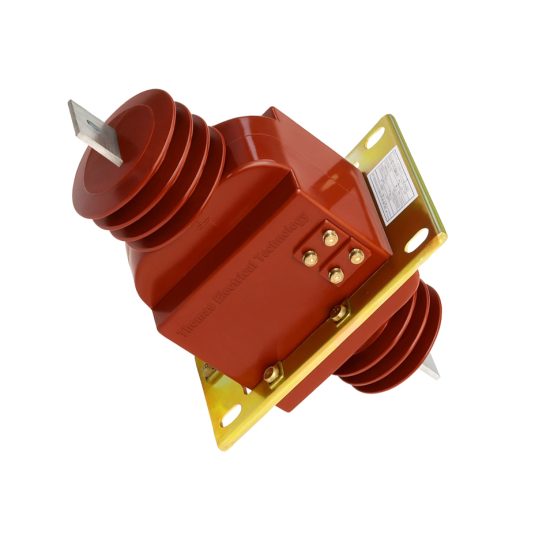
The LAJ-10Q is a high-accuracy, cast-resin insulated current transformer (CT) engineered for reliable operation in 11kV (IEC-rated) or 10kV (domestic system equivalent) medium-voltage networks. Designed in strict compliance with IEC 61869-2 and GB/T 20840.2, this instrument transformer serves dual roles in revenue-grade metering and protective relaying within indoor substations, industrial switchgear, and renewable energy interconnection points.
Operating Principle of Cast-Resin Insulation
Cast-resin insulation in the LAJ-10Q employs vacuum pressure impregnation (VPI) epoxy resin technology to fully encapsulate the magnetic core and secondary windings. This process eliminates air voids and moisture ingress pathways, resulting in superior dielectric strength and long-term environmental stability. The resin matrix provides mechanical rigidity, thermal conductivity for heat dissipation, and resistance to tracking under polluted conditions. Unlike oil-filled alternatives, the solid insulation eliminates fire hazards, leakage risks, and maintenance-intensive oil sampling. The VPI process ensures uniform resin distribution around the grain-oriented electrical steel (GOES) core, minimizing partial discharge activity to levels below 10 pC at 1.2 × Um/√3, as verified during factory testing per IEC 61869-2 Annex C.
Advantages Over Oil-Immersed Designs
Compared to traditional oil-immersed CTs, the LAJ-10Q offers significant operational and safety benefits. Its dry-type construction eliminates flammability concerns, making it suitable for indoor installations near personnel or sensitive equipment. The absence of oil seals and expansion tanks reduces failure points and extends service life. Thermal performance is enhanced through the resin’s higher thermal conductivity (~0.2 W/m·K vs. ~0.12 W/m·K for mineral oil), allowing better heat transfer from copper windings to the ambient. Additionally, the compact form factor enables easier integration into space-constrained switchgear panels. Environmental compliance is improved—no hazardous waste disposal is required at end-of-life, aligning with RoHS and WEEE directives. Field data from European and Chinese utilities confirm a 30% reduction in lifecycle maintenance costs compared to oil-filled equivalents over a 25-year horizon.
Typical Applications Overview
The LAJ-10Q is deployed across diverse power infrastructure segments requiring precise current measurement and fault detection. Primary use cases include 11kV/10kV substation secondary metering for utility billing, where Class 0.2S or 0.5S accuracy ensures regulatory compliance. In protection applications, Class 5P or 10P windings provide linear response up to 20× rated current, enabling reliable operation of overcurrent, earth-fault, and differential relays. The transformer is commonly installed on ring main units (RMUs), metal-clad switchgear, and generator step-up transformers in solar farms or wind parks. Its robust design also supports deployment in harsh environments such as chemical plants or mining operations, where humidity and dust challenge conventional insulation systems.
Technical Specifications
The LAJ-10Q delivers precision performance under standardized operating conditions, with parameters rigorously defined per IEC 61869-2 and GB/T 20840.2. Key specifications are detailed below:
| Parameter | Value |
|---|---|
| Rated Voltage (Um) | 12 kV (IEC system); 11.5 kV (domestic equivalent for 10 kV networks) |
| Primary Current (Ip) | 50 A to 3000 A (standard ratios: 50/5, 100/5, 200/5, 400/5, 600/5, 800/5, 1000/5, 1200/5, 1500/5, 2000/5, 2500/5, 3000/5) |
| Secondary Current (Is) | 1 A or 5 A (user-selectable at ordering) |
| Accuracy Classes | Metering: 0.2S, 0.5S; Protection: 5P10, 5P20, 10P10, 10P20 |
| Rated Output (Burden) | 5 VA, 10 VA, 15 VA, 20 VA, 30 VA (per winding) |
| Insulation Level | Power Frequency Withstand: 28 kV rms / 1 min; Lightning Impulse: 75 kV peak (1.2/50 µs) |
| Short-Time Thermal Current | 25 kA for 1 s (Ith), 40 kA for 0.5 s |
| Dynamic Withstand Current | 62.5 kA peak (2.5 × Ith) |
| Core Material | Grain-Oriented Electrical Steel (GOES), M4 grade, 0.23 mm thickness |
| Insulation System | VPI Epoxy Resin, UL 94 V-0 flame rating |
| Polarity | Reducing polarity (standard) |
Standard Service Conditions
The LAJ-10Q is rated for continuous operation under the following environmental conditions per IEC 61869-2 Clause 5.1: Ambient temperature range of –25°C to +40°C (with derating above +40°C); relative humidity up to 100% (condensation permitted); altitude ≤ 1000 m above sea level (for altitudes >1000 m, voltage withstand values must be corrected per IEC 60071-2). The transformer is designed for indoor installation only—outdoor exposure requires additional UV-resistant coating not provided in standard configuration. Pollution degree is classified as PD 2 (moderate), suitable for non-industrial or light industrial atmospheres. Installation orientation is vertical, with primary conductor passing axially through the central aperture (diameter: 38 mm standard).
Electrical Performance Tolerances
Current error and phase displacement are tightly controlled within IEC 61869-2 limits. For Class 0.2S, current error must not exceed ±0.2% and phase displacement ≤ ±10 minutes at 100% rated current. At 20% rated current, error tolerance widens to ±0.35%. Protection-class windings (e.g., 5P20) exhibit composite error ≤5% at 20× rated current under specified burden. Burden tolerance is ±10% of nominal value. Temperature rise under rated load is limited to 60 K for windings (measured by resistance method), ensuring long-term insulation integrity. Partial discharge inception voltage exceeds 18 kV (rms), well above the maximum operating voltage of 12/√3 ≈ 6.9 kV.
Typical Applications
The LAJ-10Q’s dual-function design enables versatile deployment across modern power systems requiring both fiscal metering and dependable protection.
Substation Secondary Metering
In 11kV/10kV distribution substations, the LAJ-10Q provides the current input for revenue meters used in utility billing. Installed on outgoing feeders or incomers, its Class 0.2S or 0.5S windings ensure compliance with EN 50470-1 and DL/T 614 standards for electricity metering accuracy. The low phase error (<5 minutes at 100% In) minimizes reactive energy measurement drift. Secondary terminals are housed in an IP2X-protected compartment to prevent accidental contact during meter replacement. In smart grid deployments, the CT interfaces with AMI (Advanced Metering Infrastructure) concentrators via shielded twisted-pair cables, with burden carefully matched to avoid saturation during inrush events.
Industrial Power Distribution
Within manufacturing facilities, the LAJ-10Q monitors critical loads such as induction furnaces, large motors, or rectifier transformers. Protection-class windings (e.g., 10P20) feed digital relays that detect phase imbalances, ground faults, or overload conditions. The high short-circuit withstand capability (25 kA/1s) ensures survival during downstream bus faults. In arc flash mitigation schemes, the CT’s fast response time (<20 ms to 90% of final value) enables rapid breaker tripping. The cast-resin body resists chemical vapors common in petrochemical plants, unlike paper-oil insulation which degrades under such exposure.
Renewable Energy Integration
Solar photovoltaic (PV) and wind farms utilize the LAJ-10Q at the point of interconnection (POI) to the 11kV grid. Metering windings track exported energy for feed-in tariff calculations, while protection windings safeguard inverters and step-up transformers from islanding or DC injection faults. The CT’s linearity under distorted waveforms (THD up to 15%) ensures accurate harmonic current measurement per IEEE 519. Inverter ride-through events generate transient overcurrents; the LAJ-10Q’s 5P20 rating maintains accuracy up to 20× rated current, preventing nuisance tripping during grid disturbances.
Rural and Suburban Distribution Networks
In remote or semi-urban areas, the LAJ-10Q is mounted on pole-top or pad-mounted switchgear to monitor feeder loading and enable automated sectionalizing. Its maintenance-free design is ideal for locations with limited technician access. The wide primary current range (50–3000 A) accommodates varying load profiles—from lightly loaded rural lines to dense suburban feeders. During monsoon seasons, the hydrophobic resin surface sheds water, maintaining creepage distance integrity even under heavy contamination. Utilities report >99.5% operational availability over 10 years in such deployments.
Backup Generator Synchronization
At hospitals, data centers, and airports, the LAJ-10Q facilitates seamless transfer between utility and backup generator sources. Protection windings detect reverse power flow or out-of-phase conditions during auto-transfer sequences. The CT’s low remanence (<10% of saturation flux density) ensures rapid demagnetization after fault clearance, critical for synchronism check relays. Installation on generator output breakers requires careful attention to burden matching to avoid saturation during motor-starting inrush currents.
Compliance with International Standards
The LAJ-10Q is engineered to meet stringent global and regional standards, ensuring interoperability and regulatory acceptance.
IEC 61869-2 Compliance Details
IEC 61869-2:2012 (“Instrument transformers – Part 2: Additional requirements for current transformers”) defines performance, testing, and marking requirements for CTs. The LAJ-10Q complies with all mandatory clauses, including accuracy class definitions (Table 101), insulation coordination (Clause 6), temperature rise limits (Clause 7), and short-circuit performance (Clause 8). Factory tests include routine verification of ratio error, polarity, and power frequency withstand voltage. Type tests—conducted on representative samples—validate lightning impulse strength, temperature rise, and short-time current withstand. The transformer’s nameplate includes all IEC-mandated markings: manufacturer, model, serial number, rated voltage, primary/secondary currents, accuracy classes, burden, and standard reference (IEC 61869-2).
GB/T 20840.2 Alignment
For the Chinese market, the LAJ-10Q conforms to GB/T 20840.2-2013, the national adoption of IEC 61869-2 with minor modifications. Key differences include: (1) domestic voltage designation as “10kV” instead of “11kV,” though insulation levels remain identical (28 kV/75 kV); (2) requirement for CCC (China Compulsory Certification) mark; (3) additional vibration test per GB/T 11022 for seismic zones. Accuracy class tolerances are harmonized—Class 0.2S in GB/T 20840.2 matches IEC 61869-2 exactly. The core material specification references GB/T 2521 for GOES, equivalent to IEC 60404-8-7.
Testing and Certification Requirements
Certification involves third-party validation by accredited laboratories (e.g., KEMA, CESI, or China National Institute of Standardization). Routine tests (100% production) include: visual inspection, winding resistance measurement, ratio and polarity verification, and power frequency withstand at 28 kV for 1 minute. Type tests (per batch or design change) encompass: temperature rise (using mutual heating method), short-circuit withstand (25 kA/1s), lightning impulse (75 kV BIL), and partial discharge (<10 pC at 1.2 × 6.9 kV). Each unit ships with a test report traceable to ISO/IEC 17025-accredited calibration.
Short-Circuit Test (for CT)
Unlike VTs, CTs require verification of saturation characteristics. Inject primary current up to 20× rated value (e.g., 2000 A for a 100/5 CT) at rated frequency into a burden equal to nameplate VA. Measure secondary current; composite error must be ≤5% for 5P20 class. Use a variable-ratio current transformer or high-current test set. Saturation voltage (knee-point) should exceed 2 × burden × rated secondary current (e.g., >200 V for 20 VA, 5 A CT). Low knee-point indicates core damage or excessive air gaps.
Preventive Maintenance Guide
Although cast-resin CTs are largely maintenance-free, periodic checks extend service life and prevent unexpected failures.
Periodic Inspection Schedule
Conduct visual and thermographic inspections annually. Check for: (1) surface cracks or tracking marks on resin; (2) loose terminal connections (torque to 2.5 N·m for M6 screws); (3) corrosion on grounding lugs; (4) abnormal heating (>10 K above ambient) via infrared camera. Clean dust deposits with dry, oil-free compressed air (≤3 bar). After severe fault events (e.g., downstream short-circuit), perform insulation resistance and ratio tests regardless of schedule. Record all findings in asset management software for trend analysis.
Maintenance Intervals and Fault Diagnosis
Every 5 years, execute a full diagnostic suite: insulation resistance, ratio/polarity, and partial discharge measurement (if portable PD detector available). Typical faults include: (1) open secondary circuit—causes dangerous overvoltage; always short S1–S2 before disconnecting meter; (2) core saturation due to excessive burden—verify burden calculation matches actual wiring impedance; (3) moisture ingress at terminal seal—evidenced by fogging inside viewing window (if equipped). Replace units showing insulation resistance <100 MΩ or ratio error >2× tolerance. Expected service life is 25–30 years under normal conditions.
| Maintenance Interval | Activities |
|---|---|
| Annual | Visual inspection, IR thermography, terminal torque check |
| 5-Year | Insulation resistance, turns ratio, polarity, PD screening |
| Post-Fault | Full electrical tests plus mechanical integrity assessment |
Conclusion
The LAJ-10Q 11kV cast-resin current transformer represents a benchmark in reliability, accuracy, and compliance for modern medium-voltage networks. By leveraging VPI epoxy resin encapsulation and high-permeability GOES cores, it achieves exceptional dielectric strength, thermal stability, and measurement fidelity across both metering (Class 0.2S/0.5S) and protection (5P/10P) functions. Its adherence to IEC 61869-2 and GB/T 20840.2 ensures global acceptance, while the dry-type design eliminates fire hazards and reduces lifecycle costs compared to oil-immersed alternatives. Field-proven in substations, industrial plants, and renewable energy sites worldwide, the LAJ-10Q delivers consistent performance under demanding electrical and environmental conditions. With a design life of 25–30 years and minimal maintenance requirements, it provides utilities and industrial operators with a robust, future-proof solution for current sensing in 11kV (or 10kV domestic) systems. Proper installation, initial commissioning tests, and adherence to the recommended maintenance schedule further guarantee decades of trouble-free operation, supporting grid resilience and accurate energy accounting.
Q1: Can the LAJ-10Q be used outdoors?
No. The standard LAJ-10Q is rated for indoor use only. Outdoor installation requires a version with UV-stabilized resin and enhanced creepage distance, which is not part of the base model.
Q2: What is the maximum allowable burden for a 0.2S class winding?
The burden must not exceed the rated VA (e.g., 10 VA) and should be within ±10% tolerance. Exceeding burden causes increased ratio error and potential saturation during faults.
Q3: How is knee-point voltage calculated for protection applications?
Knee-point voltage (Vk) should satisfy Vk ≥ 2 × If × (Rct + Rb), where If is max fault current, Rct is CT secondary resistance, and Rb is lead + relay resistance.
Q4: Is the LAJ-10Q suitable for harmonic-rich environments?
Yes. The GOES core and linear design maintain accuracy up to 15% THD. However, for harmonic metering beyond Class 0.5S, specialized wideband CTs may be required.
Q5: What happens if the secondary circuit is left open?
An open secondary generates dangerously high voltages (several kV), risking insulation breakdown and personnel hazard. Always short-circuit secondary terminals before disconnecting loads.
Q6: Can primary current exceed 3000 A?
The standard LAJ-10Q maxes at 3000 A primary. For higher currents, use multiple CTs in parallel or select a different model like the LAJ-20Q series.
Q7: Are spare secondary windings available?
Yes. The LAJ-10Q can be ordered with up to three independent secondary windings (e.g., one 0.2S for metering, one 5P20 for protection, one 10P10 for backup).