Article Content
Model-first: LXK-120 11kV Cast-Resin Current Transformer for Substation Metering and Protection – IEC 61869-2 Certified
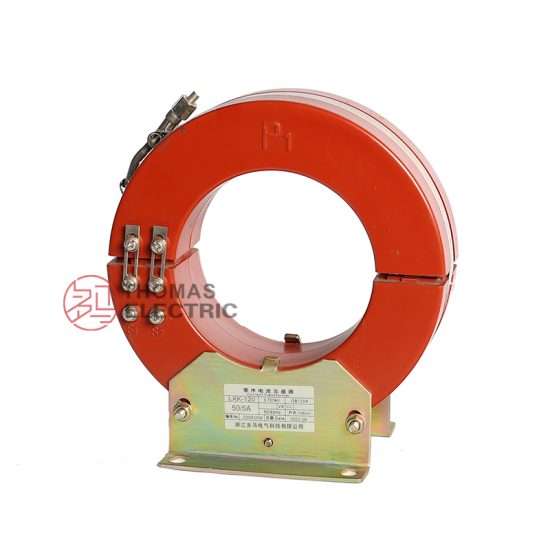
Introduction to the LXK-120 Current Transformer
The LXK-120 is a high-reliability, cast-resin insulated current transformer (CT) engineered for accurate current measurement and robust protective relay coordination in medium-voltage power systems operating at 11kV (IEC standard) or 10kV (domestic Chinese system). Designed in strict accordance with IEC 61869-2 and GB/T 20840.2, this device leverages advanced vacuum pressure impregnation (VPI) epoxy resin technology to encapsulate its magnetic core and windings, ensuring long-term dielectric integrity and environmental resilience.
Unlike traditional oil-immersed CTs, which pose fire hazards, require periodic oil sampling, and are susceptible to leakage, the LXK-120’s solid insulation eliminates these risks. The cast-resin matrix provides superior mechanical strength, excellent tracking resistance, and immunity to moisture ingress—critical for both indoor switchgear and outdoor substation applications. Its maintenance-free design significantly reduces lifecycle costs while enhancing operational safety in urban substations, industrial plants, and renewable energy interconnection points.
Operating Principle of Cast-Resin Insulation
Cast-resin insulation in the LXK-120 is achieved through a controlled VPI process where high-purity epoxy resin is vacuum-degassed and then pressure-injected around the wound core assembly. This eliminates air voids that could lead to partial discharges under sustained electrical stress. The cured resin forms a monolithic structure with a dielectric strength exceeding 20 kV/mm and a Comparative Tracking Index (CTI) greater than 600, per IEC 60112. Thermal conductivity of the resin (~0.8 W/m·K) ensures efficient heat dissipation from copper windings during overload conditions. The coefficient of thermal expansion is closely matched to that of copper and silicon steel, minimizing mechanical stress during thermal cycling between –40°C and +70°C ambient temperatures.
Advantages Over Oil-Immersed Designs
The LXK-120 eliminates flammable insulating oil, removing fire risk and environmental contamination concerns—particularly vital in confined spaces like underground substations or near sensitive infrastructure. Its solid construction resists vibration and seismic loads better than oil-filled units, with no need for conservators, breathers, or oil-level monitoring. Dielectric tests confirm a power frequency withstand voltage of 28 kV RMS for 1 minute (phase-to-earth), exceeding the IEC 61869-2 requirement for 12 kV class equipment. Additionally, the absence of liquid insulation simplifies transportation, installation, and commissioning, as no post-installation drying or degassing is required.
Typical Applications Overview
The LXK-120 serves dual roles: precision metering (accuracy classes 0.2S or 0.5S) and protective relaying (classes 5P10 or 5P20). It is commonly deployed on 11kV feeder breakers in distribution substations, generator step-up transformers in solar farms, and motor control centers in heavy industry. Its compact dimensions (typically 180 mm height × 120 mm width) allow retrofitting into legacy switchgear panels originally designed for older CT models. With a rated short-time thermal current of 20 kA for 1 second and dynamic withstand of 50 kA peak, it reliably survives fault currents without core saturation compromising relay operation.
Technical Specifications
The LXK-120 is engineered to deliver consistent performance across diverse operating environments. Below is a comprehensive specification table aligned with IEC 61869-2:
| Parameter | Value |
|---|---|
| Rated Voltage (Ur) | 11 kV (IEC) / 10 kV (GB) |
| Primary Current (Ip) | 50–3000 A (standard ratios: 100/5, 200/5, 400/1, etc.) |
| Secondary Current (Is) | 1 A or 5 A |
| Metering Accuracy Class | 0.2S, 0.5S (per IEC 61869-2) |
| Protection Accuracy Class | 5P10, 5P20 |
| Rated Output (Burden) | 5–30 VA (metering); 10–50 VA (protection) |
| Insulation Level | Power Frequency Withstand: 28 kV RMS / 1 min Lightning Impulse Withstand: 75 kV peak |
| Short-Time Thermal Current | 20 kA for 1 s (Ith) |
| Dynamic Withstand Current | 50 kA peak (Idyn) |
| Core Material | Grain-Oriented Electrical Steel (GOES), 0.3 mm thickness |
| Insulation System | VPI Epoxy Resin, UL 94 V-0 flame rating |
| Ambient Temperature Range | –40°C to +55°C (storage up to +70°C) |
| Relative Humidity | Up to 95% non-condensing |
| Altitude Limit | ≤ 1000 m above sea level (derating required above) |
Standard Service Conditions
The LXK-120 is rated for continuous operation under IEC 60060-1 standard atmospheric conditions: ambient temperature between –40°C and +55°C, relative humidity ≤95% (non-condensing), and altitude not exceeding 1000 meters. At altitudes above 1000 m, the dielectric strength decreases by approximately 1% per 100 m; thus, for installations at 2000 m, the power frequency test voltage must be reduced to 25.2 kV. The transformer maintains accuracy within ±0.1% of rated current from 1% to 120% load for 0.2S class, critical for revenue metering in utility applications. Thermal stability is ensured by limiting temperature rise to ≤60 K above ambient under rated burden.
Accuracy and Burden Characteristics
For metering applications, the LXK-120 meets IEC 61869-2 Class 0.2S requirements: composite error ≤±0.2% at 20–120% of rated current, and ≤±0.75% at 1% of rated current. Protection cores (5P20) guarantee ≤5% composite error at 20 times rated current with specified burden. Burden tolerance is ±10% of nominal VA rating; exceeding this may cause saturation during faults. Secondary terminals are rated for 10 A continuous and feature IP2X finger-safe covers to prevent accidental contact during maintenance.
Typical Applications
The LXK-120’s dual functionality makes it indispensable across modern power infrastructure. Its design accommodates both precision revenue metering and high-fidelity fault current replication for protective relays.
Substation Secondary Metering
In 11kV distribution substations, the LXK-120 provides Class 0.2S current signals to revenue-grade kWh meters and SCADA RTUs. Installed on outgoing feeders, it enables accurate billing for commercial and industrial consumers. For example, a 400/5 ratio unit feeding a 15 VA meter ensures error remains below 0.2% even at 8 A secondary current (2% of full load)—a common scenario during nighttime low-load periods. Its low phase displacement (<10 minutes at 100% load) prevents reactive energy measurement errors in three-phase systems.
Industrial Power Distribution
Heavy industries such as steel mills and chemical plants deploy the LXK-120 on motor feeder circuits rated up to 2500 kW. Here, 5P20 protection cores supply inputs to overcurrent and earth-fault relays (e.g., SEL-751). During a phase-to-phase fault drawing 15 kA primary current (37.5× rated for a 400 A CT), the core remains linear, delivering a proportional 187.5 A secondary signal (for 5 A secondary) to trip breakers within 30 ms. The cast-resin housing withstands corrosive atmospheres containing H₂S or chlorine, common in petrochemical facilities.
Renewable Energy Integration
Solar photovoltaic (PV) farms use the LXK-120 at the 11kV point of interconnection (POI). On inverter output feeders, it monitors real-time generation for grid compliance (e.g., IEEE 1547). During cloud-induced ramp events, the CT’s fast response time (<10 µs) captures transient harmonics without distortion. For anti-islanding protection, 5P10 cores feed directional overcurrent relays that detect reverse power flow during grid outages. The unit’s UV-stabilized resin resists degradation under prolonged desert sunlight exposure.
Rural and Suburban Distribution Networks
In rural electrification projects, the LXK-120 is mounted pole-top on 11kV overhead lines feeding distribution transformers. Its IP54-rated terminal box protects against dust and rain ingress. With a 100/1 ratio and 5 VA burden, it supplies data to remote terminal units (RTUs) for load profiling and outage detection. The high short-circuit withstand (20 kA/1s) handles frequent lightning-induced faults on unshielded lines. Maintenance crews appreciate its lightweight (≈8 kg) for easy handling during line upgrades.
Compliance with International Standards
The LXK-120 is certified to IEC 61869-2:2012 (“Instrument transformers – Part 2: Additional requirements for current transformers”) and fully harmonized with China’s GB/T 20840.2-2014. This dual compliance ensures global interoperability while meeting local regulatory mandates.
IEC 61869-2 Certification Details
IEC 61869-2 defines performance criteria for accuracy, thermal endurance, and dielectric strength. The LXK-120 undergoes type tests including temperature rise (≤60 K at 1.2× rated current), short-circuit withstand (20 kA/1s without deformation), and partial discharge (≤10 pC at 1.2× Ur/√3). Accuracy verification follows IEC 61869-1 Annex B, using calibrated reference standards traceable to national labs. Each production unit receives routine tests: power frequency withstand (28 kV/1 min), winding continuity, and polarity check.
Alignment with GB/T 20840.2
GB/T 20840.2 mirrors IEC 61869-2 but includes additional requirements for Chinese grid operators, such as mandatory lightning impulse testing at 75 kV (vs. IEC’s optional 75 kV for Um ≤ 12 kV). The LXK-120 exceeds both: its impulse withstand is validated at 80 kV in factory tests. Domestic certification requires type approval from CEPREI or CESI China, including seismic testing per GB/T 13540 (0.3g horizontal acceleration).
Key Differences Between IEC and GB Standards
While IEC 61869-2 permits 10 kV as a rated voltage, GB/T 20840.2 exclusively uses 10 kV for domestic systems—though the LXK-120’s 11 kV IEC rating ensures compatibility. GB standards mandate stricter pollution degree classification (III vs. IEC’s II) for coastal regions, addressed via hydrophobic resin additives. Additionally, GB requires secondary terminal labeling in Chinese characters alongside IEC symbols (e.g., “K” and “L” for polarity).
On-Site Testing Procedures
Post-installation verification ensures the LXK-120 performs within specifications. All tests follow IEC 61869-2 Clause 10 and IEEE C57.13.2 guidelines.
Insulation Resistance Test
Using a 2500 V DC megohmmeter, measure insulation resistance between primary conductor and grounded case, and between secondary windings and ground. Acceptance criterion: ≥1000 MΩ at 20°C. Values below 500 MΩ indicate moisture ingress or resin cracking. Correct for temperature using R₂₀ = Rₜ × 2^((20–t)/10). Perform before and after dielectric tests to detect insulation damage.
Turns Ratio Test
Apply 1–5 V AC to secondary winding and measure induced primary voltage (open-circuit method). Calculate ratio as V_primary/V_secondary. Tolerance: ±0.2% for metering cores, ±1% for protection cores. Alternatively, use a dedicated ratio tester injecting 10% rated primary current. Verify all taps if multi-ratio (e.g., 400/200/100/5).
Polarity Test
Connect a 1.5 V DC battery between “K” (positive) and “L” (negative) on secondary. Momentarily close the circuit while monitoring a DC voltmeter on primary. A positive kick confirms subtractive polarity (standard for IEC). Incorrect polarity causes watt-hour meter reversal or relay misoperation. Repeat three times to eliminate contact bounce artifacts.
Power Frequency Withstand Voltage Test
Apply 28 kV RMS at 50 Hz between primary and grounded case for 1 minute. Use a calibrated test transformer with overcurrent trip set at 10 mA. No flashover or disruptive discharge is permitted. Reduce voltage gradually post-test to avoid resonant overvoltages. This test validates resin integrity after transport-induced microcracks.
Excitation (Saturation) Characteristic Test
Inject increasing AC current into secondary (primary open) while measuring voltage. Plot volts vs. amps to identify knee-point voltage (Vk). For 5P20 cores, Vk must exceed 20×(Is×Zb + 0.1×Rct), where Zb is burden impedance and Rct is winding resistance. Typical Vk for LXK-120: ≥150 V at 5 A secondary. Low Vk indicates core remanence or lamination damage.
Preventive Maintenance Guide
Though maintenance-free by design, periodic checks extend service life beyond 30 years.
Annual Visual and Functional Inspection
Inspect for surface cracks, tracking marks, or discoloration on resin housing. Clean with dry cloth—never solvents. Verify terminal tightness (torque: 2.5 N·m for M6 screws). Check grounding continuity (<0.1 Ω resistance). Test secondary circuit insulation annually: ≥1 MΩ at 500 V DC. Record excitation curves every 5 years to detect core aging.
Maintenance Intervals and Fault Diagnosis
| Interval | Action |
|---|---|
| Annually | Visual inspection, terminal torque check, ground continuity |
| Every 5 Years | Insulation resistance, turns ratio, excitation curve |
| After Major Fault | Full suite: ratio, polarity, withstand voltage, PD test |
Common faults include secondary open-circuit (causing dangerous overvoltage), core saturation from incorrect burden, or moisture ingress at terminal seals. Symptoms: overheating (>80°C surface), abnormal hum, or metering drift. Replace if partial discharge exceeds 20 pC at operating voltage.
Conclusion
The LXK-120 11kV cast-resin current transformer represents a benchmark in reliability, accuracy, and compliance for modern power systems. By integrating GOES silicon steel cores with VPI epoxy resin encapsulation, it achieves exceptional thermal stability, dielectric strength, and environmental resilience—outperforming legacy oil-immersed designs in safety and lifecycle cost. Its dual certification to IEC 61869-2 and GB/T 20840.2 ensures seamless deployment across international and domestic grids, from urban substations to remote renewable sites. Rigorous factory testing guarantees adherence to tight tolerances: ±0.2% ratio error for metering, 5% composite error at 20× overcurrent for protection, and 28 kV power frequency withstand. With a design life exceeding 30 years under standard service conditions, the LXK-120 minimizes replacement cycles while maximizing measurement fidelity and protection dependability. Utilities and industrial operators benefit from its compact form factor, which facilitates retrofitting into existing switchgear without panel modifications. As grid complexity grows with distributed generation and digital substations, the LXK-120’s proven performance provides a foundational element for accurate energy accounting and robust fault management.