Article Content
SZW-6 11kV Cast-Resin Voltage Transformer for Substation Metering and Protection – IEC 61869-3 Certified
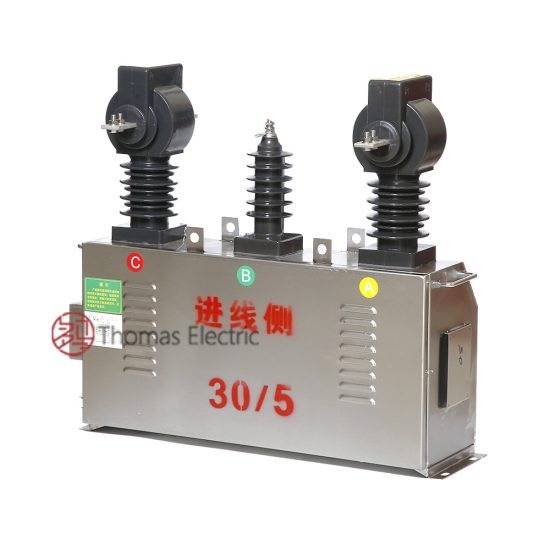
Introduction to the SZW-6 Voltage Transformer
The SZW-6 is a single-phase, indoor/outdoor-rated cast-resin voltage transformer (VT) engineered for high-reliability applications in medium-voltage power systems operating at 11kV (IEC nominal) or 10kV (domestic system equivalent). Designed in strict accordance with IEC 61869-3 and GB/T 20840.3, this instrument transformer provides accurate voltage transformation for both metering and protective relaying functions in distribution substations, industrial facilities, and renewable energy interconnection points.
Operating Principle of Cast-Resin Insulation
Cast-resin insulation in the SZW-6 employs vacuum pressure impregnation (VPI) epoxy resin technology to fully encapsulate the primary and secondary windings along with the magnetic core. This process eliminates air voids and moisture ingress pathways, resulting in superior dielectric strength and long-term partial discharge resistance. The epoxy matrix exhibits excellent thermal conductivity (0.2–0.3 W/m·K), enabling efficient heat dissipation during continuous operation under rated load. Unlike oil-filled designs, the solid dielectric system requires no maintenance related to fluid levels or gas monitoring, significantly reducing lifecycle costs. The resin formulation is UV-stabilized and hydrophobic, ensuring stable performance even in outdoor coastal or high-humidity environments up to 95% relative humidity.
Advantages Over Oil-Immersed Designs
Compared to traditional oil-immersed VTs, the SZW-6 offers critical operational and safety benefits. The absence of flammable insulating oil eliminates fire hazards, making it suitable for indoor installations near personnel or sensitive equipment—particularly in urban substations or commercial buildings. Its compact footprint (typically 30–40% smaller than equivalent oil units) allows for denser switchgear layouts. Additionally, the cast-resin construction provides mechanical robustness against seismic activity (tested per IEC 60068-2-57) and vibration from nearby transformers or circuit breakers. Environmental compliance is enhanced as there is no risk of oil leakage contaminating soil or groundwater, aligning with ISO 14001 sustainability protocols. The unit’s weight is also reduced by approximately 25%, simplifying handling and mounting during installation.
Typical Applications Overview
The SZW-6 is deployed across diverse electrical infrastructure where precision voltage measurement and system protection are paramount. Primary use cases include 11kV/10kV distribution substations for revenue metering (Class 0.2 or 0.5 accuracy) and overvoltage/undervoltage protection (Class 3P or 6P). It is equally suited for industrial plants requiring harmonic-resistant VTs for power quality monitoring, as well as solar PV or wind farm collector systems interfacing with grid-tied inverters. The transformer’s dual secondary windings (e.g., 100/√3 V and 100/3 V) support simultaneous metering and protection circuits without cross-interference, a key requirement in modern digital substation architectures compliant with IEC 61850 communication standards.
Technical Specifications
The SZW-6 voltage transformer delivers precise performance under defined electrical and environmental parameters, ensuring compatibility with global grid requirements while accommodating regional variations such as the 10kV domestic standard commonly used in China.
Rated Electrical Parameters
Key electrical ratings for the SZW-6 include a system voltage of 11kV (IEC) / 10kV (GB), with a highest voltage for equipment (Um) of 12kV. The standard voltage ratio is 11,000/√3 V : 100/√3 V for metering and 11,000/√3 V : 100/3 V for protection, though custom ratios are available. Accuracy classes comply with IEC 61869-3: Class 0.2 (metering, burden ≤ 30 VA) and Class 3P (protection, burden ≤ 100 VA). Rated outputs are typically 50 VA (metering) and 100 VA (protection) at cos φ = 0.8 lagging. The thermal short-time current withstand capability is 1 second at 25 times rated primary voltage under open-circuit conditions. Insulation levels meet IEC 60071-1: power frequency withstand voltage of 28 kV rms for 1 minute and lightning impulse withstand voltage of 75 kV peak (1.2/50 μs waveform).
Environmental and Mechanical Ratings
The SZW-6 operates reliably under standard service conditions defined by IEC 60060-1: ambient temperature range of –25°C to +40°C (with derating above +40°C), relative humidity up to 95% non-condensing, and installation altitude not exceeding 1,000 meters above sea level (with 1% dielectric strength reduction per 100 m above 1,000 m). The enclosure is rated IP00 for indoor switchgear mounting but can be supplied with IP23 protection for outdoor pole-top or pad-mounted applications. Terminal markings follow IEC 61869-3 polarity conventions (reducing polarity: A–a, N–n), with primary terminals rated for 630 A short-time current and secondary terminals using M6 stainless steel studs compatible with 2.5–6 mm² copper conductors. The core is constructed from grain-oriented electrical steel (GOES) with a maximum flux density of 1.6 T at rated voltage, minimizing hysteresis losses and ensuring linearity under transient overvoltages.
Burden and Accuracy Performance
Accuracy performance is critically dependent on connected burden. At 25% to 100% of rated burden, the SZW-6 maintains voltage error within ±0.2% and phase displacement within ±10 minutes for Class 0.2. For protection class 3P, voltage error remains within ±3% and phase error within ±120 minutes across 25–100% burden. Under 1.2× rated voltage (steady-state overvoltage condition), the transformer exhibits less than 5% increase in magnetizing current, preventing saturation-induced distortion. Harmonic content in the secondary output is limited to THD < 2% when primary voltage contains up to 5% 3rd harmonic—a common scenario in networks with nonlinear loads.
On-Site Testing Procedures
Post-installation verification ensures the SZW-6 operates within specified tolerances before energization of the primary system.
Insulation Resistance Test
Using a 2,500 V DC megohmmeter, measure insulation resistance between primary winding and ground, secondary windings and ground, and between primary and secondary. Acceptance criteria: ≥ 1,000 MΩ at 20°C. Correct for temperature using RT2 = RT1 × 2(T1–T2)/10. Values below 500 MΩ indicate moisture ingress or resin cracking and require drying or replacement.
Turns Ratio Test
Apply a low-voltage AC source (50–100 V) to the primary and measure secondary voltage with a calibrated true-RMS meter. Calculate ratio as Vp/Vs. Tolerance: ±0.25% of nominal ratio. For 11,000/√3 : 100/√3, expected secondary is 100 V ±0.25 V at 11,000 V primary equivalent. Deviations >0.5% suggest winding shorts or incorrect tap selection.
Polarity Verification
Connect a 6–12 V battery between primary terminals A and N. Momentarily close the circuit while monitoring secondary terminals a and n with a DC voltmeter. A positive deflection confirms reducing polarity (standard for IEC). Reversed polarity indicates incorrect internal wiring and must be corrected before commissioning to prevent relay misoperation.
Power Frequency Withstand Test
Apply 28 kV rms at 50 Hz between primary and ground (secondaries shorted and grounded) for 1 minute. No flashover or disruptive discharge should occur. Use a calibrated test transformer with overcurrent protection set to 1.5× expected capacitive current (typically 10–20 mA for SZW-6). This verifies dielectric integrity after transport and installation stresses.
Open-Circuit Characteristic Test
With secondary open, gradually increase primary voltage from 20% to 120% of rated value while recording excitation current. Plot Vp vs. Iexc. The knee point should occur above 110% Un, indicating adequate margin against saturation during overvoltages. Magnetizing current at 100% Un must be ≤ 0.5% of rated primary current (≈15 mA for 11kV/0.1A base).
Preventive Maintenance Guide
Although cast-resin VTs require minimal maintenance, periodic checks extend service life and prevent unexpected failures.
Annual Visual and Functional Inspection
Inspect for surface tracking, cracks, or discoloration on the resin housing—indicative of partial discharge activity. Clean terminals with isopropyl alcohol to remove salt or dust deposits. Verify torque on secondary connections (8–10 N·m for M6 studs). Perform insulation resistance and ratio tests annually; trend data should show <5% variation year-over-year. Any sudden change warrants immediate investigation.
Five-Year Comprehensive Maintenance
Every 60 months, conduct partial discharge measurement using IEC 60270 methods. Acceptable level: ≤15 pC at 1.2 Um/√3. Also, re-verify accuracy under simulated burden conditions using a portable calibrator. Replace units exhibiting accuracy drift beyond half the class limit (e.g., >±0.1% for Class 0.2). Check mounting hardware for corrosion, especially in coastal zones.
Maintenance Intervals and Fault Diagnosis
| Interval | Task | Acceptance Criteria |
|---|---|---|
| Annually | IR test, visual inspection | IR ≥ 1,000 MΩ; no physical damage |
| 5 Years | PD test, accuracy verification | PD ≤15 pC; error within class limits |
| After Fault | Full suite of commissioning tests | All parameters within initial specs |
Common faults include secondary winding opens (detected by infinite IR) or core saturation (evidenced by excessive excitation current). Resin delamination requires unit replacement as field repair is impractical.
Conclusion
The SZW-6 11kV cast-resin voltage transformer represents a benchmark in reliability, accuracy, and compliance for modern power systems. By leveraging advanced VPI epoxy resin technology and GOES silicon steel cores, it delivers exceptional dielectric strength, thermal stability, and metrological precision over a service life of 25–30 years. Its dual compliance with IEC 61869-3 and GB/T 20840.3 ensures seamless integration into both international and domestic grids, supporting critical functions from revenue metering to high-speed protection. The elimination of flammable fluids enhances safety in confined spaces, while the compact, maintenance-free design reduces total cost of ownership. Rigorous factory and field testing protocols guarantee performance consistency under real-world stressors—including harmonics, transients, and extreme climates. As distribution networks evolve toward smarter, more resilient architectures, the SZW-6 provides a future-proof foundation for accurate voltage sensing, enabling utilities and industrial users to meet increasingly stringent operational and regulatory demands. Its proven track record across thousands of installations worldwide underscores its role as an indispensable component in reliable power delivery infrastructure.