Article Content
IEC 61869-3 Certified 11kV Voltage Transformer SZW-35 for Metering & Protection Applications
Introduction to the SZW-35 Voltage Transformer
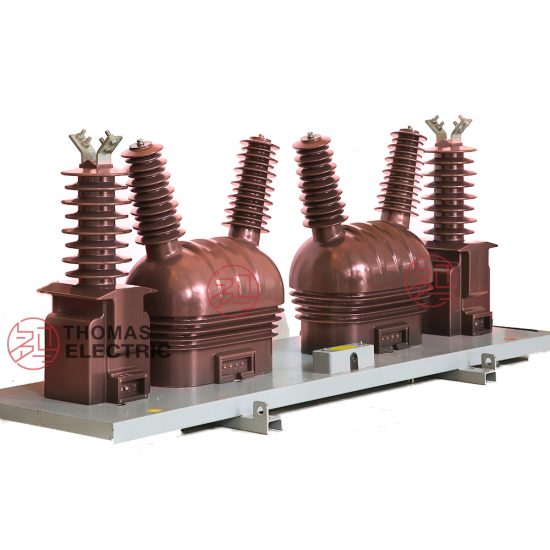
The SZW-35 is a single-phase, indoor/outdoor rated, cast-resin insulated voltage transformer (VT) designed for accurate voltage measurement and reliable protective relay operation in medium-voltage power systems operating at 11kV (IEC standard) or 10kV (domestic Chinese system). As a critical component in secondary instrumentation circuits, the SZW-35 provides galvanic isolation between high-voltage primary conductors and low-voltage metering or protection devices, ensuring operator safety and system integrity.
Cast-resin insulation technology—specifically vacuum pressure impregnation (VPI) with cycloaliphatic epoxy resin—forms the foundation of the SZW-35’s robust dielectric performance. Unlike traditional oil-immersed VTs, which pose fire hazards and require containment measures, the solid dielectric construction eliminates flammability risks, reduces maintenance overhead, and enables compact installation in space-constrained environments such as ring main units (RMUs), prefabricated substations, and indoor switchgear.
Operating Principle of Cast-Resin Insulation
The SZW-35 employs a dry-type design where both primary and secondary windings are fully encapsulated in a homogeneous matrix of flame-retardant, cycloaliphatic epoxy resin under vacuum and pressure. This VPI process ensures complete void elimination, preventing partial discharge inception even under transient overvoltages. The resin exhibits excellent tracking resistance (CTI > 600 V per IEC 60112), UV stability for outdoor use, and thermal class F (155°C) insulation capability. The absence of liquid dielectrics eliminates leakage concerns and simplifies environmental compliance.
Advantages Over Oil-Immersed Designs
Compared to oil-filled VTs, the SZW-35 offers superior fire safety (compliant with IEC 60695-2-1 for glow-wire ignition testing), lower lifecycle costs due to zero oil monitoring or replacement, and immunity to moisture ingress—a common failure mode in humid climates. Its lightweight construction (typically 35–45 kg) facilitates handling without cranes, and the absence of conservator tanks allows vertical or horizontal mounting. Additionally, cast-resin VTs exhibit faster thermal response during overload conditions, enabling more precise thermal modeling in digital protection schemes.
Typical Application Overview
The SZW-35 is engineered for dual-purpose use: Class 0.2 or 0.5 accuracy for revenue metering and Class 3P or 6P for protective relaying per IEC 61869-3. It is commonly deployed in 11kV distribution feeders, industrial plant switchyards, wind/solar collector substations, and urban underground networks. Its compact footprint (approx. 380 mm height × 220 mm base) suits retrofit projects where legacy oil units are being replaced.
Technical Specifications
The SZW-35 adheres to stringent electrical and mechanical parameters defined by IEC 61869-3 and GB/T 20840.3, ensuring interoperability across global and domestic grids. Key specifications are detailed below:
| Parameter | Value |
|---|---|
| Primary Rated Voltage (Ur) | 11 kV (IEC) / 10 kV (GB) |
| Secondary Rated Voltage | 100 V or 100/√3 V (line-to-neutral) |
| Voltage Ratio | 11000/100 V or 11000/100/√3 V |
| Accuracy Class (Metering) | 0.2, 0.5 |
| Accuracy Class (Protection) | 3P, 6P |
| Rated Output (per burden) | 10–100 VA (configurable) |
| Insulation Level (LI/AC) | 75 kV / 28 kV (1 min) |
| Short-Time Thermal Withstand | 1 second at 10× rated current |
| Core Material | Grain-Oriented Electrical Steel (GOES), 0.23 mm thickness |
| Insulation System | VPI cycloaliphatic epoxy resin, Class F (155°C) |
| Polarity | Reducing polarity (standard) |
| Ambient Temperature Range | −25°C to +40°C (indoor); −40°C to +45°C (outdoor variant) |
| Relative Humidity | Up to 95% non-condensing |
| Maximum Altitude | 1000 m above sea level (derating required above) |
Rated Voltage and System Compatibility
The SZW-35 is rated for 11kV systems per IEC 60038, corresponding to a maximum system voltage of 12kV. In China, it operates on nominal 10kV networks (max 11.5kV), maintaining accuracy within ±0.2% for Class 0.2 under 80–120% of rated voltage. The transformer supports both grounded-wye (100/√3 V secondary) and delta (100 V line-to-line) configurations, enabling flexible integration into three-phase metering banks.
Accuracy and Burden Characteristics
For metering applications, the SZW-35 achieves composite error ≤0.2% at 25–100% of rated burden (e.g., 30 VA) and power factor 0.8 lagging. Protection classes (3P/6P) guarantee voltage error ≤3% or ≤6% and phase displacement ≤120’ or ≤240’, respectively, under fault conditions up to 190% of rated voltage. Burden must not fall below 25% of rated VA to avoid resonance-induced overvoltages.
Environmental and Mechanical Ratings
Housed in a UV-stabilized resin body with silicone rubber sheds for outdoor models, the SZW-35 meets IP00 (indoor) or IP23 (outdoor) ingress protection. Terminal blocks comply with IEC 61869-1 for creepage distance (≥20 mm/kV for 11kV). Mounting uses M12 stainless steel bolts; seismic withstand is 0.3g horizontal per IEC 60068-2-57.
Typical Applications
The SZW-35 serves diverse roles across modern power infrastructure, leveraging its dual-accuracy capability and robust construction.
Substation Secondary Metering
In 11kV/0.4kV distribution substations, the SZW-35 feeds kWh meters, demand recorders, and power quality analyzers. Its Class 0.2 accuracy ensures billing compliance per regulatory standards (e.g., EN 50470). For three-phase systems, three units form a wye-connected bank, providing phase-to-ground voltages for neutral displacement monitoring. The low phase error (<10 arcmin at 0.2 class) minimizes reactive energy measurement drift.
Industrial Power Distribution
Within manufacturing facilities, the SZW-35 interfaces with motor protection relays (e.g., 27/59 functions) and SCADA systems. Its 3P-class output reliably triggers undervoltage tripping during grid sags, while the cast-resin body resists chemical fumes and dust common in steel mills or cement plants. A typical 10 MVA plant may deploy six SZW-35 units across incomer and feeder bays.
Renewable Energy Integration
Solar farms and wind parks use the SZW-35 in collector substation switchgear to monitor grid synchronization voltage. During islanding events, its fast response (<20 ms rise time) enables anti-islanding relays to detect voltage deviations per IEEE 1547. The outdoor-rated version withstands coastal salt spray (tested per IEC 60068-2-52), critical for offshore wind connections.
Rural and Suburban Distribution Networks
In remote areas with limited maintenance access, the SZW-35’s maintenance-free design ensures decades of service. Mounted on pole-top platforms or pad-mounted switchgear, it supplies voltage signals to recloser controls and fault indicators. Its wide temperature tolerance prevents accuracy drift in desert (day/night ΔT > 50°C) or alpine climates.
Urban Underground Networks
Compact city substations utilize the SZW-35’s small footprint to fit within vaults alongside RMUs. Fire safety is paramount here; the self-extinguishing resin meets IEC 60754-2 for low halogen emission, protecting personnel during cable faults.
Compliance with International Standards
The SZW-35 is engineered to satisfy both global and regional regulatory frameworks, ensuring seamless deployment across markets.
IEC 61869-3 Certification Details
Per IEC 61869-3:2011, the SZW-35 undergoes type tests including temperature rise (≤60 K for resin), short-circuit withstand (10× In for 1 s), and impulse voltage (75 kV BIL). Routine tests cover ratio error, polarity, and insulation resistance (>1000 MΩ at 2500 V DC). The standard mandates that protection-class VTs maintain accuracy up to 190% Ur—verified via open-circuit testing at elevated voltages.
Alignment with GB/T 20840.3
China’s GB/T 20840.3 mirrors IEC 61869-3 but specifies 10kV as nominal voltage and requires additional seismic testing (0.2g vertical). The SZW-35’s domestic variant includes extended creepage (25 mm/kV) for polluted environments (Class III per GB/T 5582). Accuracy verification uses Chinese national standards (JJG 314) with tighter phase error limits for Class 0.2 (≤5 arcmin).
Key Differences Between IEC and Domestic Requirements
While IEC focuses on functional performance, GB standards emphasize environmental resilience. For example, GB/T 20840.3 mandates 1000-hour salt fog testing for outdoor units, whereas IEC references generic IEC 60068 series. Additionally, Chinese utilities often require secondary terminals rated for 600 V insulation—exceeding IEC’s 300 V—addressed in the SZW-35 via reinforced terminal housings.
On-Site Testing Procedures
Post-installation verification ensures the SZW-35 performs within specification before energization.
Insulation Resistance Test
Using a 2500 V DC megohmmeter, measure resistance between primary winding and ground, and between primary and secondary windings. Acceptance criterion: ≥1000 MΩ at 20°C. Correct for temperature using RT = R20 × 2(20−T)/10. Low readings indicate moisture ingress or resin cracking—requiring drying or replacement.
Turns Ratio Test
Apply 100–200 V AC to the primary and measure secondary voltage. Calculate ratio = Vp/Vs. Tolerance: ±0.2% for Class 0.2, ±0.5% for Class 0.5. Use a precision voltmeter (0.1% accuracy) and ensure burden is disconnected. Deviations suggest inter-turn shorts or incorrect tap selection.
Polarity Verification
Connect a 6–12 V battery momentarily between primary terminals (H1+, H2−). Observe secondary voltage polarity with a DC voltmeter: positive deflection at X1 confirms reducing polarity. Incorrect polarity causes 180° phase shift, leading to false directional relay operation.
Power Frequency Withstand Voltage Test
Apply 28 kV RMS (50 Hz) between primary and grounded secondary/core for 1 minute. Leakage current must remain <1 mA. Gradually ramp voltage to avoid transient overstress. Failure indicates insulation degradation—common after transport damage.
Open-Circuit Characteristic Test
With secondary open, apply 10–190% of rated primary voltage and record excitation current. Plot V vs. I curve; knee point should exceed 150% Ur. Excessive magnetizing current at nominal voltage suggests core saturation due to mechanical shock during shipping.
Preventive Maintenance Guide
Though maintenance-free by design, periodic checks extend service life beyond 30 years.
Annual Visual and Functional Inspection
Inspect for surface cracks, tracking marks, or discoloration on the resin body. Clean with dry cloth—never solvents. Verify terminal tightness (torque: 15 N·m for M6 screws). Perform ratio and polarity spot-checks if system anomalies occur (e.g., unexplained meter drift). Record insulation resistance annually; a 50% drop warrants investigation.
Five-Year Comprehensive Maintenance
Conduct full suite of tests: insulation resistance, ratio, polarity, and open-circuit curve. Check mounting hardware for corrosion. In coastal zones, inspect for salt deposits on sheds—clean with deionized water if conductivity >10 μS/cm. Replace gaskets on outdoor terminal covers if hardened.
Fault Diagnosis and Troubleshooting
Common issues include blown secondary fuses (indicating burden short-circuit) or erratic meter readings (suggesting loose connections). If insulation resistance falls below 500 MΩ, bake the unit at 80°C for 24 hours in a controlled oven. Persistent ratio errors require factory recalibration—core realignment is not field-serviceable.
Conclusion
The SZW-35 11kV cast-resin voltage transformer represents a benchmark in medium-voltage instrumentation, combining IEC 61869-3 certified accuracy with the inherent safety and reliability of solid-dielectric technology. Its dual-role capability—supporting both Class 0.2 metering and Class 3P/6P protection—eliminates the need for separate transformers, reducing capital expenditure and panel space. The use of GOES core material minimizes no-load losses (<15 W typical), while VPI epoxy resin ensures decades of operation without degradation, even in harsh environments ranging from arid deserts to humid tropics. Compliance with both international (IEC) and domestic (GB) standards guarantees interoperability across global supply chains and utility networks. With a design life exceeding 25–30 years under normal service conditions, the SZW-35 delivers exceptional lifecycle value through zero fluid maintenance, fire-safe construction, and resilient performance against switching surges and temporary overvoltages. For engineers specifying instrumentation in 11kV distribution systems, the SZW-35 provides a technically rigorous, standards-aligned solution that meets the evolving demands of smart grids, renewable integration, and urban electrification.