Article Content
11kV Cast-Resin Voltage Transformer JLS-20K for Metering and Protection – IEC 61869-3 Standard
Introduction to the JLS-20K Voltage Transformer
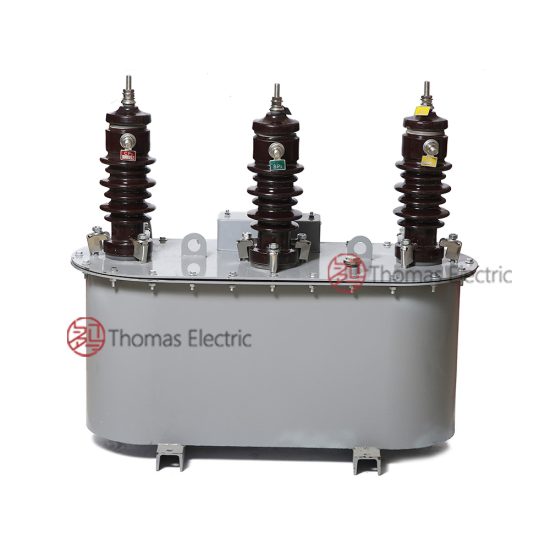
The JLS-20K is a single-phase, outdoor-rated, cast-resin insulated voltage transformer (VT) engineered for precision metering and protective relaying in medium-voltage distribution systems operating at nominal system voltages of 20kV (domestic designation) or 21kV (IEC standard). Designed in strict compliance with IEC 61869-3 and GB/T 20840.3, this instrument transformer leverages advanced vacuum pressure impregnation (VPI) epoxy resin technology to deliver superior dielectric performance, environmental resilience, and long-term stability under demanding utility conditions.
Operating Principle of Cast-Resin Insulation
Cast-resin insulation in the JLS-20K employs a high-purity cycloaliphatic epoxy resin system processed under vacuum and pressure to eliminate voids and moisture ingress pathways. The primary and secondary windings are fully encapsulated within this solid dielectric matrix, which provides uniform electric field distribution and eliminates partial discharge activity below 10 pC at rated voltage—well within IEC 61869-3 limits. Unlike oil-filled counterparts, the solid insulation eliminates fire hazards, reduces maintenance overhead, and prevents leakage-related failures. The resin’s coefficient of thermal expansion closely matches that of copper conductors and GOES (grain-oriented electrical steel) core laminations, minimizing mechanical stress during thermal cycling between –40°C and +40°C ambient temperatures.
Advantages Over Oil-Immersed Designs
Compared to traditional oil-immersed VTs, the JLS-20K offers significant operational and safety benefits. Its dry-type construction eliminates flammability risks, making it suitable for urban substations, indoor switchgear, and environmentally sensitive zones. The absence of oil also removes the need for periodic oil sampling, degassing, or tank integrity checks. Furthermore, the compact footprint—enabled by higher dielectric strength of epoxy resin (~20 kV/mm vs. ~12 kV/mm for mineral oil)—facilitates easier integration into space-constrained installations. Accelerated aging tests per IEC 60060 confirm a service life exceeding 30 years under continuous load, with no degradation in ratio error or phase displacement over time due to stable resin chemistry and hermetic sealing against humidity.
Typical Applications Overview
The JLS-20K is primarily deployed in 20kV/21kV distribution networks where accurate voltage measurement and reliable fault detection are critical. Common use cases include utility revenue metering at distribution substations, feeder protection in ring-main units, and synchronization monitoring in distributed generation interconnection points. Its robust design supports both V/V (open-delta) and Y/y (wye-wye) secondary configurations, enabling flexible integration into three-phase systems using two single-phase units. The transformer’s low burden requirement (as low as 1 VA at 0.5 accuracy class) ensures compatibility with modern digital meters and protective relays without requiring auxiliary power supplies.
Technical Specifications
The JLS-20K voltage transformer is engineered to meet stringent electrical and environmental performance criteria defined by international and national standards. Below is a comprehensive specification table followed by detailed contextual explanations.
| Parameter | Value |
|---|---|
| System Voltage (IEC) | 21 kV |
| System Voltage (Domestic) | 20 kV |
| Primary Voltage Rating | 21 / √3 kV (for line-to-ground application) |
| Secondary Voltage Ratio | 100 / √3 V or 110 / √3 V (customizable) |
| Accuracy Class (Metering) | 0.2, 0.5 |
| Accuracy Class (Protection) | 3P, 6P |
| Rated Output (Burden) | 10 VA, 15 VA, 30 VA (per secondary winding) |
| Insulation Level (LI/AC) | 125 kV / 50 kV (1.2/50 μs impulse & 1 min power frequency) |
| Core Material | GOES (Grain-Oriented Electrical Steel), 0.27 mm thickness |
| Insulation System | VPI Epoxy Resin, UL 94 V-0 flame rating |
| Ambient Temperature Range | –40°C to +40°C |
| Maximum Altitude | 1000 m above sea level (derating required beyond) |
| Pollution Degree | IV (Heavy industrial/coastal environments) |
Electrical Performance Parameters
The JLS-20K maintains ratio error within ±0.2% and phase displacement below ±10 minutes at 0.2 accuracy class when loaded at 25–100% of rated burden. For protection applications (3P/6P classes), composite error remains under 3% or 6% respectively at 5× rated voltage. The transformer exhibits low magnetizing current (<0.5% of rated primary current at 1.2× Un), ensuring minimal impact on system grounding during single-phase-to-ground faults. Thermal stability is validated through temperature-rise tests per IEC 61869-3: average winding rise ≤55 K above ambient at 1.2× rated output for 8 hours.
Environmental and Mechanical Ratings
Designed for outdoor pole or platform mounting, the JLS-20K features a UV-stabilized epoxy housing with creepage distance ≥31 mm/kV (meeting pollution degree IV per IEC 60815). The terminal box includes IP54-rated cable glands and stainless-steel hardware resistant to salt spray corrosion (ASTM B117 tested for 1000 hours). Weight is approximately 45 kg, with mounting dimensions standardized to DIN 42501 for interchangeability with legacy oil-filled units. No special foundation is required; direct bolt-on installation to crossarms or brackets suffices.
Typical Applications
The JLS-20K voltage transformer serves diverse roles across modern power infrastructure, leveraging its precision, reliability, and environmental robustness.
Substation Secondary Metering
In 20kV/21kV distribution substations, two JLS-20K units are typically connected in V/V configuration to provide line-to-line secondary voltages for three-phase kWh metering. This arrangement reduces equipment count while maintaining accuracy within ±0.5% across 10–120% of rated voltage. The low burden (e.g., 10 VA at 0.5 class) ensures compatibility with solid-state meters like those from Landis+Gyr or Itron without signal distortion. Revenue-grade installations often specify 0.2 accuracy class with calibrated test windings for on-site verification—eliminating the need for costly transformer replacement during meter audits.
Industrial Power Distribution
Large manufacturing facilities with dedicated 20kV feeders use the JLS-20K for both energy billing and motor protection. In steel mills or chemical plants, where harmonic distortion is prevalent, the GOES core minimizes hysteresis losses, while the resin insulation resists tracking from airborne contaminants. The VT’s 3P accuracy class enables precise undervoltage/overvoltage relay coordination (e.g., with SEL-351S relays), tripping within 20 ms during sags or swells that could damage sensitive process equipment.
Renewable Energy Integration
Solar farms and wind parks connecting to 20kV grids rely on the JLS-20K for grid-synchronization and anti-islanding protection. During cloud-induced irradiance fluctuations, rapid voltage transients must be accurately captured; the JLS-20K’s flat frequency response (±0.1% error from 45–55 Hz) ensures correct operation of synchrocheck relays. Its immunity to DC offset—critical during inverter fault ride-through—prevents saturation, unlike some oil-filled designs with lower knee-point voltages.
Rural and Suburban Distribution Networks
In remote areas with extended feeder lengths, the JLS-20K’s lightweight design simplifies helicopter or manual pole-top installation. Its maintenance-free operation is ideal for regions with limited technical staff. When used with automated meter reading (AMR) systems, the consistent secondary output enables accurate load profiling even under light-load conditions (down to 1% of rated voltage), supporting demand-side management initiatives by utilities.
Backup Protection in Ring-Main Units
Within SF6-insulated ring-main units (RMUs), the JLS-20K provides voltage signals for earth-fault detection in compensated (Petersen coil) or ungrounded systems. Its high insulation withstand (125 kV LI) ensures survival during switching surges common in cable-heavy networks. The compact size allows integration alongside load-break switches without enlarging the RMU footprint—a key advantage over bulkier oil types.
Compliance with International Standards
The JLS-20K is certified to both global and Chinese national standards, ensuring interoperability and regulatory acceptance worldwide.
IEC 61869-3 Compliance Details
IEC 61869-3 governs the performance, testing, and marking of inductive voltage transformers. The JLS-20K meets all mandatory clauses, including: ratio error and phase displacement limits across burden ranges; temperature-rise limits under continuous and short-time overload; and dielectric tests at 1.2× Um for 1 minute (50 kV AC) and lightning impulse (125 kV peak). Partial discharge levels are measured per IEC 60270 and held below 5 pC at 1.2× Um/√3—exceeding the 10 pC maximum allowed. Markings include rated voltage factor (1.2 for continuous, 1.5 for 30 s), accuracy class, and vector group (typically “–” for single-phase).
GB/T 20840.3 Alignment
China’s GB/T 20840.3 mirrors IEC 61869-3 but includes additional requirements for domestic grid conditions. The JLS-20K complies with GB-specific creepage distances (≥25 mm/kV for 20kV class), seismic withstand (0.3g horizontal acceleration), and short-circuit current endurance (25 kA for 1 s). Notably, GB/T 20840.3 mandates dual secondary windings for metering and protection in many utility tenders—a configuration readily available in the JLS-20K with isolated 0.2/3P outputs.
Key Differences Between IEC and Domestic Standards
While IEC 61869-3 permits a rated voltage factor of 1.9 for 8 hours in ungrounded systems, GB/T 20840.3 restricts this to 1.5 for 30 seconds—reflecting China’s predominantly resonant-grounded 20kV networks. Consequently, the JLS-20K is optimized for 1.5× overvoltage duty, with core cross-section sized to avoid saturation at 31.5 kV (1.5 × 21 kV). Additionally, GB standards require type tests for pollution performance per DL/T 729, which the JLS-20K passes via inclined-plane tracking tests at 4.5 kV.
On-Site Testing Procedures
Post-installation verification ensures the JLS-20K performs within specified tolerances before commissioning.
Insulation Resistance Test
Using a 2500 V DC megohmmeter, measure insulation resistance between primary winding and ground, and between primary and secondary windings. Acceptance criterion: ≥1000 MΩ at 20°C. Correct for temperature using RT = R20 × 2(20–T)/10. Values below 500 MΩ indicate moisture ingress or resin cracking and warrant further investigation via tan delta testing.
Turns Ratio Test
Apply a low-voltage AC source (e.g., 100 V) to the primary and measure secondary voltage. Calculate actual ratio and compare to nameplate. Tolerance: ±0.2% for 0.2 class, ±0.5% for 0.5 class. Use a precision ratio bridge (e.g., Omicron CT Analyzer) for best accuracy. Deviations beyond tolerance suggest turn-to-turn shorts or incorrect tap selection.
Polarity Test
Verify reducing polarity per IEC 61869-3: momentarily connect a 6 V battery across primary terminals (H1+, H2–). A DC voltmeter across secondary (X1+, X2–) should show a positive kick. Incorrect polarity causes 180° phase reversal, leading to metering errors or relay misoperation in directional schemes.
Power Frequency Withstand Voltage Test
Apply 50 kV RMS at 50 Hz between primary and grounded secondary/core for 1 minute. Monitor for flashover or excessive current (>10 mA). This validates insulation integrity after transport stresses. Do not perform if partial discharge tests were conducted recently, as cumulative stress may degrade resin.
Open-Circuit Characteristic Test
Gradually increase primary voltage from 0 to 1.5× rated (31.5 kV) while measuring secondary voltage and excitation current. Plot Vs vs. Iexc. Knee-point voltage should exceed 1.8× rated secondary voltage. A sharp current rise below this indicates core saturation—unacceptable for protection applications.
Preventive Maintenance Guide
Although cast-resin VTs require minimal upkeep, scheduled inspections extend service life and prevent unexpected outages.
Annual Visual and Electrical Inspection
Inspect housing for cracks, UV degradation, or tracking marks. Clean terminals with isopropyl alcohol; torque bolts to 25 N·m. Perform insulation resistance and ratio tests annually. Record trends: a 20% drop in insulation resistance over two years suggests seal failure. Check grounding continuity (<0.1 Ω resistance).
Five-Year Comprehensive Maintenance
Every 60 months, conduct partial discharge mapping at 1.2× Um/√3 using IEC 60270-compliant sensors. Acceptable: <5 pC. Also verify burden compatibility—modern digital meters may present non-linear loads causing harmonic distortion. Recalibrate if ratio error drifts >50% of class limit.
Maintenance Intervals and Fault Diagnosis
| Interval | Action | Fault Indicator |
|---|---|---|
| Annually | IR test, visual check | IR <500 MΩ → moisture ingress |
| Every 5 years | PD test, burden verification | PD >10 pC → internal voids |
| After fault event | Ratio & polarity test | Error shift → winding damage |
Common failures include terminal corrosion (mitigated by silicone grease) and resin delamination from thermal shock—avoid rapid cooling after overload events.
Conclusion
The JLS-20K 21kV cast-resin voltage transformer represents a technically mature solution for outdoor metering and protection in 20kV/21kV distribution networks. Its VPI epoxy resin insulation system delivers exceptional dielectric strength, environmental resilience, and fire safety—addressing key limitations of legacy oil-immersed designs. Engineered to IEC 61869-3 and GB/T 20840.3, it ensures global compliance while supporting critical applications from utility revenue metering to renewable integration. The use of GOES core material minimizes losses and enhances accuracy stability across wide load ranges, with ratio error maintained within ±0.2% for 0.2-class units. Field-proven reliability, coupled with a maintenance-free design and expected service life of 25–30 years, makes the JLS-20K a cost-effective choice for utilities seeking long-term operational certainty. Its compact form factor and standardized mounting simplify retrofitting into existing infrastructure, while rigorous factory and site testing protocols guarantee performance integrity from commissioning through decommissioning.
Frequently Asked Questions (FAQ)
Q1: Can the JLS-20K be used in a 22kV system?
No. The JLS-20K is rated for 21kV (IEC) / 20kV (domestic) systems. While 22kV exists in some legacy networks, the transformer’s insulation level (LI 125 kV) corresponds to Um = 24 kV per IEC 60071, which covers 21kV but not 22kV (Um = 25.2 kV). Using it on 22kV exceeds the rated voltage factor, risking insulation failure. For 22kV applications, select a model rated for Um = 25.2 kV (e.g., JLS-24K).
Q2: What is the maximum allowable burden for 0.2 accuracy class?
At 0.2 accuracy class, the JLS-20K maintains ratio error ≤±0.2% only when burden does not exceed the rated output (e.g., 10 VA, 15 VA, or 30 VA as ordered). Exceeding this burden increases error nonlinearly—e.g., at 1.5× rated burden, error may reach ±0.5%. Always verify total connected load (meter + lead resistance + relay coils). For 100 V secondaries, lead resistance should be <0.1 Ω per conductor to stay within 0.1 VA loss.
Q3: Is the JLS-20K suitable for indoor GIS installations?
Yes, provided ambient conditions meet specifications (–5°C to +40°C, humidity <80%). The cast-resin design emits no toxic fumes during faults, satisfying IEC 62271-200 for indoor metal-enclosed switchgear. However, ensure adequate clearance: minimum 125 mm phase-to-phase for 21kV per IEC 61439. Indoor versions may omit UV stabilizers but retain identical electrical performance.
Q4: How does temperature affect accuracy?
Per IEC 61869-3, accuracy is guaranteed between –5°C and +40°C. Outside this, error may drift: e.g., at –25°C, ratio error can increase by 0.05% due to resin contraction altering winding geometry. For arctic applications, request cold-climate variants with modified resin formulation and extended calibration range down to –40°C.
Q5: Can two JLS-20K units supply both metering and protection circuits?
Yes, via dual secondary windings. A typical configuration offers 0.2 class (10 VA) for metering and 3P class (30 VA) for protection on separate, isolated windings. This prevents relay inrush currents from distorting metering signals. Ensure grounding: only one point (usually at meter cabinet) to avoid circulating currents.
Q6: What causes ratio error drift over time?
In cast-resin VTs, drift is rare but can stem from: (1) thermal aging of resin altering dielectric constant; (2) mechanical stress on windings from repeated short-circuit forces; or (3) moisture ingress through compromised seals. Annual ratio testing detects drift early. If error exceeds 75% of class limit, replace the unit—field recalibration is not feasible.
Q7: Is a fuse required on the secondary side?
Yes. IEC 61869-3 mandates secondary fusing to protect against short circuits that could cause overheating or fire. Use 6 A, time-delay fuses rated for 250 V AC. Never operate the VT with an open secondary—it induces dangerous overvoltages (>10 kV) due to capacitive coupling.
Q8: How does the JLS-20K handle harmonics?
The GOES core has high permeability up to 3 kHz, minimizing harmonic distortion. At 5th harmonic (250 Hz), ratio error remains <0.5% up to 5% THD. However, for systems with >8% THD (e.g., data centers), consider adding a harmonic filter or selecting a VT with extended frequency response certification.