Article Content
Outdoor 11kV Cast-Resin Current Transformer LB-10W – IEC 61869-2 Compliant
Introduction to the LB-10W Current Transformer
The LB-10W is a high-reliability, outdoor-rated cast-resin current transformer (CT) engineered for accurate current measurement and protective relay coordination in 11kV (IEC) / 10kV (domestic) medium-voltage distribution systems. Unlike legacy oil-immersed designs, the LB-10W employs vacuum pressure impregnated (VPI) epoxy resin insulation technology, eliminating fire hazards, oil leakage risks, and environmental contamination concerns. This design ensures long-term dielectric stability under harsh outdoor conditions including UV exposure, thermal cycling, and pollution.
Operating Principle of Cast-Resin Insulation
Cast-resin insulation in the LB-10W utilizes a thermosetting epoxy matrix that fully encapsulates the primary conductor, secondary windings, and magnetic core assembly. The VPI process removes air voids under vacuum before resin injection, achieving near-zero porosity. This results in superior partial discharge performance (<5 pC at 1.2 × Ur), enhanced tracking resistance (CTI > 600 V), and mechanical robustness against vibration and impact. The homogeneous dielectric structure maintains consistent electric field distribution, critical for stable ratio and phase error performance over the transformer’s 25–30 year service life. Unlike oil-filled units requiring periodic oil sampling and gasket replacement, the monolithic resin body provides maintenance-free operation even in coastal or industrial atmospheres with high salt or chemical content.
Advantages Over Oil-Immersed Designs
Compared to traditional oil-immersed CTs, the LB-10W eliminates flammability risks (non-combustible Class F insulation per IEC 60695), reduces weight by approximately 30%, and removes the need for conservator tanks or Buchholz relays. Its compact footprint simplifies mounting on poles, switchgear, or transformer bushings without oil containment provisions. Thermal performance is enhanced through the resin’s high thermal conductivity (~0.2 W/m·K), enabling better heat dissipation during overload conditions. Additionally, the absence of liquid insulation prevents moisture ingress-related degradation—a common failure mode in oil units exposed to temperature swings. These attributes make the LB-10W particularly suitable for urban substations, renewable energy sites, and remote installations where maintenance access is limited.
Typical Applications Overview
The LB-10W serves dual roles in metering and protection circuits across utility and industrial networks. In 11kV ring main units (RMUs), it provides inputs to revenue-class kWh meters (accuracy class 0.2S or 0.5S) while simultaneously feeding overcurrent relays (5P10 or 5P20 classes). Its robust short-time thermal withstand rating (e.g., 20 kA for 1 s) ensures survival during downstream faults. Common deployment scenarios include overhead line pole-top installations, pad-mounted switchgear, solar farm collector substations, and mining power distribution centers. The unit’s IP54-rated enclosure protects terminals from dust and water jets, meeting IEC 60529 requirements for outdoor exposure.
Technical Specifications
The LB-10W adheres to stringent electrical and environmental parameters defined by IEC 61869-2 and GB/T 20840.2. Key specifications are summarized below:
| Parameter | Value |
|---|---|
| Rated Voltage (Ur) | 11 kV (IEC) / 10 kV (GB) |
| System Frequency | 50/60 Hz |
| Primary Current Ratings | 50 A to 3000 A (standard); up to 4000 A optional |
| Secondary Current | 1 A or 5 A |
| Accuracy Classes | Metering: 0.2S, 0.5S; Protection: 5P10, 5P20, 10P10 |
| Rated Output (Burden) | 2.5 VA to 30 VA (per class) |
| Insulation Level (LI/AC) | 75 kV / 28 kV (1 min power frequency) |
| Short-Time Thermal Current | 20 kA for 1 s (standard); 25 kA for 1 s (optional) |
| Dynamic Withstand Current | 50 kA peak |
| Ambient Temperature Range | –40°C to +40°C |
| Altitude Limit | ≤ 1000 m (derating required above) |
| Relative Humidity | Up to 95% non-condensing |
| Core Material | Grain-Oriented Electrical Steel (GOES), low-loss grade |
| Insulation System | VPI Epoxy Resin, UL 94 V-0 rated |
Standard Service Conditions
The LB-10W is rated for continuous operation under IEC 60060-defined standard atmospheric conditions: ambient temperature between –40°C and +40°C, daily average not exceeding +35°C. Relative humidity may reach 95% provided condensation does not occur on surfaces. Installation altitude must not exceed 1000 m above sea level; for sites between 1000–2000 m, the power frequency withstand voltage must be reduced by 1% per 100 m increment per IEC 60071-1. The unit withstands solar radiation equivalent to 1120 W/m² without degradation of mechanical or electrical properties. Pollution degree is classified as III per IEC 60664-1, suitable for industrial and rural environments with moderate conductive dust or salt deposits.
Electrical Performance Tolerances
Ratio error and phase displacement comply strictly with IEC 61869-2 Table 2 limits. For a 0.2S class CT at 100% rated current, ratio error must not exceed ±0.2%, and phase error ≤ ±10 minutes. At 20% load, tolerance widens to ±0.35% ratio error. Protection class 5P10 guarantees composite error ≤5% at 10× rated current with specified burden. Burden accuracy is verified at cos φ = 0.8 (lagging) unless otherwise stated. Saturation factor (FS) is typically ≥5 for metering cores and ≥20 for protection cores, ensuring linear response during fault conditions. Secondary winding resistance is factory-measured and documented within ±5% tolerance of nominal values.
Typical Applications
The LB-10W’s versatility supports diverse grid architectures requiring precision, reliability, and compliance.
Substation Secondary Metering
In 11kV/0.4kV distribution substations, the LB-10W feeds revenue metering systems with class 0.2S or 0.5S accuracy. Installed on the HV side of distribution transformers, it enables accurate billing for commercial and industrial consumers. The cast-resin design ensures minimal drift over time—critical for regulatory compliance with metrology standards like OIML R111. Its low phase error (<5 minutes at 100% In) prevents reactive energy miscalculation. Integration with AMI (Advanced Metering Infrastructure) via digital communication modules (e.g., IEC 61850-9-2 LE) is supported through compatible merging units.
Industrial Power Distribution
Heavy industries such as steel mills, cement plants, and data centers deploy LB-10W units for motor protection and load monitoring. High short-circuit withstand (20–25 kA) protects the CT during arc-flash events on busbars. Multiple secondary windings (e.g., one 0.5S for metering, one 5P20 for protection) allow single-unit solutions, reducing space and cost. The non-flammable resin meets NFPA 70E arc-flash safety requirements, eliminating oil fire propagation risks in confined switchrooms.
Renewable Energy Integration
Solar and wind farms use LB-10W CTs at collector substation incomers to monitor generation output and provide anti-islanding protection. The wide operating temperature range accommodates desert (≥+45°C ambient) or arctic (≤–40°C) sites. Low remanence in the GOES core minimizes residual flux after grid disconnection, ensuring fast reset for reclosing sequences. Harmonic-rich waveforms from inverters are handled without saturation due to the high knee-point voltage (>150 V for 5 A secondary).
Rural and Suburban Distribution Networks
Utility pole-top installations benefit from the LB-10W’s lightweight (≈25 kg) and corrosion-resistant housing. It replaces aging oil-filled CTs in legacy 10kV networks undergoing modernization. The IP54 rating withstands monsoon rains and dust storms common in emerging markets. Reduced maintenance lowers total cost of ownership—critical for utilities managing thousands of feeders with limited field crews.
Railway Traction Systems
Although primarily designed for 50/60 Hz, the LB-10W can be adapted for 16.7 Hz or 25 Hz traction networks with derated outputs. Its robust mechanical design resists vibration from passing trains, and the resin encapsulation prevents moisture ingress in tunnel environments. Used for feeder protection and energy accounting in electrified rail corridors.
Compliance with International Standards
The LB-10W is certified to both global and Chinese national standards, ensuring interoperability and regulatory acceptance.
IEC 61869-2 Certification Details
IEC 61869-2 governs instrument transformers for AC systems >1 kV. The LB-10W meets all clauses regarding insulation coordination, temperature rise (<60 K for windings), short-circuit performance, and accuracy verification. Type tests include lightning impulse (75 kV BIL), power frequency withstand (28 kV for 1 min), and partial discharge (<10 pC at 1.2 × Ur/√3). Routine tests performed on every unit include polarity check, turns ratio verification (±0.25% tolerance), and insulation resistance (>1000 MΩ at 2500 V DC). The certification includes verification of marking legibility, terminal identification per IEC 60445, and mechanical strength of resin housing under impact (IK08 rating).
Alignment with GB/T 20840.2
GB/T 20840.2 is China’s national adoption of IEC 61869-2 with minor modifications. Key differences include: (1) domestic systems reference 10kV instead of 11kV nominal voltage, though insulation levels remain identical; (2) GB requires additional salt fog testing per GB/T 2423.17 for coastal deployments; (3) accuracy class definitions align but GB permits slightly wider tolerance bands for 0.5 class at 5% load. The LB-10W is dual-marked with both IEC and GB compliance labels, facilitating export to ASEAN markets and domestic Chinese projects. Factory test reports include both IEC and GB reference numbers for audit traceability.
Testing and Certification Documentation
Each LB-10W ships with a comprehensive test dossier including: type test certificate from an ISO/IEC 17025-accredited lab, routine test report per serial number, material safety data sheets (MSDS) for epoxy resin, and RoHS/REACH compliance declarations. Third-party certifications include CQC (China Quality Certification) and SGS for international projects. On-site commissioning teams can request digital copies via QR code on the nameplate.
On-Site Testing Procedures
Post-installation verification ensures the LB-10W performs within specification before energization.
Insulation Resistance Test
Measure insulation resistance between primary-to-secondary, primary-to-ground, and secondary-to-ground using a 2500 V DC megohmmeter. Acceptance criterion: ≥1000 MΩ at 20°C. Correct for temperature using RT2 = RT1 × 2(T1–T2)/10. Values below 500 MΩ indicate moisture ingress or resin cracking and require investigation. Perform before and after power frequency withstand tests to detect insulation degradation.
Turns Ratio Test
Apply a low-voltage AC source (5–10 V) to the primary and measure secondary voltage. Calculate actual ratio = Vp/Vs. Compare to nameplate ratio; deviation must be within ±0.25% for metering classes and ±0.5% for protection classes. Use a dedicated ratio tester (e.g., Omicron CT Analyzer) for automated comparison. Record results at 10%, 50%, and 100% of rated primary current to verify linearity.
Polarity Test
Verify reducing polarity per IEC 61869-2 Figure 3. Connect a 1.5 V DC battery momentarily between P1 and P2. Observe secondary voltage on a center-zero galvanometer connected to S1 and S2. A momentary positive deflection confirms correct polarity (S1 corresponds to P1). Incorrect polarity causes relay misoperation and meter reversal. Document polarity with photographs of terminal markings.
Power Frequency Withstand Voltage Test
Apply 28 kV RMS at 50 Hz between primary and grounded secondary/housing for 1 minute. Use a calibrated test transformer with overcurrent trip set at 1.5× expected capacitive current. No flashover or disruptive discharge is permitted. Leakage current should remain stable (<1 mA). This test validates insulation integrity after transport and installation stresses.
Short-Circuit Test (for CT)
Inject 10× rated secondary current (e.g., 50 A for 5 A CT) into the secondary winding with primary shorted. Measure voltage drop across secondary; calculate impedance Z = V/I. Compare to factory value (±10% tolerance). Excessive impedance indicates winding deformation. For protection CTs, this verifies the knee-point voltage meets 5P/10P requirements under fault simulation.
Preventive Maintenance Guide
Although cast-resin CTs are largely maintenance-free, periodic checks extend service life and prevent unexpected failures.
Annual Visual and Electrical Inspection
Inspect annually for: (1) surface cracks or UV degradation (chalky residue) on resin housing; (2) corrosion on terminals or mounting hardware; (3) loose connections (torque to 12 N·m for M8 bolts); (4) abnormal heating via thermal imaging (ΔT >10 K above ambient warrants investigation). Clean terminals with isopropyl alcohol and reapply antioxidant compound. Verify grounding continuity (<0.1 Ω resistance) between CT base and earth grid.
Five-Year Comprehensive Maintenance
Every 60 months, perform: (1) repeat insulation resistance and ratio tests; (2) check for partial discharge using ultrasonic or HFCT sensors (acceptance: <20 pC); (3) inspect creepage distance (minimum 240 mm for 11kV in pollution class III); (4) validate burden compatibility with updated relay/meter specs. Replace if ratio error exceeds twice the initial factory value or if PD activity increases by >50% year-over-year.
Maintenance Intervals and Fault Diagnosis
| Interval | Action | Fault Indicator |
|---|---|---|
| Annually | Visual inspection, torque check, IR scan | Discoloration, arcing marks, overheating |
| 5 Years | Electrical tests, PD measurement | Rising ratio error, increased PD |
| 10 Years | Full recalibration (optional) | Drift beyond class limits |
| After Fault | Post-fault diagnostics | Relay misoperation, blown fuses |
Common failure modes include secondary open-circuit during maintenance (causing core saturation and insulation damage) and incorrect burden connection leading to accuracy loss. Always short secondary terminals before disconnecting meters.
Conclusion
The LB-10W 11kV cast-resin current transformer represents a significant advancement over conventional oil-immersed designs, offering enhanced safety, environmental resilience, and long-term metrological stability. Its compliance with IEC 61869-2 and GB/T 20840.2 ensures global acceptance across utility, industrial, and renewable energy sectors. The VPI epoxy resin insulation system eliminates fire hazards and maintenance burdens associated with liquid-filled units, while the GOES silicon steel core delivers precise ratio and phase performance under both steady-state and transient conditions. With a rated service life of 25–30 years under standard operating conditions, the LB-10W provides exceptional lifecycle value through reduced operational expenditures and high reliability. Its robust short-circuit withstand capability (20–25 kA) and wide ambient temperature tolerance (–40°C to +40°C) make it suitable for the most demanding outdoor installations, from arid deserts to humid coastal regions. By integrating seamlessly into modern digital substations and legacy infrastructure alike, the LB-10W supports the evolving needs of smart grids while maintaining strict adherence to international safety and accuracy benchmarks.
Frequently Asked Questions (FAQ)
Q1: Can the LB-10W be used in a 10kV domestic system even though it’s rated 11kV?
A1: Yes. The 11kV IEC rating corresponds to the 10kV nominal system voltage used in China and other regions. The insulation level (28 kV AC withstand) is identical for both, making the LB-10W fully compatible with 10kV networks.
Q2: What happens if the secondary winding is left open-circuited during operation?
A2: An open secondary creates dangerously high voltages (several kV) across the terminals due to core saturation, risking insulation breakdown and personnel hazard. Always short-circuit secondary terminals with a link before disconnecting loads.
Q3: Is the LB-10W suitable for indoor switchgear applications?
A3: While optimized for outdoor use (IP54), the LB-10W can be installed indoors. However, for purely indoor applications, consider the LB-10 series with IP20 rating for cost optimization.
Q4: How many secondary windings can the LB-10W accommodate?
A4: Standard models offer 1–2 secondary windings (e.g., 0.5S + 5P20). Custom configurations with up to three windings are available upon request, subject to thermal and spatial constraints.
Q5: What is the maximum allowable burden for a 5P20 class winding?
A5: For 5P20, the composite error must be ≤5% at 20× rated current with the specified burden (e.g., 15 VA). Exceeding this burden degrades protection accuracy. Always verify burden = I²Z ≤ rated VA.
Q6: Does the LB-10W require drying or conditioning before first energization?
A6: No. The VPI resin process ensures moisture-free encapsulation. However, if stored below –20°C, allow 24 hours at >5°C before testing to avoid condensation.
Q7: Can the LB-10W be retrofitted onto existing oil-CT mounting brackets?
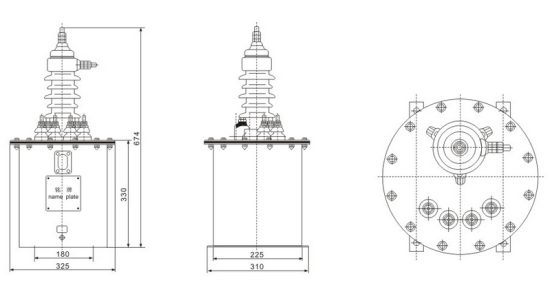
A7: Dimensional drawings are available for compatibility assessment. While mounting hole patterns may differ, adapter plates can be fabricated. Verify clearances meet IEC 61936-1 minimums (≥125 mm phase-to-phase at 11kV).
Q8: What documentation is required for grid interconnection approval?
A8: Submit the IEC 61869-2 type test certificate, routine test report, and site-specific test results (ratio, polarity, insulation resistance) to the utility authority. CQC certification is mandatory for Chinese grid projects.