Article Content
LSZY-35 33kV Cast-Resin Voltage Transformer for Substation Metering and Protection – IEC 61869-3 Certified
Introduction to the LSZY-35 Voltage Transformer
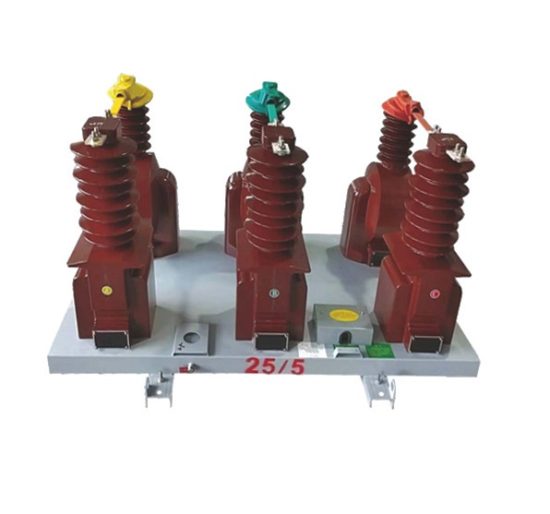
The LSZY-35 is a single-phase, indoor/outdoor-rated cast-resin voltage transformer (VT) engineered for reliable operation in 33kV (IEC) / 35kV (domestic) medium-voltage networks. Designed in strict accordance with IEC 61869-3 and GB/T 20840.3, it delivers high accuracy for both metering and protective relaying functions. Its solid dielectric construction eliminates fire hazards, oil leakage risks, and environmental contamination associated with traditional oil-immersed units—making it ideal for urban substations, industrial facilities, and renewable energy interconnection points where safety, compactness, and minimal maintenance are paramount.
Operating Principle of Cast-Resin Insulation
Cast-resin insulation in the LSZY-35 employs vacuum pressure impregnation (VPI) technology using cycloaliphatic epoxy resin. The primary and secondary windings, wound on grain-oriented electrical steel (GOES) cores, are fully encapsulated under vacuum to eliminate air voids and moisture ingress. This monolithic structure provides uniform electric field distribution, high partial discharge inception voltage (>20 kV), and excellent thermal conductivity (0.8–1.2 W/m·K). The resin’s glass transition temperature exceeds 120°C, ensuring mechanical stability across the full operational range from –40°C to +40°C ambient. Unlike oil-filled designs, there is no need for conservators, breathers, or oil-level monitoring, significantly reducing lifecycle complexity.
Advantages Over Oil-Immersed Designs
Compared to conventional oil-immersed VTs, the LSZY-35 offers superior fire resistance (IEC 60695 glow-wire test compliant), zero risk of hydrocarbon leakage, and immunity to moisture absorption—critical in coastal or high-humidity environments. Its compact footprint (typically 30–40% smaller than equivalent oil units) enables space-constrained installations such as pad-mounted switchgear or retrofit projects. Additionally, the absence of flammable dielectric fluid allows deployment in indoor substations without fire suppression systems, reducing capital expenditure. Long-term reliability is enhanced by the resin’s resistance to tracking, UV degradation (for outdoor versions), and thermal cycling fatigue over a 25–30 year service life.
Typical Application Overview
The LSZY-35 is deployed across utility distribution networks, industrial plants, and renewable generation sites requiring precise voltage measurement at 33kV system voltage (nominal 35kV in Chinese grids). Common configurations include single-pole mounting on ring-main units (RMUs), three-phase banks for line-to-ground or line-to-line measurements, and integration with digital relays and revenue-grade meters. Its dual secondary windings—typically one for 0.2/0.5 class metering and another for 3P/6P class protection—enable simultaneous compliance with metrological and safety-critical requirements without cross-interference.
Technical Specifications
The LSZY-35 is engineered to deliver consistent performance under defined service conditions while meeting stringent international and domestic standards. All parameters below reflect factory-tested values per IEC 61869-3 and GB/T 20840.3 protocols.
Rated Electrical Parameters
The primary rated voltage is 33/√3 kV (phase-to-ground) for IEC systems, corresponding to 35/√3 kV in domestic Chinese applications. Standard secondary voltages are 100/√3 V or 100 V (line-to-line), with optional 110 V variants available. Accuracy classes include 0.2, 0.5 for metering and 3P, 6P for protection, each with defined error limits: ±0.2% ratio error and ±10′ phase displacement at 0.2 class; ±3% ratio error at 3P class under 25–100% rated burden. Rated outputs range from 30 VA to 100 VA per winding, with thermal short-time withstand capability of 10 seconds at 10× rated voltage. Insulation levels comply with IEC 60071: LI 170 kV (lightning impulse), AC 70 kV (power frequency, 1 min).
Environmental and Mechanical Ratings
Designed for altitudes up to 1,000 m (derating required above 1,000 m per IEC 60071-1), the LSZY-35 operates reliably in ambient temperatures from –40°C to +40°C. Relative humidity tolerance extends to 95% non-condensing. Outdoor models feature UV-stabilized resin housings with creepage distances ≥25 mm/kV (medium pollution, Class II per IEC 60815). Terminal clearances meet IEC 61439 requirements: minimum 300 mm phase-to-phase and 250 mm phase-to-ground for 33kV systems. Mounting is via M16 stainless steel bolts with torque specification of 80 N·m; total weight ranges from 85–110 kg depending on output configuration.
Burden and Accuracy Compliance
Accuracy is guaranteed only when connected to burdens within specified limits. For example, a 0.2-class secondary must not exceed 30 VA burden to maintain ±0.2% ratio error. Exceeding rated burden increases magnetizing current, distorting waveform fidelity—particularly critical in harmonic-rich environments like variable-speed drives or solar inverters. The LSZY-35’s low excitation impedance (<0.5 Ω at rated voltage) minimizes this effect. Burden compatibility must be verified during system design; mismatched loads can degrade protection relay coordination.
Typical Applications
The LSZY-35’s robust design and dual-function capability make it suitable for diverse power infrastructure scenarios requiring accurate, reliable voltage sensing.
Substation Secondary Metering
In 33kV/35kV primary substations, the LSZY-35 supplies voltage signals to revenue meters, SCADA RTUs, and power quality analyzers. Its 0.2-class secondary ensures billing accuracy within ±0.2%, meeting regulatory requirements in most jurisdictions. Installation typically involves three units in wye configuration for three-phase metering. The cast-resin body resists electromagnetic interference from adjacent busbars, preserving signal integrity. In smart grid deployments, the VT interfaces with IEC 61850-compliant merging units, where low phase displacement (<5') is essential for synchrophasor accuracy.
Industrial Power Distribution
Heavy industries—such as steel mills, chemical plants, and data centers—use the LSZY-35 for feeder monitoring and motor protection. Here, the 3P/6P protection winding triggers undervoltage, overvoltage, or directional relays during faults. The transformer’s high saturation margin (>2.5× rated voltage) prevents core distortion during transient recovery voltages (TRVs) following circuit breaker interruption. Its compact size allows integration into metal-enclosed switchgear without derating, even in 40°C ambient conditions common in tropical regions.
Renewable Energy Integration
Solar farms and wind parks connecting to 33kV collector grids rely on the LSZY-35 for grid synchronization and anti-islanding detection. During cloud-induced irradiance swings or wind gusts, rapid voltage fluctuations demand fast-response VTs with minimal hysteresis—achieved via the GOES core’s narrow B-H loop. The unit’s outdoor rating (IP54) withstands desert dust, salt spray, and monsoon humidity. Crucially, its linear behavior under distorted waveforms (THD <5%) ensures accurate RMS voltage measurement for inverter ride-through compliance per IEEE 1547 or GB/T 19964.
Rural and Suburban Distribution Networks
In remote or semi-urban areas with limited maintenance access, the LSZY-35’s “fit-and-forget” design reduces operational costs. Mounted on pole-top platforms or pad-mounted RMUs, it supports automatic voltage regulation (AVR) and capacitor bank control. The absence of oil eliminates theft or vandalism risks. With a 30-year expected lifespan and no scheduled oil testing, utilities achieve lower total cost of ownership versus oil-filled alternatives—especially in regions with strict environmental regulations on hydrocarbon use.
Compliance with International Standards
Conformance to IEC 61869-3 and GB/T 20840.3 ensures global interoperability and performance predictability for the LSZY-35.
IEC 61869-3 Certification Requirements
IEC 61869-3 governs electromagnetic instrument transformers, specifying test methods for accuracy, insulation, temperature rise, and short-circuit withstand. The LSZY-35 undergoes type tests including: power frequency withstand (70 kV, 1 min), lightning impulse (170 kV peak, 1.2/50 μs), partial discharge (<10 pC at 1.2 × Um/√3), and temperature rise (<60 K for windings). Accuracy verification occurs at 25%, 50%, 100%, and 120% of rated voltage across 25–100% burden. All tests are witnessed by accredited third parties (e.g., KEMA, CESI), with certificates archived for traceability.
Alignment with GB/T 20840.3
GB/T 20840.3 is China’s national adoption of IEC 61869-3, with minor deviations in insulation coordination and labeling. While IEC uses 33kV as nominal system voltage, GB/T references 35kV—requiring dual-rating on nameplates. Creepage distance requirements under GB/T are slightly higher (≥31 mm/kV for heavy pollution), addressed via extended sheds on outdoor models. Both standards mandate identical accuracy classes and test procedures, ensuring the LSZY-35 meets domestic grid codes (e.g., State Grid Q/GDW standards) without redesign.
Key Differences Between IEC and Domestic Standards
The primary divergence lies in system voltage definition: IEC 60038 defines 33kV as the standard 35kV-class system voltage, whereas Chinese practice uses 35kV directly. Consequently, LSZY-35 units shipped internationally are labeled “33/√3 kV,” while domestic units read “35/√3 kV”—though internal design is identical. Additionally, GB/T 20840.3 requires Chinese-language markings and QR-code traceability, absent in IEC-only units. Performance-wise, no functional differences exist; the same production batch satisfies both regimes through dual-certification.
On-Site Testing Procedures
Post-installation verification ensures the LSZY-35 performs within specifications before energization.
Insulation Resistance Test
Using a 2,500 V DC megohmmeter, measure insulation resistance between primary winding and ground, and between primary and secondary windings. Acceptance criterion: ≥1,000 MΩ at 20°C. Correct for temperature using RT2 = RT1 × 2(T1–T2)/10. Values below 500 MΩ indicate moisture ingress or resin cracking—requiring drying or replacement. Test duration: 1 minute after stabilization.
Turns Ratio Test
Apply 100–200 V AC to the primary and measure secondary voltage. Calculate actual ratio: Vp/Vs. Compare to nameplate ratio; tolerance must be within ±0.2% for 0.2-class windings. Use a precision ratio bridge (e.g., Omicron CT Analyzer) for accuracy. Deviations >0.5% suggest winding shorts or incorrect tap selection.
Polarity Verification
Confirm reducing polarity (standard for IEC VTs): when instantaneous primary voltage is positive at H1, secondary voltage is positive at X1. Apply low-voltage DC pulse to H1–H2; observe momentary deflection on analog voltmeter connected to X1–X2. Positive kick confirms correct polarity. Incorrect polarity compromises vector group alignment in three-phase systems, causing metering errors or relay misoperation.
Power Frequency Withstand Voltage Test
Apply 70 kV AC (rms) at 50 Hz between primary and grounded tank/secondary for 1 minute. Leakage current must remain <10 mA. Any flashover, smoke, or abrupt current rise indicates insulation failure. This test validates integrity after transport-induced microcracks. Use calibrated HV test set with overcurrent trip (≤30 mA).
Open-Circuit Characteristic Test
Gradually increase primary voltage from 0 to 150% rated while measuring secondary voltage and excitation current. Plot Vs vs. Iexc. Knee point should exceed 120% rated voltage. Excessive magnetizing current (>5% of rated secondary current at 100% V) indicates core saturation issues—often due to residual stress from casting. This test is critical for protection-grade windings to ensure linear response during fault conditions.
Preventive Maintenance Guide
Although cast-resin VTs require minimal upkeep, periodic checks extend service life and prevent unexpected failures.
Annual Visual and Functional Inspection
Inspect for surface cracks, tracking marks, or discoloration on the resin housing—indicative of partial discharge or UV degradation. Clean terminals with isopropyl alcohol; verify bolt torque (80 N·m). Check secondary wiring for loose connections or corrosion. Perform insulation resistance and ratio tests annually in critical applications (e.g., generator step-up stations). Record trends; a 20% drop in insulation resistance over two years warrants further investigation.
Five-Year Comprehensive Assessment
Every five years, conduct partial discharge measurement (per IEC 60270) at 1.2 × Um/√3. Acceptable level: ≤10 pC. Also repeat open-circuit test to detect core aging. In coastal areas, inspect for salt deposit density (SDD); if >0.1 mg/cm², clean sheds with deionized water. Replace terminal lugs if oxidation exceeds 0.5 mm depth.
Maintenance Intervals and Fault Diagnosis
| Interval | Action | Fault Indicator |
|---|---|---|
| Annually | IR test, visual check | IR <500 MΩ → moisture ingress |
| 3 Years | Ratio & polarity verification | Ratio error >0.5% → winding fault |
| 5 Years | PD measurement, cleaning | PD >20 pC → internal voids |
| As needed | Thermal imaging | Hotspot >10°C above ambient → connection issue |
Common failure modes include terminal overheating (due to undersized cables) and external flashover (from pollution). Internal faults are rare but manifest as sudden accuracy loss or audible buzzing.
Conclusion
The LSZY-35 cast-resin voltage transformer represents a technically mature solution for 33kV/35kV networks demanding accuracy, safety, and longevity. By leveraging VPI epoxy resin encapsulation and GOES core technology, it achieves superior dielectric strength, thermal stability, and environmental resilience compared to oil-immersed alternatives. Full compliance with IEC 61869-3 and GB/T 20840.3 ensures seamless integration into global power systems—from urban substations to remote solar farms—while supporting both revenue metering (0.2 class) and critical protection functions (3P/6P class). Its maintenance-free design, compact form factor, and 25–30 year service life significantly reduce total cost of ownership. Rigorous factory testing and straightforward on-site verification protocols guarantee performance consistency throughout its operational lifecycle. As distribution networks evolve toward digitalization and decarbonization, the LSZY-35 provides a future-proof foundation for accurate voltage measurement in next-generation grid architectures.