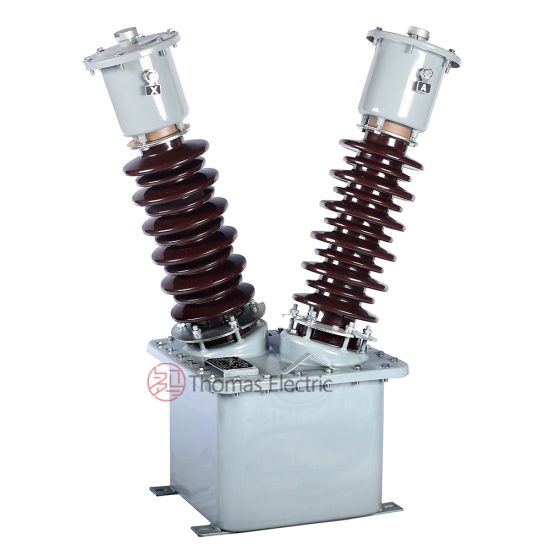
Article Content
INE-2 11kV Cast-Resin Voltage Transformer – Application Scenarios per IEC 61869-3
Introduction
The INE-2 11kV voltage transformer is a cast-resin insulated instrument transformer designed in strict accordance with the international standard IEC 61869-3. This device serves as a critical component in medium-voltage (MV) electrical networks operating at the standardized nominal system voltage of 11 kV—aligned with the IEC 60038 series and distinct from legacy domestic designations such as 10 kV. The adoption of 11 kV as the reference voltage ensures compatibility with global MV infrastructure, facilitating interoperability across transmission and distribution systems worldwide.
Cast-resin insulation technology provides superior dielectric strength, environmental resilience, and maintenance-free operation compared to oil-filled alternatives. The INE-2 is engineered for precision voltage measurement, protective relaying, and metering functions in industrial, utility, and commercial installations. Its compliance with IEC 61869-3 guarantees defined accuracy classes, thermal performance, and short-circuit withstand capabilities essential for reliable grid operation.

Application Overview
Voltage transformers (VTs), also known as potential transformers (PTs), are instrumental in stepping down high system voltages to standardized secondary values (typically 100 V or 110 V) suitable for instrumentation, protection relays, and revenue metering equipment. The INE-2 11kV VT is specifically rated for use in 11 kV networks—the internationally recognized nominal voltage per IEC standards—as opposed to region-specific variants like 10 kV (commonly used in certain national grids but non-compliant with IEC 60038).
Key application domains include:
- Substation Metering: Providing accurate voltage signals to energy meters for billing and load profiling in primary and secondary substations.
- Protective Relaying: Supplying input to overvoltage, undervoltage, and directional protection schemes in feeder and busbar protection systems.
- Power Quality Monitoring: Enabling harmonic analysis, flicker detection, and transient recording through high-fidelity voltage waveforms.
- Industrial Power Systems: Supporting control circuits, synchronization checks, and automatic transfer switch (ATS) logic in manufacturing plants and process facilities.
- Railway Electrification: Used in traction power supply systems where 11 kV feeders require precise voltage transformation for signaling and protection.
The INE-2’s cast-resin construction eliminates fire hazards, reduces environmental impact, and allows indoor or outdoor installation without additional containment. Its robust mechanical design withstands seismic activity and pollution conditions up to pollution degree III as defined in IEC 60664-1.

Case Studies
Case Study 1: Urban Distribution Substation Upgrade – Western Europe
A municipal utility in Germany undertook a modernization program for aging 10 kV infrastructure, transitioning to the IEC-standardized 11 kV network configuration. The project required replacement of legacy oil-filled VTs with maintenance-free, environmentally compliant alternatives. The INE-2 11kV cast-resin VT was selected due to its IEC 61869-3 certification, Class 0.5 accuracy for metering, and Class 3P for protection applications.
Installation occurred in compact indoor switchgear bays with limited clearance. The INE-2’s reduced footprint and absence of oil containment simplified integration. Over a 24-month monitoring period, the VT demonstrated stable ratio error (< ±0.3%) and phase displacement (< ±10 minutes) under varying load and temperature conditions (−25°C to +40°C). The utility reported zero maintenance interventions and improved reliability in fault detection during transient overvoltages.
Case Study 2: Industrial Manufacturing Plant – Southeast Asia
A semiconductor fabrication facility in Malaysia operates on an 11 kV internal distribution network to support high-power process equipment. Voltage stability and waveform fidelity are critical to prevent microprocessor-based control malfunctions. The plant replaced electromechanical VTs with the INE-2 model to enhance measurement integrity for both real-time SCADA telemetry and offline power quality audits.
The INE-2 units were installed on each 11 kV feeder supplying cleanrooms and etching stations. Their low capacitive leakage and high-frequency response (< 1 kHz bandwidth) enabled accurate capture of voltage sags and switching transients. Post-installation, the facility achieved a 40% reduction in nuisance tripping of sensitive loads and met IEEE 1159 compliance thresholds for voltage variation. The cast-resin housing also resisted chemical vapors present in adjacent production zones, confirming suitability for harsh industrial environments.
Case Study 3: Renewable Energy Integration – South Africa
A 20 MW solar photovoltaic (PV) farm in the Northern Cape connects to the national grid via an 11 kV collector substation. Accurate voltage measurement is essential for anti-islanding protection, reactive power control, and grid code compliance (NRS 097-2-1:2017, harmonized with IEC 61869). The project specification mandated VTs with dual secondary windings: one for revenue metering (Class 0.2) and another for protection relays (Class 3P).
The INE-2 11kV VT fulfilled these requirements with two independent secondary outputs. Its thermal stability ensured consistent performance despite diurnal ambient swings (5°C to 45°C). During commissioning, the VT exhibited negligible burden dependency, maintaining accuracy even at 25% of rated burden—a common scenario during partial cloud cover when PV output fluctuates. Grid operator acceptance testing confirmed compliance with all metrological and dielectric tests per IEC 61869-3, enabling seamless grid interconnection.

Technical Benefits
The INE-2 11kV cast-resin voltage transformer delivers multiple engineering advantages derived from its adherence to IEC 61869-3 and advanced materials science:
1. Precision and Accuracy Stability
Manufactured to meet defined accuracy classes (e.g., 0.2, 0.5, 3P) under specified burdens and temperatures, the INE-2 maintains ratio and phase errors within tight tolerances across its operational life. The epoxy resin matrix minimizes moisture ingress and thermal expansion effects that degrade magnetic core performance in alternative designs.
2. Environmental and Safety Compliance
Unlike oil-immersed VTs, the cast-resin construction contains no flammable or toxic substances. It complies with RoHS and REACH directives and carries no risk of leakage or fire propagation. This makes it suitable for densely populated urban substations, underground installations, and environmentally sensitive areas.
3. Mechanical and Dielectric Robustness
The solid insulation system provides uniform electric field distribution, reducing partial discharge activity to < 10 pC at 1.2 × Um/√3 (per IEC 61869-3 test protocols). The housing withstands impulse voltages of 95 kV (1.2/50 μs) and power frequency withstand of 28 kV rms for 1 minute, ensuring resilience against lightning and switching surges.
4. Long Service Life and Low Lifecycle Cost
With no consumable fluids or moving parts, the INE-2 requires no periodic maintenance. Accelerated aging tests confirm a design life exceeding 30 years under continuous 11 kV operation. This reduces total cost of ownership compared to oil-filled units requiring oil sampling, filtration, and tank inspections.
5. Global Standardization Alignment
By specifying 11 kV (not 10 kV), the INE-2 aligns with IEC 60038 nominal voltages, simplifying procurement, spare parts management, and interoperability in multinational projects. This eliminates conversion errors and ensures compatibility with IEC-certified switchgear, relays, and meters.
Frequently Asked Questions (FAQs)
Q1: Why is the system voltage specified as 11 kV instead of 10 kV?
A: The 11 kV designation follows IEC 60038, which defines standardized nominal voltages for AC transmission, distribution, and utilization systems. While some national grids historically used 10 kV, the international standard recognizes 11 kV as the correct nominal value for this class of medium-voltage networks. Using 11 kV ensures compliance with IEC 61869-3 and facilitates global equipment compatibility.
Q2: Can the INE-2 be used in outdoor installations?
A: Yes. The cast-resin housing is UV-stabilized and hydrophobic, providing reliable performance in outdoor environments with pollution degrees up to III (IEC 60664-1). However, for severe coastal or industrial atmospheres (pollution degree IV), additional creepage extension or silicone coating may be recommended.
Q3: What accuracy classes are available for the INE-2 11kV VT?
A: The INE-2 is available in metering accuracy classes 0.2, 0.5, and 1, and protection accuracy classes 3P and 6P, all per IEC 61869-3. Dual-winding configurations allow simultaneous connection to metering and protection circuits without cross-interference.
Q4: How does cast-resin insulation compare to oil insulation in terms of thermal performance?
A: Cast-resin has lower thermal conductivity than oil but compensates through optimized core geometry and homogeneous heat distribution. The INE-2 is rated for continuous operation at ambient temperatures from −25°C to +40°C, with thermal limits verified per IEC 61869-3 clause 6.5. Unlike oil-filled units, it exhibits no thermal stratification or gassing under overload conditions.
Q5: Is the INE-2 suitable for harmonic-rich environments, such as those with variable frequency drives (VFDs)?
A: Yes. The magnetic core is designed with low-loss grain-oriented steel and minimal air gaps, preserving linearity up to the 13th harmonic (750 Hz). This ensures accurate voltage representation in networks with significant harmonic distortion, critical for both protection coordination and power quality assessment.
Conclusion
The INE-2 11kV cast-resin voltage transformer represents a technically rigorous solution for modern medium-voltage applications governed by IEC 61869-3. Its alignment with the 11 kV IEC nominal voltage standard—not the outdated 10 kV domestic variant—ensures global interoperability, regulatory compliance, and future-proofing of electrical infrastructure. Through proven deployments in utility substations, industrial complexes, and renewable energy sites, the INE-2 demonstrates exceptional metrological stability, environmental safety, and lifecycle economy.
Engineers specifying instrument transformers for new installations or retrofits should prioritize IEC-standardized components like the INE-2 to mitigate compatibility risks, reduce maintenance overhead, and support the ongoing harmonization of power systems worldwide. As grids evolve toward smarter, more resilient architectures, the role of precision-engineered, standards-compliant VTs becomes increasingly pivotal in ensuring measurement integrity and system protection reliability.