Article Content
Introduction
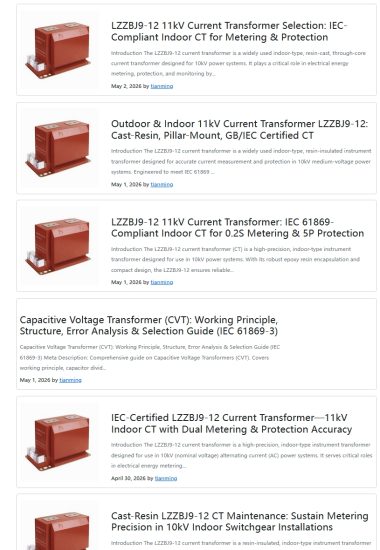
The LZZBJ9-12 current transformer is a widely used indoor-type, resin-cast, through-core current transformer designed for 10kV power systems. It plays a critical role in electrical energy metering, protection, and monitoring by accurately converting high primary currents into standardized, lower secondary currents suitable for instrumentation and relay devices. Engineaged with high insulation performance, excellent thermal stability, and robust mechanical structure, the LZZBJ9-12 ensures reliable operation under normal and transient conditions in medium-voltage switchgear installations. Its compact design allows for easy integration into ring main units (RMUs), cubicles, and other confined spaces common in urban substations and industrial facilities. This selection guide provides essential technical considerations to assist engineers and procurement specialists in choosing the appropriate variant of the LZZBJ9-12 for their specific application, ensuring safety, compliance, and long-term operational efficiency.
System Voltage
The LZZBJ9-12 is specifically engineered for use in 10kV alternating current (AC) power systems operating at a nominal frequency of 50 Hz or 60 Hz. The “12” in its model designation refers to its rated voltage class—12 kV—which indicates the maximum system voltage it can safely withstand during continuous operation and transient overvoltage events. This rating aligns with standard IEC 61869 and GB/T 20840 requirements for indoor current transformers in medium-voltage networks.
It is crucial to match the transformer’s rated voltage with the actual system voltage. While the nominal system voltage may be labeled as 10kV, the highest voltage for equipment (Um) is typically 12kV in accordance with IEC 60038 standard voltages. The LZZBJ9-12 is tested and certified for this Um = 12kV condition, including power frequency withstand voltage (typically 42 kV for 1 minute) and lightning impulse withstand voltage (75 kV peak). Using this transformer in systems exceeding 12kV Um may compromise insulation integrity, leading to flashover, partial discharge, or catastrophic failure.
Additionally, environmental factors such as altitude, humidity, and pollution levels must be considered. The standard LZZBJ9-12 is rated for operation at altitudes up to 1000 meters above sea level. For installations above this elevation, derating or special design modifications may be required due to reduced air density affecting dielectric strength. The resin-cast epoxy housing provides excellent resistance to moisture and contamination, making it suitable for indoor environments with moderate pollution (pollution degree 2 or 3 per IEC 60664).
| Parameter | Value | Standard Reference |
|---|---|---|
| Rated Voltage (Ur) | 12 kV | IEC 61869-2 |
| Highest Voltage for Equipment (Um) | 12 kV | IEC 60038 |
| Power Frequency Withstand Voltage | 42 kV, 1 min | GB/T 11022 |
| Lightning Impulse Withstand Voltage | 75 kV (peak) | IEC 60060-1 |
| Rated Insulation Level | 12/42/75 kV | IEC 61869-1 |
Transformation Ratio
The transformation ratio (also known as the current ratio) of the LZZBJ9-12 defines the relationship between the primary current (Ip) flowing through the power conductor and the standardized secondary current (Is) delivered to connected instruments or relays. Common secondary currents are 1 A or 5 A, with 5 A being more prevalent in industrial applications due to better signal-to-noise performance over longer cable runs. The primary current ratings typically range from 50 A to 3000 A or higher, depending on the specific model variant.
Selecting the correct transformation ratio is vital for both measurement accuracy and protection reliability. For metering applications, the ratio should be chosen so that the normal operating load current falls within 20% to 100% of the primary rated current. Operating consistently below 20% may result in significant measurement errors, especially at low loads. Conversely, for protection circuits, the transformer must accurately reproduce fault currents—often many times the rated current—without excessive saturation. Therefore, protection-class CTs often require higher knee-point voltages and larger core cross-sections.
The LZZBJ9-12 is available in both single-ratio and multi-ratio configurations. Multi-ratio models feature multiple secondary windings or taps on a single winding, allowing flexibility in field configuration without replacing the entire unit. For example, a 600/5 A CT might offer intermediate taps at 400/5 A and 200/5 A. When using tapped ratios, only the portion of the winding corresponding to the selected tap is active; the unused portion must remain open-circuited (never shorted) to avoid measurement errors or overheating.
It is also important to consider the burden imposed by connected devices. The total impedance (in volt-amperes or ohms) of meters, relays, and wiring must not exceed the rated burden of the CT at the specified accuracy class. Mismatched burden can lead to ratio errors and phase displacement beyond acceptable limits. Always verify that the selected ratio, combined with expected load current and connected burden, satisfies both steady-state and transient performance requirements.
| Primary Current (A) | Secondary Current (A) | Common Applications | Notes |
|---|---|---|---|
| 50–200 | 1 or 5 | Small feeders, lighting circuits | Prefer 5 A for better meter sensitivity |
| 300–800 | 5 | Main distribution, motor feeders | Standard industrial range |
| 1000–2000 | 5 | Substation incomers, large motors | Verify thermal and dynamic withstand |
| 2500–3000+ | 5 | Utility feeders, heavy industry | May require special ordering |
| Multi-tap (e.g., 600/400/200/5) | 5 | Flexible retrofit projects | Only one tap used at a time |
Accuracy Class
Accuracy class defines the permissible error limits in current transformation under specified operating conditions. For the LZZBJ9-12, accuracy classes are designated separately for measurement (metering) and protection purposes, as these functions impose different performance demands. Measurement accuracy focuses on precision under normal load conditions, while protection accuracy emphasizes fidelity during high-magnitude fault currents.
For metering, common accuracy classes include 0.2, 0.5, and 1.0, where the number represents the maximum allowable composite error percentage at rated current and specified burden. For instance, a 0.5-class CT must maintain an error of no more than ±0.5% in ratio and a phase displacement within defined limits when operating at 100% of rated current and at its rated burden. Higher accuracy (e.g., 0.2S or 0.5S) is required for revenue metering and is optimized for performance even at 1% to 120% of rated current.
Protection accuracy classes are denoted as 5P or 10P (where “P” stands for protection), followed by a number indicating the maximum composite error percentage at the accuracy limit factor (ALF). For example, a 5P10 CT guarantees ≤5% error when subjected to 10 times the rated primary current. The ALF is determined by the system’s maximum fault current and the CT’s ability to avoid saturation. Selecting an inadequate ALF can cause the CT to saturate during faults, leading to under-reach or misoperation of protective relays.
The LZZBJ9-12 may feature dual secondary windings—one wound for metering (e.g., 0.5 class) and another for protection (e.g., 5P10)—to satisfy both requirements simultaneously. It is critical to connect each winding only to its intended devices; cross-connection can degrade performance or damage equipment. Additionally, the rated burden (e.g., 10 VA, 15 VA) must match the total load of connected devices. Exceeding this burden increases errors and may invalidate the stated accuracy class.
| Accuracy Class | Application | Max Error at Rated Current | Typical Burden (VA) |
|---|---|---|---|
| 0.2 / 0.2S | Precision metering, revenue billing | ±0.2% | 5–10 |
| 0.5 / 0.5S | General metering | ±0.5% | 10–15 |
| 1.0 | Indicating instruments | ±1.0% | 10–30 |
| 5P10 | Overcurrent protection | ≤5% at 10× In | 15–30 |
| 10P10 / 10P15 | Basic protection | ≤10% at 10× or 15× In | 15–30 |
5. Burden Calculation
The burden of a current transformer (CT) is the total impedance presented to its secondary winding, comprising connected devices (relays, meters, wiring) and interconnecting conductors. Accurate burden calculation ensures the CT operates within its accuracy class and avoids saturation during normal or fault conditions.
Burden is typically expressed in volt-amperes (VA) at a specified secondary current (usually 1 A or 5 A). The total burden \( Z_b \) is calculated as:
\[
Z_b = Z_{\text{relay}} + Z_{\text{meter}} + Z_{\text{wiring}} + Z_{\text{connections}}
\]
Where each component’s impedance must be referenced to the same base (e.g., ohms at 5 A). For copper conductors, wire resistance is calculated using:
\[
R = \rho \frac{L}{A}
\]
with \( \rho = 0.0178 \, \Omega \cdot \text{mm}^2/\text{m} \) for copper at 20°C, \( L \) = total loop length (m), and \( A \) = cross-sectional area (mm²).
| Component | Typical Impedance (Ω @ 5 A) | Notes |
|---|---|---|
| Electromechanical Relay | 0.1 – 0.5 | Varies by model; check manufacturer data |
| Digital Relay | 0.01 – 0.05 | Low burden due to electronic input circuits |
| Analog Ammeter | 0.05 – 0.2 | Depends on full-scale range |
| Wiring (2.5 mm², 50 m loop) | 0.356 | Calculated: \( R = 0.0178 \times 100 / 2.5 = 0.712 \, \Omega \); loop = 2×length |
| Connection Points | 0.02 – 0.05 | Assumes clean, tight terminals |
Example: A CT feeds a digital relay (0.03 Ω), 60 m of 4 mm² cable (loop = 120 m), and two terminal connections (0.03 Ω total). Total burden:
\[
Z_b = 0.03 + \left(0.0178 \times 120 / 4\right) + 0.03 = 0.03 + 0.534 + 0.03 = 0.594 \, \Omega
\]
At 5 A, this equals \( I^2Z = 25 \times 0.594 = 14.85 \, \text{VA} \). Ensure the CT rating (e.g., 15 VA) exceeds this value with margin.
6. Short-Circuit Considerations
During short-circuit events, CTs must accurately reproduce primary fault currents without saturation to ensure protective relays operate correctly. Key parameters include the symmetrical short-circuit current, X/R ratio, and DC offset.
The maximum secondary voltage \( V_s \) a CT can develop without saturating is given by:
\[
V_s = I_s (R_{ct} + Z_b)
\]
where \( I_s \) is the secondary fault current, \( R_{ct} \) is the CT winding resistance, and \( Z_b \) is the total burden. This must be less than the CT’s knee-point voltage \( V_k \).
For high X/R systems (>15), the DC offset can significantly increase the total fault current magnitude. The worst-case asymmetrical current is:
\[
I_{\text{asym}} = I_{\text{sym}} \sqrt{1 + 2e^{-2\pi(X/R)}}
\]
| Parameter | Description | Design Impact |
|---|---|---|
| Knee-Point Voltage (\(V_k\)) | Voltage at which CT core begins to saturate | Must exceed \( V_s \) under max fault conditions |
| Accuracy Limit Factor (ALF) | Ratio of max fault current to rated current where accuracy is maintained | Select ALF ≥ (max fault current / CT ratio) |
| X/R Ratio | System reactance-to-resistance ratio at fault location | High X/R increases DC offset → higher peak current |
| CT Saturation Time | Time from fault inception to core saturation | Must exceed relay operating time (typically >20 ms) |
Verification involves comparing the required \( V_s \) with the CT’s excitation curve. If \( V_s > V_k \), select a CT with higher \( V_k \), lower burden, or larger core cross-section. Modern numerical relays often tolerate mild saturation but require waveform fidelity for algorithms like differential protection.
7. Environmental Considerations
Environmental factors significantly influence CT performance, longevity, and safety. Installations must account for temperature extremes, humidity, altitude, pollution, and mechanical stress.
Temperature: Standard CTs operate between –25°C to +55°C. High ambient temperatures reduce insulation life and increase copper resistance, raising burden. Low temperatures may embrittle materials. Derating may be needed above 40°C.
Altitude: Above 1000 m, reduced air density impairs cooling and dielectric strength. CTs rated for standard altitudes may require derating or special design above 2000 m.
Pollution & Humidity: In coastal or industrial areas, salt spray or chemical contaminants can cause tracking and flashover. Use CTs with creepage distance ≥25 mm/kV (medium pollution) or ≥31 mm/kV (heavy pollution).
| Condition | Requirement | Mitigation Strategy |
|---|---|---|
| High Humidity (>95%) | IP54 minimum enclosure | Sealed CTs with silica gel breathers or hermetic sealing |
| Outdoor Installation | UV-resistant housing, IP65 | Polymer or porcelain housings; stainless steel hardware |
| Vibration (e.g., near transformers) | Secure mounting, anti-vibration pads | Avoid resonant frequencies; use flexible leads |
| Chemical Exposure | Corrosion-resistant materials | Epoxy resin encapsulation; avoid aluminum in saline environments |
Always consult IEC 61869-2 and IEEE C57.13 for environmental classification and testing standards. For harsh environments, specify CTs with extended temperature ratings (e.g., –40°C to +70°C) and enhanced ingress protection.
8. CT Selection and Verification Checklist
Use this checklist during design, procurement, and commissioning to ensure CT suitability and compliance.
| # | Check Item | Status (✓/✗) | Remarks |
|---|---|---|---|
| 1 | Primary current rating matches system load and fault levels | e.g., 2000/5 A for 1800 A load | |
| 2 | Accuracy class meets application (e.g., 5P20 for protection) | Verify class per IEC/IEEE | |
| 3 | Total burden ≤ CT rated burden (with 10–20% margin) | Include wiring, devices, connections | |
| 4 | Knee-point voltage > required \( V_s \) under max fault | Confirm via excitation curve | |
| 5 | Environmental rating suitable for location (IP, temp, altitude) | Check site conditions | |
| 6 | Polarity marked and verified during installation | Critical for differential schemes | |
| 7 | Secondary circuits grounded at one point only | Prevents circulating currents | |
| 8 | Open-circuit protection (e.g., shorting switches) provided | Safety during maintenance |
Complete this checklist during design review and again during site acceptance testing. Retain records for future reference and regulatory compliance.