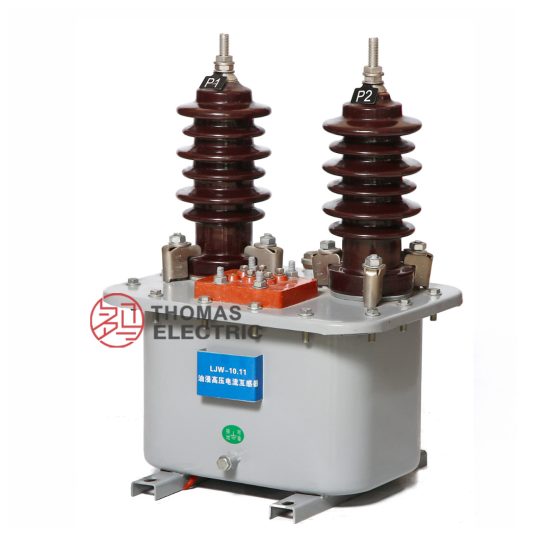
Article Content
11kV Cast-Resin Voltage Transformer JDJ-3 for Metering and Protection – IEC 61869-3 Standard
Introduction to the JDJ-3 Voltage Transformer
The JDJ-3 is a single-phase, indoor/outdoor-rated cast-resin voltage transformer (VT) engineered for precise voltage transformation in 11kV (IEC) or 10kV (domestic) medium-voltage distribution systems operating at nominal system voltages up to 12kV. Designed in strict accordance with IEC 61869-3 and GB/T 20840.3, this instrument transformer provides galvanic isolation and scales down high primary voltages to standardized secondary outputs—typically 100 V or 110 V—for interfacing with revenue metering equipment, protective relays, and power quality monitoring systems. Its robust construction ensures long-term reliability in demanding utility and industrial environments.
Operating Principle of Cast-Resin Insulation
The JDJ-3 employs vacuum pressure impregnation (VPI) epoxy resin technology to fully encapsulate its magnetic core and windings. This process eliminates air voids and moisture ingress pathways by saturating the entire coil assembly under vacuum before curing under pressure. The resulting monolithic structure exhibits superior dielectric strength (≥30 kV/mm), excellent tracking resistance (CTI ≥600), and minimal partial discharge activity (<5 pC at 1.2 × Ur). Unlike oil-filled alternatives, the solid insulation system is non-flammable, requires no maintenance of insulating fluid, and remains stable across wide thermal cycles (–40°C to +40°C ambient). The resin’s coefficient of thermal expansion closely matches that of copper and GOES silicon steel, minimizing mechanical stress during load transients.
Advantages Over Oil-Immersed Designs
Cast-resin VTs like the JDJ-3 offer significant operational and safety advantages over traditional oil-immersed units. First, they eliminate fire hazards associated with mineral oil, making them suitable for indoor substations, high-rise buildings, and confined spaces where flammability codes restrict oil use. Second, the hermetic seal prevents moisture absorption—a common failure mode in oil units—ensuring consistent insulation performance over decades. Third, the compact footprint reduces space requirements by up to 30% compared to equivalent oil-filled VTs. Finally, the absence of oil sampling, level checks, or gas monitoring simplifies lifecycle management. These attributes make the JDJ-3 ideal for modern smart grids prioritizing safety, sustainability, and minimal maintenance.
Typical Applications Overview
The JDJ-3 is deployed across diverse infrastructure segments requiring accurate voltage sensing. In utility substations, it feeds data to digital protective relays (e.g., overvoltage, undervoltage, and directional earth-fault schemes) and revenue-class kWh meters. Industrial facilities use it for motor protection coordination and power factor correction control. Renewable integration points—such as solar farms or wind turbine step-up transformers—rely on its stable ratio accuracy to meet grid code compliance (e.g., IEEE 1547). Rural distribution networks benefit from its resilience to pollution and humidity, while urban ring-main units leverage its compactness. All applications demand adherence to defined accuracy classes (0.2, 0.5, or 3P) per IEC 61869-3.
Technical Specifications
The JDJ-3 voltage transformer is engineered to deliver precision and durability under standard service conditions. Below are its key electrical and environmental parameters, validated through type and routine tests per IEC 61869-3.
| Parameter | Value |
|---|---|
| Primary Rated Voltage (Ur) | 11 kV (IEC) / 10 kV (GB) |
| Secondary Rated Voltage | 100 V or 110 V (user-selectable) |
| Voltage Ratio | 11000/√3 : 100/√3 V or 10000/√3 : 100/√3 V |
| Accuracy Class | Metering: 0.2, 0.5; Protection: 3P |
| Rated Output (per burden class) | 10 VA, 30 VA, 50 VA, 100 VA |
| Insulation Level (LI/AC) | 75 kV / 28 kV (1 min, 50 Hz) |
| Partial Discharge | <5 pC at 1.2 × Ur |
| Core Material | Grain-Oriented Electrical Steel (GOES), M4 grade |
| Insulation System | Epoxy resin (VPI), UL 94 V-0 rated |
| Ambient Temperature Range | –40°C to +40°C |
| Altitude Limit | ≤1000 m above sea level (derating required above) |
| Relative Humidity | ≤95% (non-condensing) |
| Service Life | 25–30 years under normal operating conditions |
Electrical Performance Parameters
The JDJ-3 maintains ratio error within ±0.2% and phase displacement ≤10 minutes for Class 0.2 under burdens from 25% to 100% of rated VA. For protection Class 3P, composite error remains below 3% at 5% to 100% of rated voltage and up to 100% of rated burden. The transformer’s magnetizing current is minimized through optimized GOES core lamination stacking, reducing no-load losses to ≤1.5 W. Thermal stability is ensured by limiting temperature rise to ≤55 K above ambient at rated output, verified via hot-spot thermocouples during type testing. Secondary terminals are rated for 10 A continuous current, with short-time withstand capability of 250 A for 1 second.
Environmental and Mechanical Ratings
Designed for both indoor switchgear panels and outdoor pole-mounted installations, the JDJ-3 features UV-stabilized resin housing with IP54 ingress protection. The creepage distance exceeds 25 mm/kV (medium pollution class III per IEC 60815), preventing flashovers in coastal or industrial atmospheres. Mounting is via two M12 threaded inserts with torque specification of 35 N·m. The unit weighs approximately 28 kg and measures 320 mm (H) × 220 mm (W) × 180 mm (D). Altitude derating follows IEC 60071-2: for every 100 m above 1000 m, the AC withstand voltage must be reduced by 1%. Humidity tolerance includes condensation resistance during rapid temperature swings, critical for tropical climates.
Typical Applications
The JDJ-3 voltage transformer serves as a foundational component in modern power systems where measurement integrity and protection reliability are non-negotiable.
Substation Secondary Metering
In 11kV/0.4kV distribution substations, the JDJ-3 supplies scaled voltage signals to Class 0.2S revenue meters for accurate energy billing. Its low phase error ensures correct calculation of reactive energy (kVArh), essential for power factor penalty avoidance. When paired with Class 0.2 current transformers, the combined metering accuracy meets MID (Measuring Instruments Directive) requirements. The VT’s stable ratio over time eliminates frequent recalibration needs, reducing operational expenditure. In digital substations, its analog output interfaces with merging units (MUs) for IEC 61850-9-2 LE sampled value transmission.
Industrial Power Distribution
Large manufacturing plants utilize the JDJ-3 for motor protection schemes, particularly in medium-voltage induction motor feeders (e.g., 11kV pumps or compressors). Protective relays monitor undervoltage conditions that could cause motor stalling or overheating. The VT’s Class 3P accuracy ensures reliable operation during fault-induced voltage sags down to 5% of nominal. Additionally, it supports automatic voltage regulator (AVR) systems in captive power plants, maintaining bus voltage within ±2% tolerance. The cast-resin design resists chemical fumes and dust prevalent in cement, mining, or chemical processing facilities.
Renewable Energy Integration
Solar photovoltaic (PV) farms employ the JDJ-3 at the point of interconnection (POI) to satisfy grid operator requirements for voltage ride-through (VRT) monitoring. During grid disturbances, inverters must remain connected if voltage stays within specified envelopes (e.g., 88%–110% for 1 second per ENTSO-E). The JDJ-3’s fast response time (<10 ms) and low harmonic distortion (<0.5% THD at rated load) provide clean signals for inverter control algorithms. Similarly, in wind turbine step-up transformers, it enables synchronization checks and islanding detection via rate-of-change-of-frequency (ROCOF) relays.
Rural and Suburban Distribution Networks
In remote areas with long feeder lines, the JDJ-3 enables voltage profile monitoring at sectionalizing points. Utilities install it alongside reclosers to implement adaptive voltage regulation, reducing line losses and improving end-user voltage quality. Its immunity to moisture ingress makes it suitable for unsheltered pole-top installations in high-rainfall regions. For rural electrification projects in Asia and Africa, the 10kV domestic variant aligns with local grid standards while maintaining IEC-level performance. The transformer’s lightweight design simplifies manual handling during deployment in areas lacking heavy-lift equipment.
Compliance with International Standards
The JDJ-3 is certified to both international and Chinese national standards, ensuring global interoperability and regulatory acceptance.
IEC 61869-3 Compliance Details
IEC 61869-3 governs the performance, testing, and marking of inductive voltage transformers. The JDJ-3 meets all mandatory clauses, including: ratio error limits per accuracy class (Table 101), temperature rise tests (Clause 7.3), short-circuit withstand (Clause 7.6), and electromagnetic compatibility (EMC) immunity per IEC 61000-4 series. Type tests include power frequency withstand (28 kV for 1 min), lightning impulse (75 kV peak, 1.2/50 μs waveform), and partial discharge measurement at 1.2 × Ur. Routine tests on every unit cover polarity verification, turns ratio (±0.2% tolerance), and insulation resistance (>1000 MΩ at 2500 V DC).
Alignment with GB/T 20840.3
GB/T 20840.3 is the Chinese adoption of IEC 61869-3 with minor national deviations. Key differences include: primary voltage designation (10kV vs. 11kV), creepage distance requirements (slightly higher in GB for heavy pollution zones), and secondary voltage options (100 V standard in GB vs. 100/110 V in IEC). The JDJ-3 is dual-marked to satisfy both standards, enabling export to ASEAN markets and domestic use in China. Certification is issued by CEPREI or TÜV SÜD after successful completion of full type test reports, including seismic withstand (0.3g horizontal acceleration) for earthquake-prone regions.
Testing and Certification Requirements
Manufacturers must maintain a quality management system per ISO 9001 and conduct annual surveillance audits. Each production batch undergoes statistical process control (SPC) for core loss and ratio consistency. Third-party certification bodies verify compliance through witnessed type tests at accredited laboratories. Markings on the nameplate include: manufacturer ID, serial number, IEC/GB standard references, accuracy class, rated output, and insulation levels. For export to Europe, CE marking under the Low Voltage Directive (2014/35/EU) is mandatory, referencing harmonized standard EN 61869-3.
On-Site Testing Procedures
Field commissioning and periodic verification require standardized tests to ensure the JDJ-3 operates within specifications.
Insulation Resistance Test
Perform using a 2500 V DC megohmmeter between primary winding and ground, and between secondary windings and ground. Acceptance criterion: ≥1000 MΩ at 20°C. Correct for temperature using the formula RT2 = RT1 × 2(T1–T2)/10. Low readings indicate moisture ingress or resin degradation. Always discharge windings for 5 minutes post-test to prevent residual charge hazards. This test is mandatory after transportation or prolonged storage.
Turns Ratio Test
Apply a low-voltage AC source (50–100 V) to the primary and measure secondary voltage with a calibrated true-RMS meter. Calculate actual ratio and compare to nameplate. Tolerance: ±0.2% for metering classes, ±0.5% for protection. Use a dedicated ratio tester (e.g., Omicron CT Analyzer) for automated comparison. Deviations beyond tolerance suggest turn-to-turn shorts or incorrect tap selection. Verify all available secondary taps if multi-ratio.
Polarity Test
Confirm reducing polarity per IEC 61869-3 Clause 5.3. Connect a 6–12 V battery across primary terminals (H1+, H2–). Momentarily close the circuit while monitoring secondary with a DC voltmeter (X1+, X2–). A positive kick indicates correct polarity. Incorrect polarity causes 180° phase reversal, leading to relay misoperation or metering errors. Document results with oscillogram traces if using automated testers.
Power Frequency Withstand Voltage Test
Apply 28 kV RMS at 50 Hz between primary and grounded secondary/core for 1 minute. Use a calibrated HV test set with overcurrent trip (≤100 mA). No flashover or disruptive discharge is permissible. Reduce voltage gradually post-test. This test validates insulation integrity after installation but is typically omitted during routine maintenance unless damage is suspected. Always isolate connected equipment beforehand.
Open-Circuit Characteristic Test
With secondary open, apply variable voltage (0–120% of Ur/√3) to primary and record excitation current. Plot Iexc vs. V. Knee-point should exceed 150% of rated voltage. Excessive magnetizing current indicates core saturation or shorted laminations. Compare to factory baseline; >20% deviation warrants investigation. This test assesses core health and is recommended every 5 years.
Preventive Maintenance Guide
Proactive maintenance extends service life and prevents unplanned outages.
Periodic Visual and Functional Inspection
Conduct annually: check for resin cracks, discoloration (indicating overheating), terminal corrosion, or loose mounting hardware. Clean surface with dry cloth; avoid solvents. Verify secondary wiring tightness (torque: 2.5 N·m for M6 terminals). Perform insulation resistance and ratio tests as baseline. Record ambient conditions and compare trends year-over-year. Immediate replacement is required if cracks expose internal components or if IR drops below 500 MΩ.
Long-Term Maintenance Schedule
Every 5 years, perform comprehensive diagnostics: open-circuit test, partial discharge scan (using HFCT sensors), and thermal imaging under load. Every 10 years, consider dielectric frequency response (DFR) analysis to detect moisture in resin matrix. Replace surge arresters connected to secondary if leakage current exceeds 0.5 mA. Maintain a logbook with test data, environmental exposure, and fault history. Units in coastal or industrial zones may require biennial inspections due to accelerated aging.
| Interval | Tasks |
|---|---|
| Annual | Visual inspection, IR test, ratio check, terminal torque verification |
| 5-Year | Open-circuit test, PD measurement, thermal scan, burden verification |
| 10-Year | DFR analysis, core loss measurement, full re-certification if required |
Conclusion
The JDJ-3 11kV cast-resin voltage transformer represents a mature, field-proven solution for accurate voltage transformation in medium-voltage networks. Its epoxy-encapsulated design delivers exceptional dielectric reliability, eliminating the fire risks and maintenance overhead of oil-filled alternatives. Compliance with IEC 61869-3 and GB/T 20840.3 ensures global acceptance across utility, industrial, and renewable sectors. With defined accuracy classes (0.2, 0.5, 3P), it supports both revenue metering and critical protection functions without compromise. Rigorous on-site testing protocols—insulation resistance, ratio verification, polarity confirmation, and open-circuit characterization—enable confident commissioning and ongoing performance validation. When maintained per the recommended schedule (annual visual checks, 5-year diagnostics), the JDJ-3 consistently achieves its designed service life of 25–30 years. Its resilience to environmental stressors—humidity, pollution, thermal cycling—makes it particularly suited for challenging deployments in tropical, coastal, or industrial settings. As distribution networks evolve toward digitalization and distributed generation, the JDJ-3’s stable, low-distortion output remains foundational for grid observability and protection integrity.
Frequently Asked Questions (FAQ)
Q1: Can the JDJ-3 be used in a 12kV system even though it’s rated 11kV?
A: Yes. The 11kV rating refers to the IEC maximum system voltage (Um = 12kV). The JDJ-3 is designed for continuous operation on 12kV networks per IEC 60038.
Q2: What is the acceptable tolerance for the turns ratio test during commissioning?
A: For metering accuracy classes (0.2, 0.5), tolerance is ±0.2%. For protection class (3P), ±0.5% is acceptable per IEC 61869-3 Table 101.
Q3: How often should insulation resistance be tested?
A: Annually as part of preventive maintenance, and always after transportation, prolonged storage, or exposure to moisture.
Q4: Is the JDJ-3 suitable for outdoor installation?
A: Yes. It features UV-resistant resin, IP54 protection, and creepage distance for pollution class III, making it suitable for uncovered outdoor substations.
Q5: What secondary burden should be used during open-circuit testing?
A: The secondary must remain open-circuited (infinite burden) to measure pure excitation characteristics without load influence.
Q6: Can multiple JDJ-3 units share a common secondary neutral?
A: Yes, but the neutral must be grounded at a single point (typically at the relay panel) to prevent circulating currents and ensure safety.