Contenido del artículo
For Substation Metering & Protection: LZX-10 11kV Cast-Resin Current Transformer per IEC 61869-2
Introduction to the LZX-10 Current Transformer
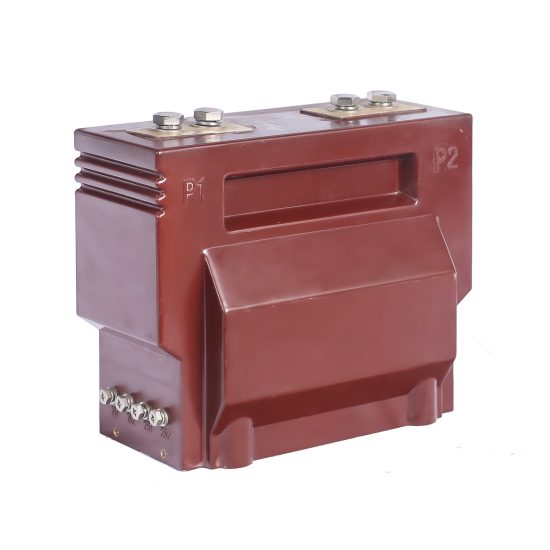
The LZX-10 is a high-reliability, cast-resin insulated current transformer (CT) engineered for accurate current measurement and robust protective relay coordination in medium-voltage power systems operating at 11kV (IEC standard) or 10kV (domestic Chinese system). Designed in strict accordance with IEC 61869-2 and GB/T 20840.2, this instrument transformer leverages vacuum pressure impregnation (VPI) epoxy resin technology to deliver superior dielectric performance, environmental resilience, and long-term operational stability without the fire hazards or maintenance demands associated with oil-filled alternatives.
Operating Principle of Cast-Resin Insulation
Cast-resin insulation in the LZX-10 utilizes a two-component epoxy system cured under vacuum and pressure to fully encapsulate the magnetic core and windings. This process eliminates air voids and moisture ingress pathways, resulting in a homogeneous dielectric structure with high partial discharge inception voltage (>20 kV at 50 Hz). The resin matrix provides mechanical rigidity, thermal conductivity for heat dissipation, and resistance to tracking under polluted or humid conditions. Unlike oil-immersed CTs, the solid insulation ensures no leakage, no need for conservator tanks, and immunity to oil degradation over time. The VPI technique further enhances resin penetration into winding interstices, ensuring uniform stress distribution during transient overvoltages.
Advantages Over Oil-Immersed Designs
The LZX-10’s cast-resin construction offers significant operational advantages. It is inherently fire-retardant (compliant with IEC 60695 glow-wire tests), making it suitable for indoor substations, commercial buildings, and confined spaces where flammability is a concern. Maintenance requirements are drastically reduced—no oil sampling, no dielectric testing of insulating fluid, and no risk of tank corrosion. The compact, monolithic design allows for easier handling and installation on switchgear panels or bus supports. Additionally, the absence of liquid insulation eliminates temperature-dependent expansion issues and simplifies transportation logistics. Field data from utility deployments show a mean time between failures (MTBF) exceeding 30 years for cast-resin CTs like the LZX-10, compared to 15–20 years for conventional oil types under similar loading conditions.
Typical Applications Overview
The LZX-10 serves dual roles in power systems: precision metering for energy billing and revenue-grade accuracy, and reliable fault current detection for protective relaying. Its design accommodates both indoor switchgear installations (e.g., metal-clad 11kV cubicles) and outdoor pole-mounted or pad-mounted configurations. Common deployment sites include urban distribution substations, industrial plant switchyards, renewable energy collector substations (solar PV and wind farms), and railway traction feeders. The transformer’s robustness against pollution, UV exposure, and thermal cycling makes it ideal for harsh environments, while its low phase error and ratio error ensure compliance with Class 0.2S and 0.5 accuracy requirements for modern smart metering infrastructure.
Technical Specifications
The LZX-10 is engineered to meet stringent electrical and environmental performance criteria. Below is a comprehensive specification table followed by detailed service condition parameters.
| Parameter | Value |
|---|---|
| Rated System Voltage (IEC) | 11 kV |
| Rated System Voltage (Domestic) | 10 kV |
| Rated Primary Current | 50 A to 4000 A (standard ratios available) |
| Rated Secondary Current | 1 A or 5 A |
| Accuracy Classes | Metering: 0.2S, 0.5S; Protection: 5P10, 5P20, 10P10 |
| Rated Output (Burden) | 5 VA to 30 VA (per class and ratio) |
| Insulation Level (IEC 60071-1) | Power Frequency Withstand: 28 kV rms / 1 min Lightning Impulse Withstand: 75 kV peak |
| Short-Time Thermal Current | 25 kA for 1 s (Ith) |
| Dynamic Withstand Current | 62.5 kA peak (Idyn) |
| Core Material | Grain-Oriented Electrical Steel (GOES), CRGO grade |
| Insulation System | VPI Epoxy Resin, UL 94 V-0 rated |
| Ambient Temperature Range | –40°C to +40°C |
| Altitude Limit | ≤ 1000 m above sea level (derating required above) |
| Relative Humidity | Up to 95% non-condensing |
Standard Service Conditions
The LZX-10 is rated for continuous operation under standard IEC 60060-1 environmental conditions. Ambient temperature must not exceed +40°C average over 24 hours, with a maximum of +45°C for short durations. Installation altitude must be ≤1000 m; for altitudes between 1000–2000 m, the power frequency withstand voltage must be derated by 1% per 100 m above 1000 m. Relative humidity up to 95% is permissible provided condensation does not occur on the surface—this is ensured by the hydrophobic nature of the cured epoxy resin. The transformer is designed for three-phase systems with balanced loading; unbalanced conditions must not exceed 10% negative-sequence current for extended periods to avoid core saturation and measurement errors.
Electrical Performance Tolerances
Per IEC 61869-2, the LZX-10 maintains strict error limits. For Class 0.2S metering, ratio error must not exceed ±0.2% and phase displacement ≤ ±10 minutes at 100% rated current. At 1% rated current, ratio error tolerance widens to ±0.75%. Protection classes such as 5P20 guarantee that composite error remains ≤5% at 20 times rated current with specified burden. Burden tolerance is ±10% of nominal value. The secondary winding DC resistance is measured at 20°C and must fall within ±5% of factory test values. These tolerances are validated during type testing and verified during routine production tests using calibrated reference standards traceable to national metrology institutes.
Typical Applications
The LZX-10 cast-resin current transformer is deployed across diverse power infrastructure segments due to its dual functionality, reliability, and compliance with international standards.
Substation Secondary Metering
In 11kV/0.4kV distribution substations, the LZX-10 provides revenue-grade current signals to kWh meters, demand recorders, and power quality analyzers. Installed on the medium-voltage side of distribution transformers, it enables accurate billing for commercial and industrial consumers. The 0.2S accuracy class ensures compliance with regulatory requirements (e.g., EU Measuring Instruments Directive or China’s DL/T 448). Its low excitation impedance minimizes burden impact on metering circuits, even when multiple devices share the same CT secondary. In smart grid deployments, the LZX-10 interfaces with digital metering units via analog inputs or through merging units in IEC 61850-compliant architectures.
Industrial Power Distribution
Within manufacturing facilities, chemical plants, and data centers, the LZX-10 monitors feeder currents for load management and protective coordination. Its 5P20 class reliably drives overcurrent and earth-fault relays during bolted faults up to 20× rated current. The cast-resin body resists chemical vapors, dust, and mechanical vibration common in industrial settings. For example, in a steel mill with harmonic-rich loads, the LZX-10’s GOES core maintains linearity up to the 13th harmonic, preventing relay misoperation. Installation on withdrawable switchgear allows for easy maintenance without de-energizing adjacent circuits.
Renewable Energy Integration
Solar photovoltaic (PV) and wind farm collector substations utilize the LZX-10 for both generation metering and anti-islanding protection. In a 10 MW solar array, multiple LZX-10 units on 11kV feeders supply current data to SCADA systems for performance monitoring and to distance relays for grid disconnection during faults. The transformer’s fast saturation recovery ensures accurate fault current representation during transient events caused by cloud-induced irradiance changes or wind gusts. Its UV-stable resin housing withstands decades of direct sunlight exposure without embrittlement.
Rural and Suburban Distribution Networks
Pole-mounted LZX-10 CTs enable remote monitoring and automated sectionalizing in rural 11kV radial feeders. Paired with reclosers or automated circuit breakers, they provide fault location data to reduce outage durations. In suburban ring-main units (RMUs), their compact footprint fits within limited enclosure space while delivering Class 0.5S accuracy for residential aggregation metering. The design includes optional secondary shorting links for safe replacement during live-line maintenance—a critical feature for utilities minimizing customer interruption.
Compliance with International Standards
The LZX-10 is certified to IEC 61869-2:2012 (“Instrument transformers – Part 2: Additional requirements for current transformers”) and aligns with the Chinese national standard GB/T 20840.2-2014, which adopts IEC 61869-2 with minor national deviations.
IEC 61869-2 Compliance Details
IEC 61869-2 defines performance, testing, and marking requirements for electromagnetic CTs. The LZX-10 meets all mandatory clauses, including: defined accuracy classes with error limits across specified current ranges; thermal and dynamic short-circuit withstand capabilities; insulation coordination per IEC 60071; and marking requirements (e.g., polarity dots, accuracy class, rated output). Type tests include temperature rise (≤60 K for resin), short-circuit (thermal and dynamic), and impulse voltage tests. Routine tests performed on every unit include turns ratio verification (±0.25% tolerance), polarity check, and power frequency withstand at 80% of type test voltage (22.4 kV for 1 min).
GB/T 20840.2 Alignment and National Deviations
GB/T 20840.2 mirrors IEC 61869-2 but includes supplementary requirements for the Chinese market. Key additions include mandatory seismic testing (horizontal acceleration 0.25g for Zone II), stricter partial discharge limits (<10 pC at 1.2 × Um/√3), and labeling in Chinese characters. The LZX-10 undergoes these additional tests at accredited labs such as China Electric Power Research Institute (CEPRI). Notably, GB/T permits 10kV as the nominal system voltage (vs. 11kV in IEC), though the insulation levels remain identical (28/75 kV). This dual-rating simplifies procurement for domestic projects while maintaining export compatibility.
Testing and Certification Requirements
Certification involves third-party validation by bodies like KEMA (now DNV), CESI, or CEPREI. The LZX-10 holds full type test reports covering all IEC 61869-2 clauses. Production units undergo 100% routine testing: insulation resistance (>1000 MΩ at 2500 V DC), ratio error (using calibrated bridge or digital comparator), and polarity (via DC kick test). Optional special tests include temperature rise under harmonic load and seismic simulation. All test data is archived for 10 years per ISO 9001 requirements.
On-Site Testing Procedures
Post-installation verification ensures the LZX-10 performs within specifications. The following tests are recommended per IEC 60186 and IEEE C57.13.
Insulation Resistance Test
Measure insulation resistance between primary-to-secondary, primary-to-ground, and secondary-to-ground using a 2500 V DC megohmmeter. Acceptance criterion: ≥1000 MΩ at 20°C. Correct for temperature using RT2 = RT1 × 2(T1–T2)/10. Low readings indicate moisture ingress or resin cracking—requiring drying or replacement. Perform before and after high-voltage tests to detect insulation damage.
Turns Ratio Test
Apply low-voltage AC (5–10 V) to the secondary winding and measure induced primary voltage (for window-type CTs) or use a dedicated ratio tester injecting primary current. Calculate actual ratio = Ip/Is. Tolerance: ±0.25% of nameplate ratio for metering classes, ±0.5% for protection. Example: For 400/5 A CT, measured ratio must be 79.8–80.2. Deviations suggest turn-to-turn shorts or incorrect tap selection.
Polarity Test
Verify reducing polarity using the DC kick method: connect a 6–12 V battery momentarily to P1–P2; observe secondary voltage deflection on a center-zero galvanometer connected to S1–S2. A positive kick at battery connection confirms correct polarity (S1 corresponds to P1). Incorrect polarity causes watt-hour meter reversal or relay miscoordination. Digital testers automate this with phase angle measurement (<1° error acceptable).
Power Frequency Withstand Voltage Test
Apply 22.4 kV rms (80% of 28 kV type test) at 50 Hz between primary and grounded secondary/enclosure for 1 minute. Use a calibrated HV test set with overcurrent trip. No flashover or disruptive discharge permitted. Leakage current should remain stable (<1 mA). This test validates insulation integrity after transport and installation stresses. Always discharge the unit through a grounding stick post-test.
Excitation (Saturation) Characteristic Test
For protection CTs, perform excitation curve testing to verify knee-point voltage (Vk). Inject increasing AC voltage into secondary while measuring current. Plot V vs. I; Vk is where slope drops to 45°. For 5P20 class, Vk ≥ (20 × In × Zb) / √2. Example: 400/5 A, 15 VA → Zb=0.6 Ω → Vk ≥ 170 V. Low Vk indicates core degradation or incorrect design.
Preventive Maintenance Guide
Although cast-resin CTs require minimal maintenance, periodic checks extend service life and prevent unexpected failures.
Periodic Inspection Schedule
Conduct visual and electrical inspections annually. Check for: surface cracks, tracking marks, or discoloration on resin housing; loose terminal connections (torque to 12 N·m for M6 bolts); corrosion on mounting hardware; and integrity of secondary shorting links. Clean housing with dry cloth or mild detergent—never abrasive cleaners. Verify secondary circuit continuity and insulation resistance. After severe weather (lightning, flooding), perform immediate inspection regardless of schedule.
Long-Term Maintenance Intervals
Every 5 years, repeat on-site tests: insulation resistance, ratio, and excitation curve. Compare results to baseline commissioning data; >10% deviation warrants investigation. Replace gaskets on terminal boxes if hardened. Every 10 years, consider thermographic scanning under load to detect hot spots indicating internal faults. The LZX-10’s expected service life is 25–30 years under normal conditions; beyond this, proactive replacement is advised even if functional, due to gradual resin aging.
| Interval | Actions |
|---|---|
| Annual | Visual inspection, terminal torque check, IR test |
| 5 Years | Full electrical tests (ratio, polarity, excitation), compare to baseline |
| 10 Years | Thermographic scan, gasket replacement, review loading history |
| 25+ Years | Evaluate for replacement based on condition assessment |
Conclusion
The LZX-10 11kV cast-resin current transformer represents a benchmark in medium-voltage instrumentation, combining precision metering capability with dependable protection performance in a maintenance-free, environmentally resilient package. Its compliance with IEC 61869-2 and GB/T 20840.2 ensures global interoperability and regulatory acceptance, while the use of GOES core material and VPI epoxy resin guarantees low losses, high accuracy, and exceptional dielectric strength. Field-proven in applications ranging from urban substations to remote renewable sites, the LZX-10 delivers consistent performance across extreme temperatures, humidity, and pollution levels. With a design life of 25–30 years and minimal lifecycle costs, it offers superior total cost of ownership compared to legacy oil-immersed designs. Utilities and industrial operators selecting the LZX-10 benefit from enhanced grid reliability, accurate energy accounting, and future-proof compatibility with digital substation architectures.
Q1: Can the LZX-10 be used in 10kV systems?
Yes. While rated for 11kV per IEC standards, the LZX-10 is fully compatible with 10kV domestic systems (common in China and parts of Asia). The insulation level (28/75 kV) exceeds requirements for both voltages, ensuring safe operation.
Q2: What is the maximum altitude rating?
Standard units are rated for ≤1000 m. For installations between 1000–2000 m, apply a 1% per 100 m derating factor to the power frequency withstand voltage. Custom units with enhanced clearances are available for >2000 m.
Q3: Is the LZX-10 suitable for outdoor use?
Yes. The UV-stabilized epoxy resin housing and IP54-rated terminal box (with optional IP55) make it suitable for both indoor and outdoor environments, including coastal and industrial zones.
Q4: How many secondary windings can the LZX-10 support?
Standard models offer 1–3 independent secondary windings (e.g., one for metering, one for protection, one for backup). Each winding is isolated and can have different accuracy classes and burdens.
Q5: What happens if the secondary is left open-circuited?
Never operate the LZX-10 with an open secondary—it can generate hazardous overvoltages (>3 kV) and cause core saturation or insulation failure. Always short-circuit secondaries during maintenance using the provided links.