Contenido del artículo
Model-first: DZJ-3 11kV Cast-Resin Voltage Transformer for Substation Metering and Protection – IEC 61869-3 Certified
Introduction to the DZJ-3 Voltage Transformer
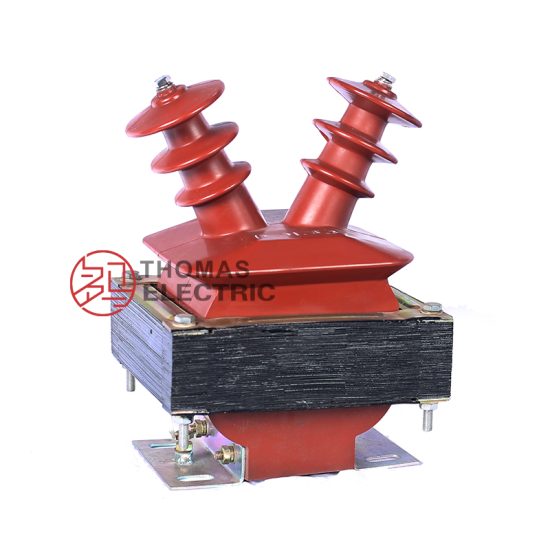
The DZJ-3 is a single-phase, indoor/outdoor-rated cast-resin voltage transformer (VT) engineered for high-reliability operation in 11kV (IEC nominal) or 10kV (domestic system) distribution networks. Designed in strict accordance with IEC 61869-3 and GB/T 20840.3, this instrument transformer provides accurate voltage scaling for both metering and protective relaying functions. Its construction leverages vacuum pressure impregnation (VPI) epoxy resin technology, which fully encapsulates the primary and secondary windings along with the magnetic core, eliminating air voids and moisture ingress pathways.
Unlike traditional oil-immersed VTs, the DZJ-3’s solid insulation system offers superior fire resistance (non-flammable), minimal maintenance requirements, and immunity to oil leakage—critical advantages in confined substations, urban switchgear rooms, and environmentally sensitive zones. The absence of liquid dielectric also simplifies transportation, installation, and disposal logistics while meeting stringent environmental regulations.
Typical deployment scenarios include medium-voltage switchgear panels, ring main units (RMUs), renewable energy collector substations, and industrial power distribution centers where space constraints, safety, and long-term stability are paramount.
Operating Principle of Cast-Resin Insulation
Cast-resin insulation in the DZJ-3 VT relies on a two-stage VPI process using cycloaliphatic epoxy resin systems. During manufacturing, the wound core assembly—comprising grain-oriented electrical steel (GOES)—is placed in a mold under vacuum to remove entrapped air. Epoxy resin is then introduced under pressure, ensuring complete penetration into inter-turn spaces and lamination gaps. Post-curing at controlled temperatures yields a monolithic, mechanically rigid structure with excellent thermal conductivity (0.2–0.3 W/m·K) and high dielectric strength (>20 kV/mm).
This solid dielectric exhibits negligible aging under continuous operating stress up to 1.2 × Un (13.2 kV) and withstands transient overvoltages per IEC 60071 coordination levels. The coefficient of thermal expansion closely matches that of copper and steel, minimizing mechanical stress during thermal cycling from –40°C to +100°C. Additionally, the hydrophobic surface repels moisture, maintaining surface resistivity >10¹² Ω even at 95% relative humidity.
Advantages Over Oil-Immersed Designs
The DZJ-3 eliminates several failure modes inherent to oil-filled VTs. First, there is no risk of oil degradation due to oxidation or moisture absorption, which can reduce breakdown voltage and cause sludge formation. Second, the solid resin body prevents internal partial discharges (PD) below 10 pC at rated voltage—well under the IEC 61869-3 limit of 20 pC—ensuring decades of stable performance. Third, the unit is inherently explosion-proof (EEx nA IIC T4 certified options available), making it suitable for hazardous locations without additional containment.
From a lifecycle perspective, the DZJ-3 requires no oil sampling, gas monitoring, or conservator tank maintenance. Its weight is typically 30–40% less than equivalent oil units, reducing structural support demands. Furthermore, end-of-life handling avoids hazardous waste classification under EU Directive 2000/53/EC, streamlining decommissioning.
Typical Applications Overview
The DZJ-3 serves dual roles: precision metering (accuracy class 0.2 or 0.5) and protective relaying (class 3P). In utility substations, it feeds revenue-grade kWh meters and SCADA voltage inputs. In industrial plants, it interfaces with motor protection relays, undervoltage trip coils, and power quality analyzers. Its compact footprint (typically 320 mm height × 180 mm width) allows integration into 630 A RMUs without derating. For solar farms, the DZJ-3 monitors grid-tie voltage at the point of common coupling (PCC), enabling anti-islanding detection per IEEE 1547.
Technical Specifications
The DZJ-3 is engineered to deliver consistent performance across diverse environmental and electrical conditions. Below is a comprehensive specification table aligned with IEC 61869-3 Clause 5 and GB/T 20840.3 Annex A:
| Parameter | Value |
|---|---|
| System Voltage (IEC) | 11 kV |
| System Voltage (Domestic) | 10 kV |
| Rated Primary Voltage (Unp) | 11/√3 kV (phase-to-earth) |
| Rated Secondary Voltage (Uns) | 100/√3 V or 110/√3 V (configurable) |
| Voltage Ratio | 11000/√3 : 100/√3 V (standard) |
| Accuracy Class (Metering) | 0.2, 0.5 (per IEC 61869-3 Table 3) |
| Accuracy Class (Protection) | 3P (composite error ≤ 3% at 5%–100% Un) |
| Rated Output (Burden) | 30 VA (0.2 class), 50 VA (0.5/3P class) |
| Insulation Level (LI/AC) | 75 kV / 28 kV (1.2/50 μs lightning impulse & 1-min AC) |
| Short-Time Thermal Withstand | 1 s at 16 kA (symmetrical) |
| Core Material | GOES M4, 0.3 mm thickness, step-lap joints |
| Insulation System | VPI cycloaliphatic epoxy resin, UL 94 V-0 rated |
| Ambient Temperature Range | –40°C to +40°C (indoor/outdoor) |
| Altitude Limit | ≤ 1000 m (derating required above) |
| Relative Humidity | Up to 95% non-condensing |
Standard Service Conditions
The DZJ-3 is rated for continuous operation under IEC 60060-1 standard atmospheric conditions: temperature 20°C ±15°C, pressure 101.3 kPa ±10%, and absolute humidity ≤11 g/m³. At altitudes exceeding 1000 m, the external insulation withstand voltage must be corrected by a factor K = 1 + (H – 1000)/7500, where H is altitude in meters. For example, at 2000 m, the 28 kV AC test voltage becomes 28 × [1 + (1000)/7500] ≈ 31.7 kV. Indoor installations require minimum IP2X enclosure protection; outdoor variants feature IP54-rated terminal boxes with silicone rubber bushings resistant to UV and ozone degradation.
Electrical Performance Parameters
Voltage error and phase displacement are tightly controlled. At 0.2 accuracy class, voltage error must not exceed ±0.2% and phase error ≤ ±10 minutes at 80–120% Un and 25–100% burden. For 3P protection class, composite error (εc) is defined as εc = √[(εv)² + (δ × π/180 × Uns/Unp)²] ≤ 3% at 5% Un with rated burden. The magnetizing current at 1.9 × Un (temporary overvoltage condition) remains below 0.5 A, preventing core saturation during ferroresonance events. Secondary terminals are labeled “a” (polarity) and “n” (neutral) per IEC 61869-3 Figure 2, with standard screw-type connectors accepting 2.5–6 mm² Cu conductors.
Typical Applications
The DZJ-3 voltage transformer is deployed across multiple sectors requiring precise, reliable voltage measurement under demanding conditions.
Substation Secondary Metering
In 11kV/0.4kV distribution substations, the DZJ-3 supplies scaled-down voltage signals to multi-function energy meters (e.g., IEC 62053-22 Class 0.5S). Its low phase error ensures accurate reactive energy (kVArh) billing, critical for power factor penalty calculations. The transformer is typically mounted on the busbar side of the incoming circuit breaker, with secondary wiring routed through shielded twisted-pair cables to minimize electromagnetic interference (EMI) from adjacent CTs or switchgear operations. Redundant VTs may be installed for N+1 metering architectures in critical infrastructure.
Industrial Power Distribution
Within manufacturing facilities, the DZJ-3 interfaces with digital protective relays (e.g., Siemens 7SJ62, SEL-351) for undervoltage (27), overvoltage (59), and directional earth-fault (67N) protection. Its 3P accuracy class guarantees correct relay operation during voltage sags down to 5% Un—a common occurrence during large motor starts or upstream faults. The cast-resin body withstands chemical exposure in petrochemical plants and vibration in mining operations (tested per IEC 60068-2-6 sinusoidal vibration up to 2 g at 10–55 Hz).
Renewable Energy Integration
Solar photovoltaic (PV) and wind farms utilize the DZJ-3 at the MV collection point to monitor grid voltage for synchronization and fault ride-through (FRT) compliance. During grid disturbances, the VT must maintain output within ±1% error to enable inverters to inject reactive current per ENTSO-E requirements. The DZJ-3’s low thermal time constant (<15 minutes) allows rapid stabilization after cloud-induced irradiance fluctuations in PV systems.