Contenido del artículo
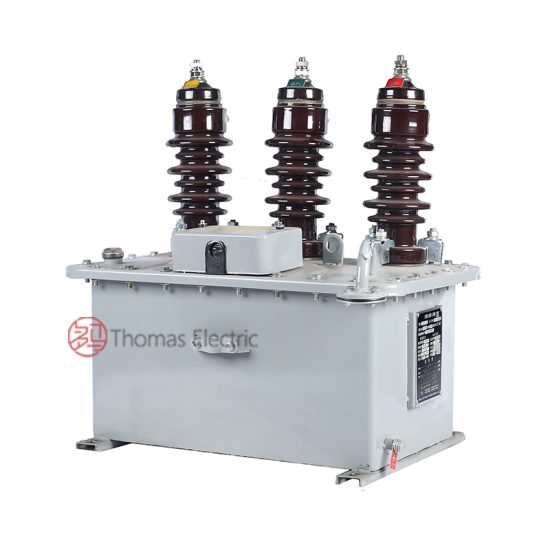
IEC 61869-3 Certified 11kV Voltage Transformer SEL-351 for Metering & Protection Applications
Introduction to the SEL-351 Voltage Transformer
The SEL-351 is a single-phase, indoor/outdoor-rated cast-resin voltage transformer (VT) engineered for high-reliability metering and protective relaying in medium-voltage power systems operating at nominal system voltages of 11kV (IEC standard) or 10kV (domestic equivalent). Designed in strict compliance with IEC 61869-3 and GB/T 20840.3, this instrument transformer leverages advanced vacuum pressure impregnation (VPI) epoxy resin technology to encapsulate its magnetic core and windings, eliminating risks associated with oil-filled alternatives such as fire hazards, leakage, and environmental contamination.
Operating Principle of Cast-Resin Insulation
Cast-resin insulation in the SEL-351 employs a thermosetting epoxy compound that fully encapsulates the primary and secondary windings along with the grain-oriented electrical steel (GOES) core. During manufacturing, the assembly undergoes vacuum degassing followed by pressure impregnation to eliminate air voids and moisture—critical factors that could lead to partial discharge under service conditions. The resulting monolithic structure provides uniform dielectric strength, excellent thermal conductivity (0.8–1.2 W/m·K), and mechanical rigidity. This design ensures stable performance across temperature cycles from –40°C to +40°C ambient, with a maximum hot-spot temperature rise of ≤60 K above ambient under rated load. The absence of liquid insulation eliminates maintenance requirements related to oil sampling, drying, or level monitoring, significantly reducing lifecycle costs in both urban substations and remote rural installations.
Advantages Over Oil-Immersed Designs
Compared to traditional oil-immersed VTs, the SEL-351’s cast-resin construction offers superior safety, environmental compatibility, and operational resilience. Oil-filled units pose fire risks in confined switchgear rooms and require containment bunds per IEC 61936, whereas the SEL-351 is inherently non-flammable (UL 94 V-0 rated) and suitable for installation in public-access areas without secondary containment. Additionally, the epoxy matrix exhibits negligible aging under continuous partial discharge activity below 10 pC (per IEC 60270), ensuring long-term dielectric integrity. The compact footprint—typically 30% smaller than equivalent oil units—facilitates retrofitting into legacy switchgear bays. Furthermore, the SEL-351 demonstrates exceptional resistance to humidity ingress (IP54 rating on terminal box), making it ideal for coastal or tropical environments where salt fog and condensation degrade paper-oil insulation systems over time.
Typical Applications Overview
The SEL-351 is deployed across diverse infrastructure segments requiring precise voltage transformation for revenue metering, fault detection, and synchro-check functions. In 11kV primary distribution substations, it supplies secondary voltages (e.g., 100/√3 V or 110/√3 V) to digital multifunction meters and numerical relays such as SEL-351S or SEL-751. Industrial facilities utilize it for harmonic monitoring in variable-frequency drive (VFD) applications due to its low phase displacement error (<±10 minutes at 0.5 VA burden). Renewable energy plants integrate the SEL-351 into solar inverter interconnection schemes to provide accurate grid-synchronization signals. Its robust design also supports deployment in railway traction networks (25 kV systems via step-down configurations) and mining operations where explosive atmospheres prohibit oil-based equipment.
On-Site Testing Procedures
Post-installation verification ensures the SEL-351 performs within specifications before energization.
Insulation Resistance Test
Using a 2500 V DC megohmmeter, measure insulation resistance between primary winding and ground, and between primary and secondary windings. Acceptance criteria: ≥1000 MΩ at 20°C. Correct for temperature using RT = R20 × 2(20–T)/10. Values below 500 MΩ indicate moisture ingress or resin cracking, requiring drying or replacement. Perform before and after power frequency withstand tests to detect insulation degradation.
Turns Ratio Test
Apply 100 V AC (50 Hz) to the primary and measure secondary voltage with a calibrated voltmeter (accuracy ±0.1%). Calculate ratio error: [(Vp/Vs)measured – (Vp/Vs)nominal] / (Vp/Vs)nominal × 100%. Acceptable tolerance: ±0.2% for 0.2 class, ±3% for 3P class. Use a dedicated ratio tester (e.g., Omicron CT Analyzer) for automated comparison against nameplate data.
Polarity Test
Verify reducing polarity per IEC 61869-3 Figure 5. Connect a 6 V battery between primary terminals (H1+, H2–). Momentarily close the circuit while monitoring secondary with a DC millivoltmeter (X1+, X2–). A positive kick confirms correct polarity. Incorrect polarity causes 180° phase shift, leading to false tripping in differential protection schemes. Document results with oscillograph traces if available.
Power Frequency Withstand Voltage Test
Apply 28 kV rms (50 Hz) between primary and grounded tank/secondary for 1 minute. Use a calibrated test transformer with overcurrent trip set at 10 mA. Monitor for flashover, excessive leakage current (>1 mA), or audible discharge. Failure indicates voids in resin or surface contamination. De-energize immediately if arcing occurs. Perform only after insulation resistance test confirms dry conditions.
Open-Circuit Characteristic Test
Gradually increase primary voltage from 0 to 1.5 × Un while measuring secondary voltage and excitation current. Plot Vs vs Iexc. Knee point should exceed 1.8 × Un/√3. Excessive excitation current (>50 mA at 1.2 Un) suggests core lamination damage or shorted turns. This test validates saturation margin for protection applications during fault conditions.
Preventive Maintenance Guide
Although cast-resin VTs require minimal maintenance, periodic checks extend service life beyond 30 years.
Annual Visual and Functional Inspection
Inspect for physical damage (cracks, discoloration), terminal corrosion, and loose connections. Clean housing with isopropyl alcohol to remove conductive dust. Verify secondary fuses are intact and torque terminals to 2.5 N·m. Perform insulation resistance and ratio tests annually in harsh environments (coastal, industrial); biennially in controlled indoor settings. Record trends—resistance dropping >20% year-over-year warrants investigation.
Five-Year Comprehensive Maintenance
Every 60 months, conduct partial discharge measurement using IEC 60270 methods. Acceptable level: <10 pC at 1.2 Un/√3. Re-torque all mechanical fasteners to compensate for thermal cycling effects. Check grounding continuity (<0.1 Ω resistance). Replace terminal box gaskets if hardened. Update test records in asset management systems for predictive analytics.
Categorías
- Uncategorized
- Transformadores Combinados
- Caja de Medición de Alta Tensión
- TC de Secuencia Cero
- Transformador de Corriente
- TC de Baja Tensión
- TC de Interior 3kV-12kV
- TC Exteriores 3kV-12kV
- CTS de 15 kV a 24 kV
- TCs de 27,5 kV-40,5 kV
- Transformadores de potencial
- Bobina de Descarga
- Dispositivos de Maniobra
Blog
Recommended Posts


