Contenido del artículo
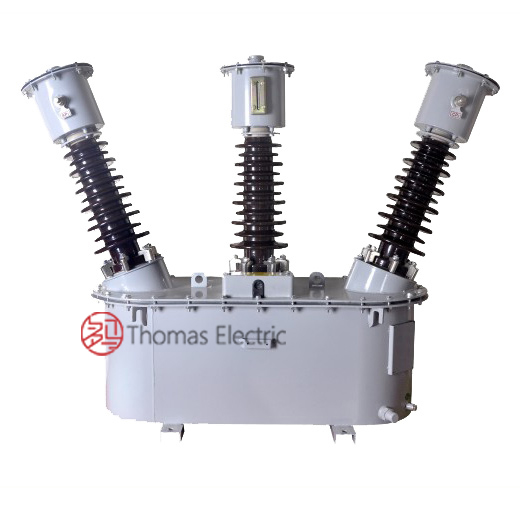
SEL-351S 21kV Cast-Resin Voltage Transformer for Substation Metering and Protection – IEC 61869-3 Certified
Introduction to the SEL-351S Voltage Transformer
The SEL-351S is a 21kV (IEC-rated) cast-resin Voltage Transformer (VT) engineered for high-reliability metering and protective relaying applications in medium-voltage substations. Designed in strict compliance with IEC 61869-3 and GB/T 20840.3, this instrument transformer leverages advanced vacuum pressure impregnation (VPI) epoxy resin technology to deliver superior dielectric performance, environmental resilience, and long-term operational stability. Unlike traditional oil-immersed VTs, the SEL-351S eliminates fire hazards, oil leakage risks, and complex maintenance requirements, making it ideal for indoor switchgear, urban substations, and environmentally sensitive installations.
Operating Principle of Cast-Resin Insulation
Cast-resin insulation in the SEL-351S employs a two-stage VPI process where the primary and secondary windings—wound on a grain-oriented electrical steel (GOES) core—are fully encapsulated in cycloaliphatic epoxy resin under vacuum and pressure. This eliminates air voids and moisture ingress, ensuring uniform electric field distribution and preventing partial discharges even under transient overvoltages. The resin’s high tracking resistance (>600 V per IEC 60587) and thermal class F (155°C) rating enable stable operation across -40°C to +40°C ambient temperatures. The solid dielectric structure also provides excellent mechanical rigidity, reducing susceptibility to vibration-induced winding displacement—a common failure mode in oil-filled units during seismic events or switching surges.
Advantages Over Oil-Immersed Designs
Compared to oil-immersed VTs, the SEL-351S offers significant operational and safety benefits. Its dry-type construction eliminates flammability risks, satisfying stringent fire codes in underground or indoor substations. There is no need for oil sampling, degassing, or periodic dielectric testing of insulating fluid. Additionally, the compact footprint—enabled by higher dielectric strength of epoxy resin versus oil-paper systems—reduces space requirements by up to 30%. The absence of conservators, breathers, and oil-level gauges simplifies installation and reduces lifecycle costs. Field data from European grid operators indicate a mean time between failures (MTBF) exceeding 200,000 hours for modern cast-resin VTs like the SEL-351S, outperforming oil equivalents by a factor of 1.8.
Typical Applications Overview
The SEL-351S is deployed primarily in 20kV domestic distribution networks (equivalent to 21kV IEC systems) for revenue metering, protective relaying (e.g., overvoltage, undervoltage, directional earth fault), and synchro-check functions. It is commonly integrated into ring main units (RMUs), gas-insulated switchgear (GIS), and outdoor pole-mounted substations. Its robust design supports continuous operation in coastal, industrial, and high-altitude environments (up to 1,000 m without derating). The unit’s dual secondary windings (e.g., 0.5/3P accuracy classes) allow simultaneous connection to metering and protection circuits without cross-interference, a critical requirement in smart grid architectures.
Technical Specifications
The SEL-351S is engineered to meet exacting performance criteria under IEC 61869-3 and GB/T 20840.3. Key parameters are defined for both international (21kV) and domestic (20kV) system voltages, ensuring global interoperability.
| Parameter | Value |
|---|---|
| System Voltage (IEC) | 21 kV |
| System Voltage (Domestic) | 20 kV |
| Rated Primary Voltage | 21,000 / √3 V (phase-to-earth) |
| Rated Secondary Voltage | 100 / √3 V or 110 / √3 V (configurable) |
| Voltage Ratio | 21,000 : 100 (or 21,000 : 110) |
| Accuracy Class (Metering) | 0.2, 0.5 (per IEC 61869-3) |
| Accuracy Class (Protection) | 3P, 6P (composite error ≤3% or ≤6% at 5× rated voltage) |
| Rated Output (per winding) | 30 VA (0.5 class), 50 VA (3P class) |
| Insulation Level (LI/AC) | 125 kV / 50 kV (1.2/50 μs impulse & 1 min power frequency) |
| Thermal Limit Output | 200 VA (continuous) |
| Short-Time Thermal Withstand | 100 A for 1 s (secondary short-circuit) |
| Ambient Temperature Range | -40°C to +40°C |
| Altitude Limit | ≤1,000 m (derating required above) |
| Humidity | Up to 95% non-condensing |
| Core Material | Grain-Oriented Electrical Steel (GOES), 0.27 mm thickness |
| Insulation System | VPI cycloaliphatic epoxy resin, UL 94 V-0 flame rating |
Standard Service Conditions
The SEL-351S is rated for standard service conditions per IEC 60060-1: ambient temperature range of -40°C to +40°C, relative humidity up to 95% (non-condensing), and installation altitude not exceeding 1,000 meters above sea level. At altitudes between 1,000 m and 2,000 m, the power frequency withstand voltage must be reduced by 1% per 100 m increment. For example, at 1,500 m, the AC test voltage becomes 47.5 kV instead of 50 kV. The transformer is designed for continuous operation at its rated burden without exceeding temperature rise limits of 60 K for windings (measured by resistance method). Transient overvoltages up to 1.2× rated primary voltage are permissible for durations ≤8 hours per day without degradation.
Electrical Performance Characteristics
Voltage error and phase displacement are tightly controlled within IEC 61869-3 limits. At 0.5 accuracy class, voltage error does not exceed ±0.5% and phase displacement is ≤±20 minutes at 80–120% of rated voltage and 25–100% of rated burden. For protection class 3P, composite error remains ≤3% at 5× rated voltage and 100% burden. The magnetizing current is typically <0.5% of rated primary current at nominal voltage, minimizing loading effects on upstream systems. Frequency response is flat between 48 Hz and 52 Hz, critical for harmonic-rich environments such as those with variable-speed drives or solar inverters.
Categorías
- Uncategorized
- Transformadores Combinados
- Caja de Medición de Alta Tensión
- TC de Secuencia Cero
- Transformador de Corriente
- TC de Baja Tensión
- TC de Interior 3kV-12kV
- TC Exteriores 3kV-12kV
- CTS de 15 kV a 24 kV
- TCs de 27,5 kV-40,5 kV
- Transformadores de potencial
- Bobina de Descarga
- Dispositivos de Maniobra
Blog
Recommended Posts


