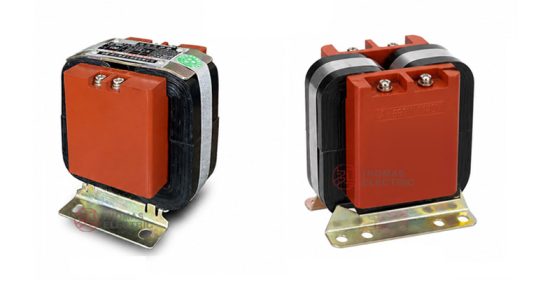
Product Overview
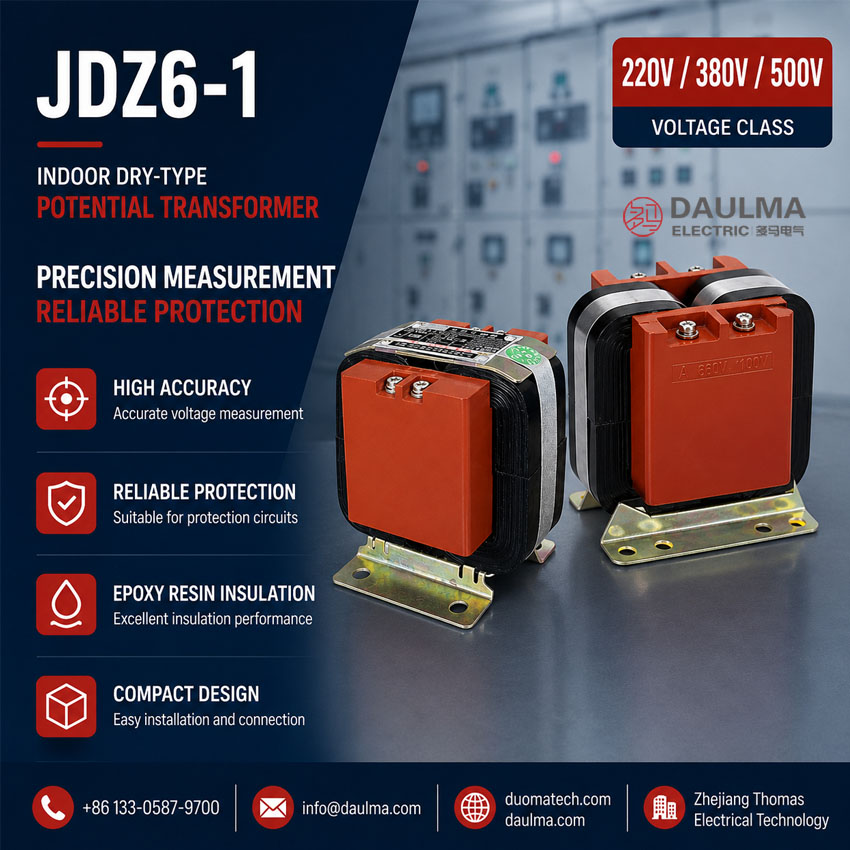
The JDZ6-1 indoor dry-type potential transformer is an epoxy resin insulated voltage transformer designed for indoor power systems requiring voltage measurement, electrical energy metering, and relay protection. It converts the primary system voltage into a standardized secondary voltage signal for measuring instruments, energy meters, and protection devices.
The JDZ6-1 series is designed for 50Hz AC systems and is commonly used in indoor switchgear, metering panels, distribution cabinets, and power monitoring systems. The product adopts a cast-resin insulated dry-type structure with a C-shaped silicon steel core, supporting compact installation, stable insulation performance, and convenient terminal connection for secondary circuits.
Product Type
| Item | Specification |
|---|---|
| Product name | Indoor Dry-Type Potential Transformer |
| Model series | JDZ6-1 |
| Product structure | Indoor epoxy resin insulated dry-type voltage transformer |
| Rated frequency | 50Hz |
| Rated voltage ratio | 220/100V, 380/100V, 500/100V |
| Rated secondary voltage | 100V |
| Installation location | Indoor |
| Typical applications | Voltage measurement, electric energy metering, power monitoring, relay protection |
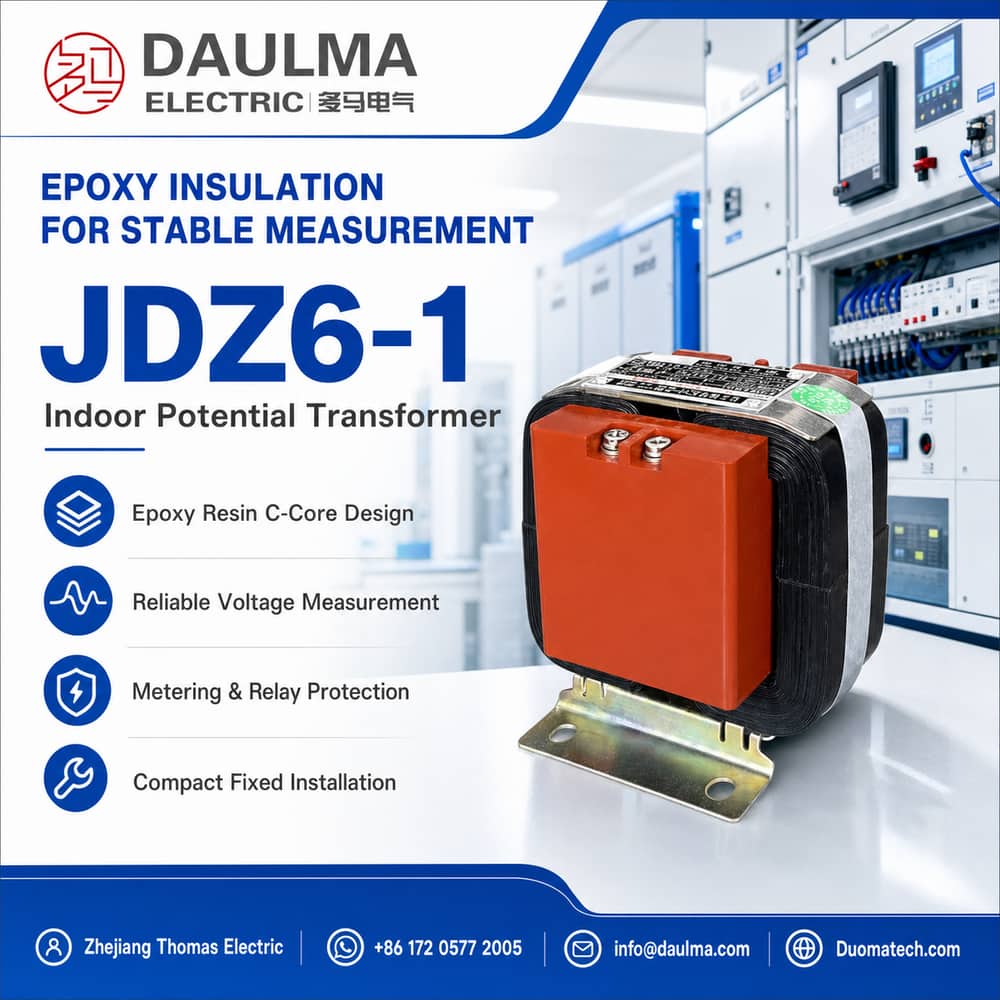
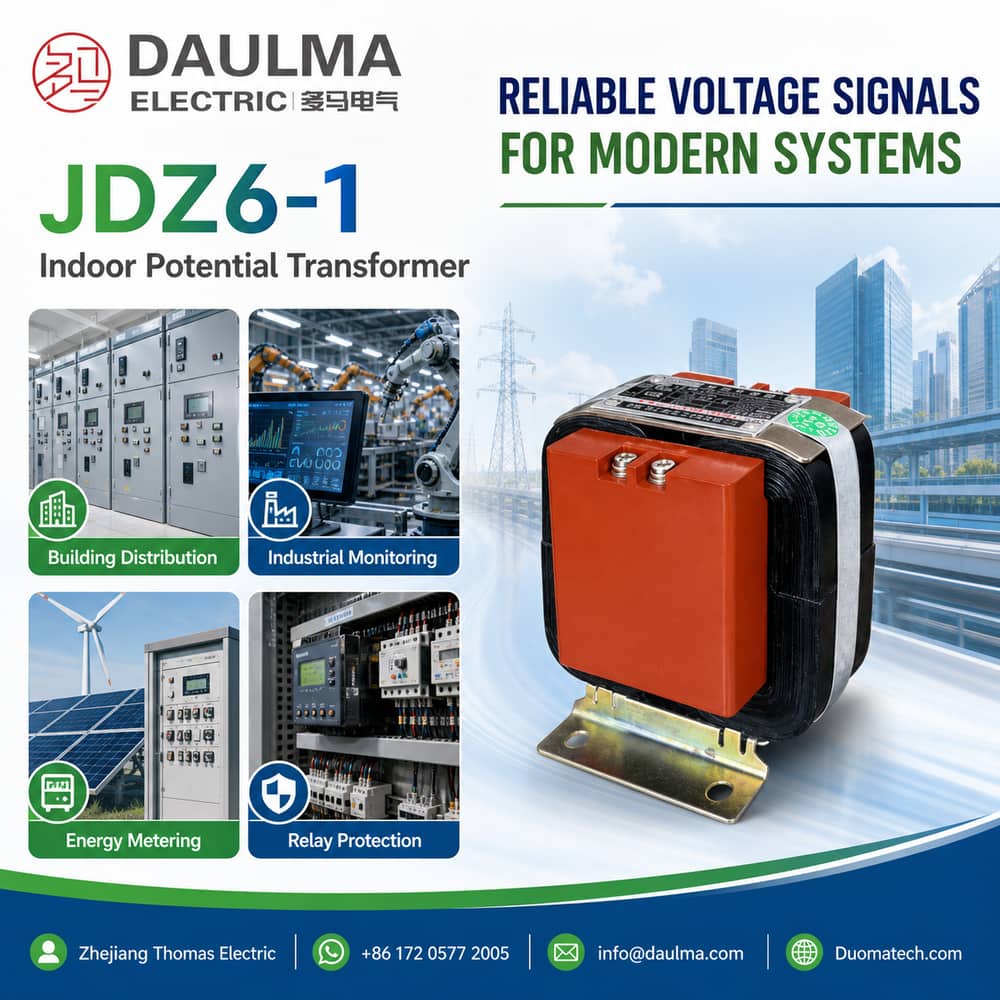
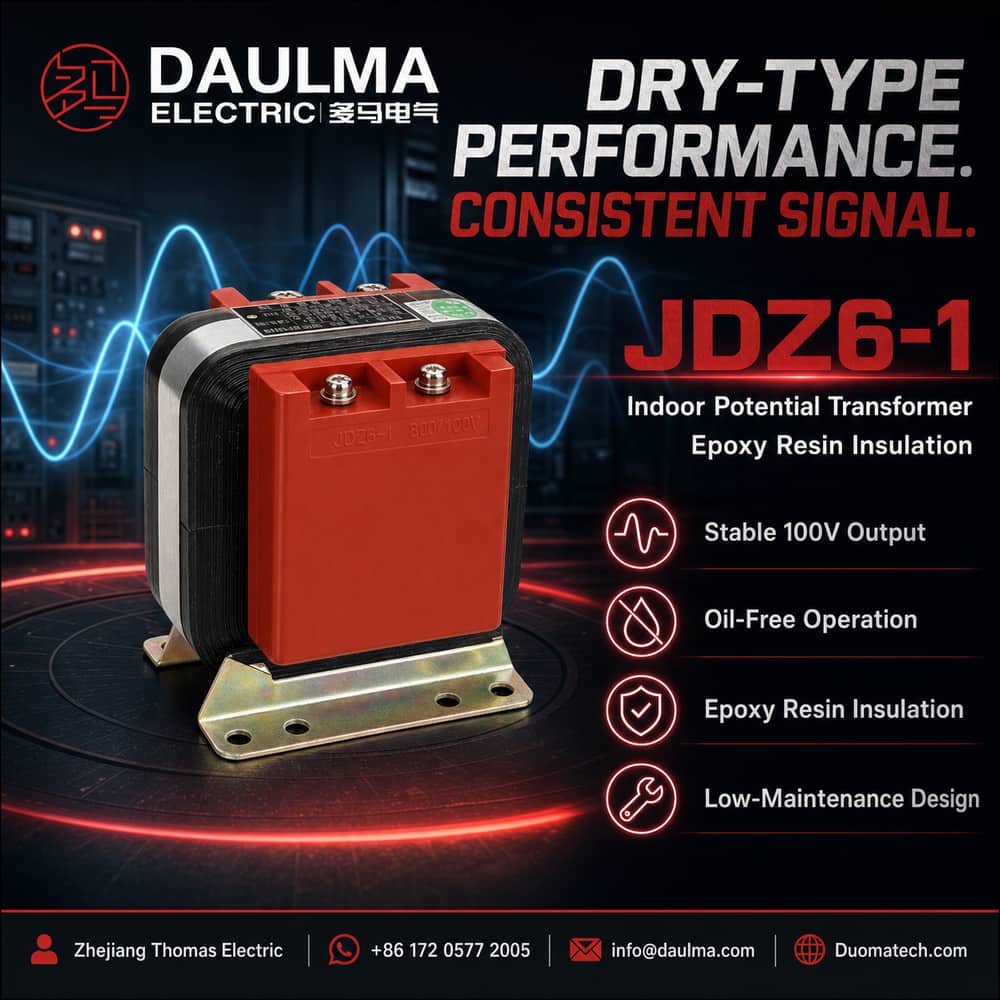
Product Display
Main Applications
- Indoor AC power systems requiring voltage measurement
- Electrical energy metering circuits and metering cabinets
- Power monitoring panels and distribution cabinets
- Relay protection circuits requiring isolated voltage signals
- Low-voltage switchgear and control cabinets
- Instrument voltage input circuits for meters, relays, and monitoring devices
Key Technical Features
- Epoxy resin insulation: Cast-resin insulation supports dielectric strength, mechanical stability, and moisture resistance for indoor applications.
- Dry-type structure: The transformer does not use oil insulation, making it suitable for compact indoor cabinet installation.
- C-core magnetic structure: The core is made of cold-rolled silicon steel sheets and formed into a C-shaped structure for stable electromagnetic performance.
- Standard 100V secondary output: Compatible with common voltage meters, energy meters, relays, and power monitoring instruments.
- Multiple voltage ratios: Common ratios include 220/100V, 380/100V, and 500/100V for different low-voltage measurement circuits.
- Metering and protection use: Suitable for voltage measurement, energy metering, power monitoring, and relay protection applications.
Working Principle
The JDZ6-1 potential transformer operates according to electromagnetic induction. The primary winding is connected to the measured circuit, and the secondary winding outputs a proportional reduced voltage signal, typically 100V. This allows voltage measurement and protection equipment to receive a safe, standardized signal while maintaining electrical isolation from the primary circuit.
Model Designation
The model code can be interpreted as follows:
| Code | Meaning |
|---|---|
| J | Voltage transformer / potential transformer |
| D | Indoor use |
| Z | Casting resin insulated structure |
| 6 | Voltage grade / design category code |
| 1 | Design number |
Technical Data
| Item | Specification |
|---|---|
| Rated frequency | 50Hz |
| Rated voltage ratio | 220/100V, 380/100V, 500/100V |
| Rated secondary voltage | 100V |
| Accuracy class | 0.5, 1, 3 according to rated output and project requirement |
| Rated output | 15VA / 25VA / 50VA according to accuracy class |
| Limit output | 100VA |
| Insulation type | Epoxy resin / cast resin insulation |
| Core structure | C-shaped cold-rolled silicon steel core |
| Installation location | Indoor |
| Applicable standards | GB/T 20840.1, GB/T 20840.3; project-specific requirements can be confirmed by agreement |
Rated Voltage Ratio, Accuracy and Output Reference
| Rated Voltage
Ratio (V) |
Rated
Frequency (Hz) |
Rated Output
0.5 Class (VA) |
Rated Output 1
Class (VA) |
Rated Output 3
Class (VA) |
Limit Output
(VA) |
|---|---|---|---|---|---|
| 220/100 | 50 | 15 | 25 | 50 | 100 |
| 380/100 | 50 | 15 | 25 | 50 | 100 |
| 500/100 | 50 | 15 | 25 | 50 | 100 |
Note: Special voltage ratios, output ratings, and installation requirements can be confirmed by technical agreement before ordering.
Service Conditions
- Installation location: indoor
- Rated frequency: 50Hz
- Altitude: not more than 1000m unless otherwise specified
- Ambient temperature: -5°C to +40°C
- 24-hour relative humidity average: not more than 95%
- Monthly relative humidity average: not more than 90%
- The installation environment should be free from severe dust, smoke, corrosive gas, steam, salt contamination, explosive medium, and strong vibration.
- For special altitude, humidity, temperature, pollution level, or cabinet layout requirements, technical confirmation is recommended before ordering.
Standards & Compliance
The JDZ6-1 indoor dry-type potential transformer can be supplied according to GB/T 20840.1, GB/T 20840.3, and customer-specific technical requirements. Final standards, routine test items, nameplate data, and acceptance documents should be confirmed in the technical agreement.
Installation & Dimensions
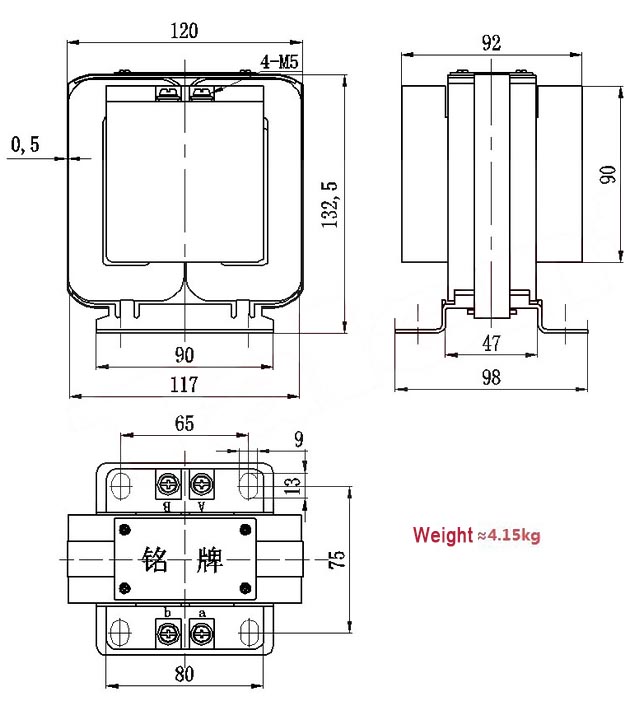
The JDZ6-1 series adopts a compact epoxy resin insulated structure for indoor fixed installation. The primary and secondary terminals are routed to the connection pedestal for convenient wiring. Final outline and mounting dimensions should be confirmed according to the approved drawing before cabinet design or batch ordering.
Outline & Installation Reference
| Item | Reference Description |
|---|---|
| Product structure | Indoor dry-type epoxy resin insulated potential transformer |
| Core structure | C-shaped cold-rolled silicon steel core |
| Installation method | Indoor fixed installation |
| Primary terminal marking | A and X |
| Secondary terminal marking | a and x |
| Outline dimensions | Refer to approved drawing before cabinet layout |
Unit: mm for dimensional drawings. Final dimensions are subject to confirmed drawing and selected specification.
Connection & Wiring Notes
- Connect primary terminals according to the marked symbols A and X.
- Connect secondary terminals according to the marked symbols a and x.
- Confirm the voltage ratio, rated output, accuracy class, and wiring diagram before energizing.
- The transformer must be properly grounded according to project and local electrical requirements.
- Secondary terminal wiring should match the actual wiring diagram and connected instrument requirements.
Safety Notes
- Inspect the product before installation and confirm that there are no visible defects, loose parts, or terminal damage.
- Confirm that the product parameters match the selection requirements before installation.
- Tighten mounting bolts securely and maintain correct terminal orientation during installation.
- Do not operate the transformer under overload conditions beyond the specified rating.
- Installation, testing, and maintenance should be performed by qualified electrical personnel.
Ordering Information
Please provide the following information when ordering or requesting a quotation:
- Product model: JDZ6-1
- Rated voltage ratio, such as 220/100V, 380/100V, or 500/100V
- Insulation level and applicable standard
- Rated output and required accuracy class
- Rated frequency and operating environment
- Installation dimensions or cabinet layout requirements
- Quantity and application, such as metering, monitoring, or relay protection
- Special requirements for terminals, labels, drawings, inspection documents, certificates, or packaging
Selection Guidelines
- Confirm system voltage: Select the voltage ratio according to the measured circuit voltage.
- Confirm secondary voltage: Match the 100V secondary output with the connected meter, relay, or instrument requirement.
- Select accuracy class: Use the required accuracy class according to metering, monitoring, or protection purpose.
- Check rated output: The total burden of meters, relays, instruments, and secondary wiring should not exceed the rated output.
- Confirm service conditions: Check altitude, temperature, humidity, and pollution level before installation.
- Confirm installation space: Check outline dimensions, terminal direction, and cabinet clearance before batch installation.