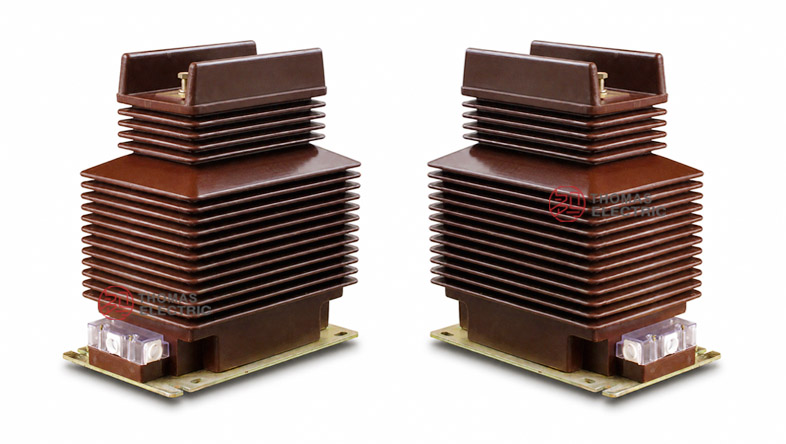
Product Overview
The LZZB8 / LZZBJ9-35/250(III) indoor epoxy cast-resin current transformer is a fully enclosed pillar-type current transformer designed for 35kV / 40.5kV indoor medium-voltage power systems. It is used for current measurement, energy metering and relay protection in AC networks with rated frequency of 50Hz or 60Hz. The product adopts epoxy resin casting insulation, with the primary winding, secondary winding and magnetic core sealed inside the cast-resin body to provide reliable insulation strength, moisture resistance and mechanical stability for indoor switchgear applications.
The key point of this model is the 250 structure code: 220 refers to the epoxy casting body width, also understood as the product body width, while f is the structure variant code used for this product platform. Therefore, this product should be positioned as a 35kV-class indoor epoxy cast-resin pillar CT with 250mm cast body width, suitable for 35kV / 40.5kV switchgear and distribution cabinets where installation space, insulation distance and terminal arrangement need to be clearly controlled. Typical project configurations can include high-current and protection-class requirements such as 2500A, 0.2S / 5P20, 50VA, subject to final drawing and nameplate confirmation.
Product Type
Product Show
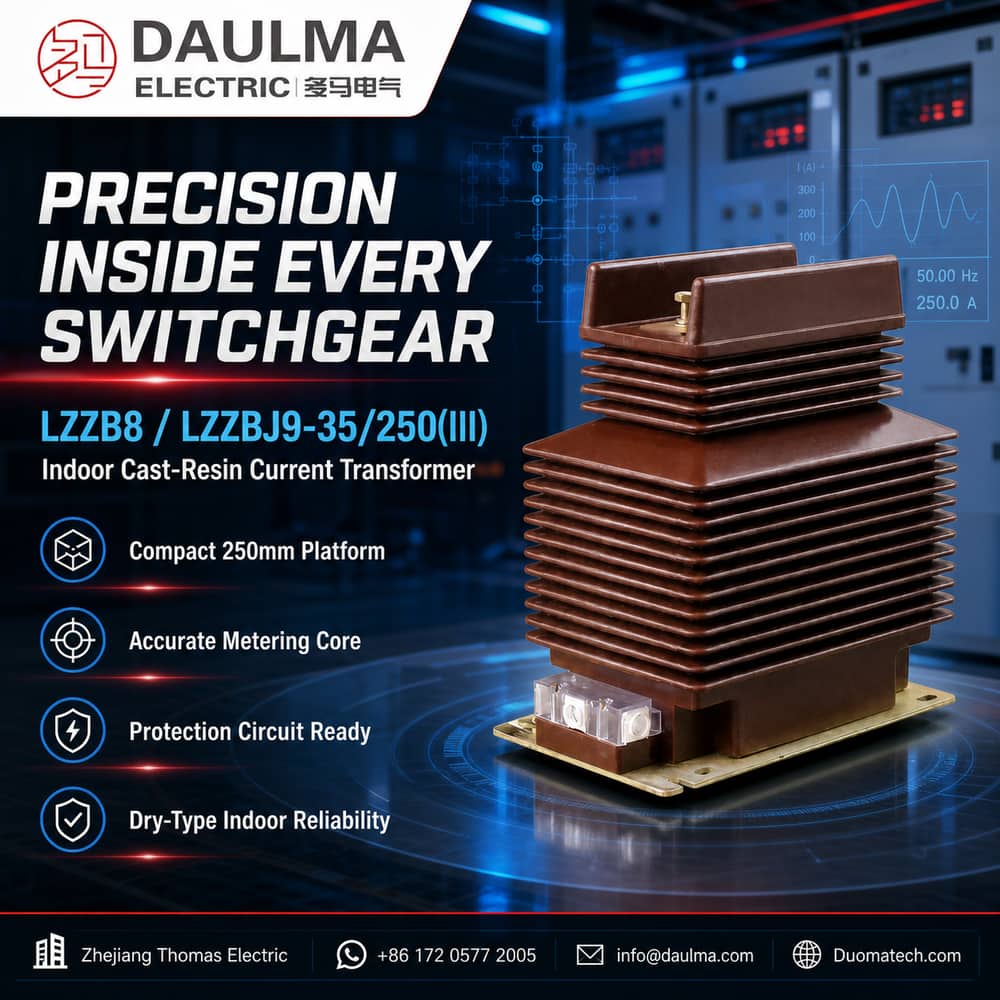
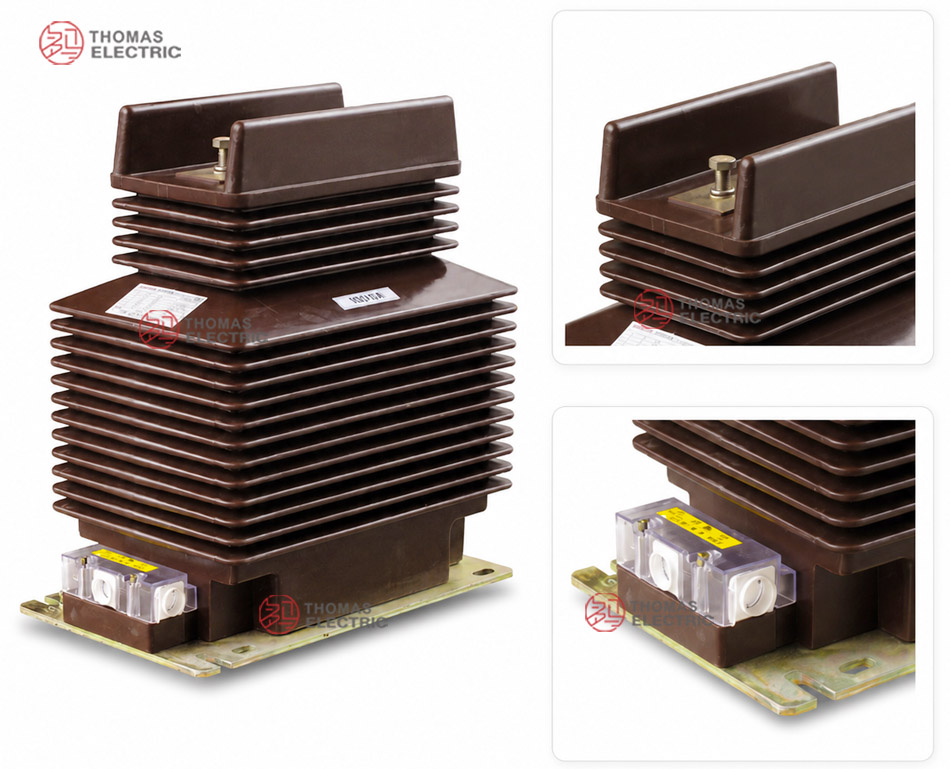
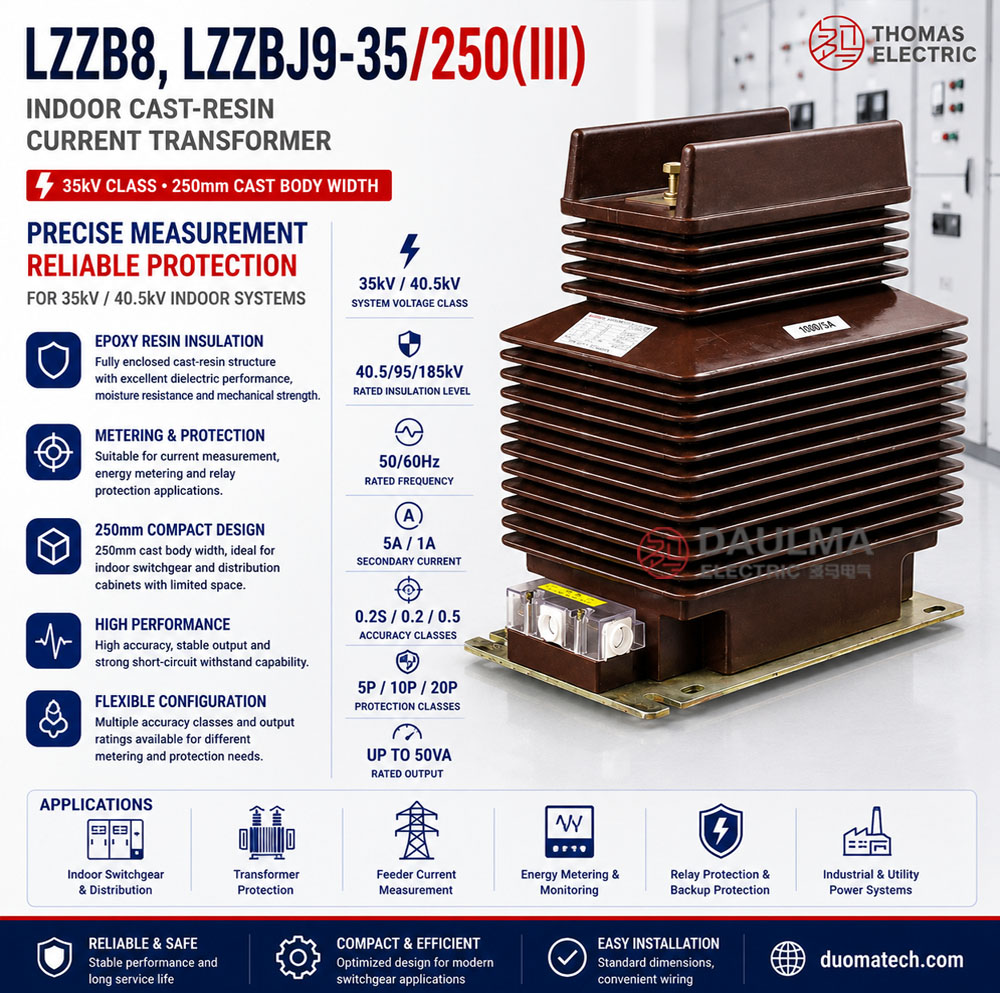
| Item | Specification |
|---|---|
| Product name | Indoor Epoxy Cast-Resin Current Transformer |
| Model | LZZB8 / LZZBJ9-35/250(III) |
| Installation condition | Indoor |
| Structure | Fully enclosed pillar-type epoxy resin cast structure |
| Cast body width | 250mm reference, represented by “250” in the model code |
| Application | Current measurement, energy metering and relay protection |
| System voltage class | 35kV / 40.5kV |
| Rated insulation level | 40.5/95/185kV |
| Rated frequency | 50Hz or 60Hz |
| Rated secondary current | 5A or 1A |
| Typical accuracy configuration | 0.2S / 5P20, 0.2 / 5P20, 0.5 / 5P20, 0.2S / 0.5 / 5P20 and project-specific combinations |
| Typical burden | 15VA, 25VA, 30VA, 50VA or customized according to winding function |
Model Explanation
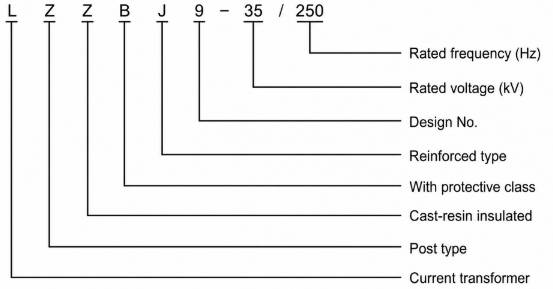
- L: Current transformer.
- Z: Pillar-type / support-type current transformer structure.
- Z: Epoxy resin casting insulation.
- B: Current transformer series with metering and protection winding options.
- J: Reinforced / enhanced insulation structure design.
- 9: Design sequence / product platform code.
- 35: 35kV class product platform, suitable for 35kV and 40.5kV systems.
- 250: Epoxy casting body width, meaning the product cast-resin body width is 250mm.
- III: Structure version code
Applications
- 35kV and 40.5kV indoor medium-voltage power systems
- 35kV switchgear and indoor distribution cabinets
- Current measurement for incoming and outgoing feeder circuits
- Energy metering and power measurement panels
- Relay protection for medium-voltage feeders, transformers and bus sections
- Industrial substations, utility substations and power distribution rooms
- Projects requiring a 250mm cast body width for cabinet layout or insulation coordination
- High-current indoor CT applications requiring configurations such as 2500A, 0.2S / 5P20 and 50VA
Features
- 250mm cast body width: The “250” in the model code directly represents the epoxy casting width / product body width, making it easier to match cabinet space and installation layout.
- 35kV / 40.5kV insulation platform: Rated insulation level of 40.5/95/185kV for international 35kV-class systems.
- Fully enclosed epoxy structure: The primary winding, secondary winding and magnetic core are sealed inside the resin casting body.
- Indoor pillar-type design: Suitable for switchgear, distribution cabinets and medium-voltage indoor electrical rooms.
- Measurement and protection functions: Supports high-accuracy metering cores and protection-class cores in the same CT body.
- High burden options: Typical protection output can reach 50VA depending on current ratio and accuracy configuration.
- Moisture-resistant insulation: Epoxy resin casting improves insulation stability and reduces maintenance requirements.
- Flexible customization: Current ratio, accuracy class, rated burden and secondary winding arrangement can be produced according to project requirements.
Structure Overview
The LZZB8 / LZZBJ9-35/250(III) adopts an epoxy resin cast insulated and fully enclosed pillar-type structure. The 250mm cast body width is an important structural parameter for switchgear layout, because it affects product body size, cabinet installation space, conductor clearance and the position of the secondary terminal area.
The primary outlet terminals are identified as P1 and P2. Secondary terminals may be arranged as 1S1, 1S2, 2S1, 2S2 and additional groups according to the number of secondary windings. The terminal layout should always follow the approved wiring diagram and nameplate marking.
Operating Principle
The LZZB8 / LZZBJ9-35/250(III) current transformer converts primary current in a 35kV / 40.5kV circuit into a standardized secondary current, normally 5A or 1A. The secondary current is connected to energy meters, measuring instruments, protection relays or monitoring equipment, allowing safe current measurement and protection control without direct connection to the high-voltage circuit.
For metering applications, the CT must keep ratio accuracy and phase displacement within the selected class and rated burden. For protection applications, the protection winding must provide dependable secondary output during fault-current conditions. Therefore, current ratio, secondary current, accuracy class, rated burden, short-time thermal current and dynamic current must be selected together according to the switchgear design and system fault level.
Technical Data
| Parameter | Specification |
|---|---|
| Model | LZZB8 / LZZBJ9-35/250(III) |
| Product type | Indoor epoxy cast-resin current transformer |
| Cast body width | 250mm reference |
| System voltage class | 35kV / 40.5kV |
| Rated insulation level | 40.5/95/185kV |
| Rated frequency | 50Hz or 60Hz |
| Rated secondary current | 5A or 1A |
| Power-frequency withstand voltage | Primary to secondary and earth: 95kV / 1min reference |
| Secondary power-frequency withstand voltage | Secondary to secondary and earth: 3kV / 1min reference |
| Lightning impulse withstand voltage | 185kV reference for 40.5kV insulation level |
| Ambient temperature | -15°C to +40°C reference from high-altitude catalogue; -5°C to +40°C for standard catalogue reference |
| Altitude | Up to 3000m reference for high-altitude version; standard altitude by project agreement |
| Humidity condition | 24h average relative humidity not exceeding 95% reference |
| Pollution severity | Class II reference for indoor service condition |
| Applicable standards | IEC 61869-1, IEC 61869-2, GB/T 20840.1, GB/T 20840.2; legacy IEC 60044-1 / GB1208 / JJG 1021 references by agreement |
Selection Table
The following table is for preliminary selection and website display. Long table headings and accuracy-class cells are split into multiple lines to reduce overflow on product pages.
| Rated
Primary |
Accuracy
Class |
Rated
Output |
Short-Time ThermalCurrent |
Rated
Dynamic |
|---|---|---|---|---|
| 50 | 0.2 / 0.2 0.2 / 0.5 0.5 / 0.5 0.2 / 5P20 0.5 / 5P20 0.2S / 5P20 |
0.2: 15VA 0.5: 25VA 5P20: 50VA |
3kA | 7.5kA |
| 75 | 0.2: 15VA 0.5: 25VA 5P20: 50VA |
5kA | 12.5kA | |
| 100 | 0.2: 15VA 0.5: 25VA 5P20: 50VA |
8kA | 20kA | |
| 315 | 0.2: 15VA 0.5: 25VA 5P20: 50VA |
12kA | 30kA | |
| 200 | 0.2: 15VA 0.5: 25VA 5P20: 50VA |
16kA | 40kA | |
| 300, 400 | 0.2 / 0.2 / 5P20 0.2 / 0.5 / 5P20 0.5 / 0.5 / 5P20 0.2 / 5P20 / 5P20 5P20 / 5P20 / 5P20 |
0.2: 15VA 0.5: 25VA 5P20: 50VA |
20kA | 50kA |
| 600 | 0.2: 15VA 0.5: 25VA 5P20: 50VA |
31.5kA | 80kA | |
| 800, 1000, 1200, 1500, 1600 | 0.2: 15VA 0.5: 25VA 5P20: 50VA |
40kA | 100kA | |
| 2500 | 0.2S / 5P20 0.2 / 5P20 0.5 / 5P20 |
50VA typical for protection winding | By agreement | By agreement |
Note: The table is for preliminary selection. If the required data is beyond the above scope, it can be confirmed by technical agreement between manufacturer and purchaser. Final values shall follow the approved drawing, nameplate and factory test report.
Operating Conditions
- Installation: Indoor installation for 35kV / 40.5kV switchgear and distribution systems.
- Rated frequency: 50Hz or 60Hz.
- Ambient temperature: -15°C to +40°C reference for high-altitude version; daily average not more than +30°C.
- Altitude: Does not exceed 3000m for high-altitude design reference; confirm insulation correction for special projects.
- Humidity: 24h average relative humidity not exceeding 95% reference.
- Pollution severity: Class II reference for indoor service condition.
- Site condition: No severe shake or bump in the installation site.
- Air quality: Ambient air should not be significantly polluted by dust, smoke, corrosive gases, vapours or salt.
Installation and Dimensions
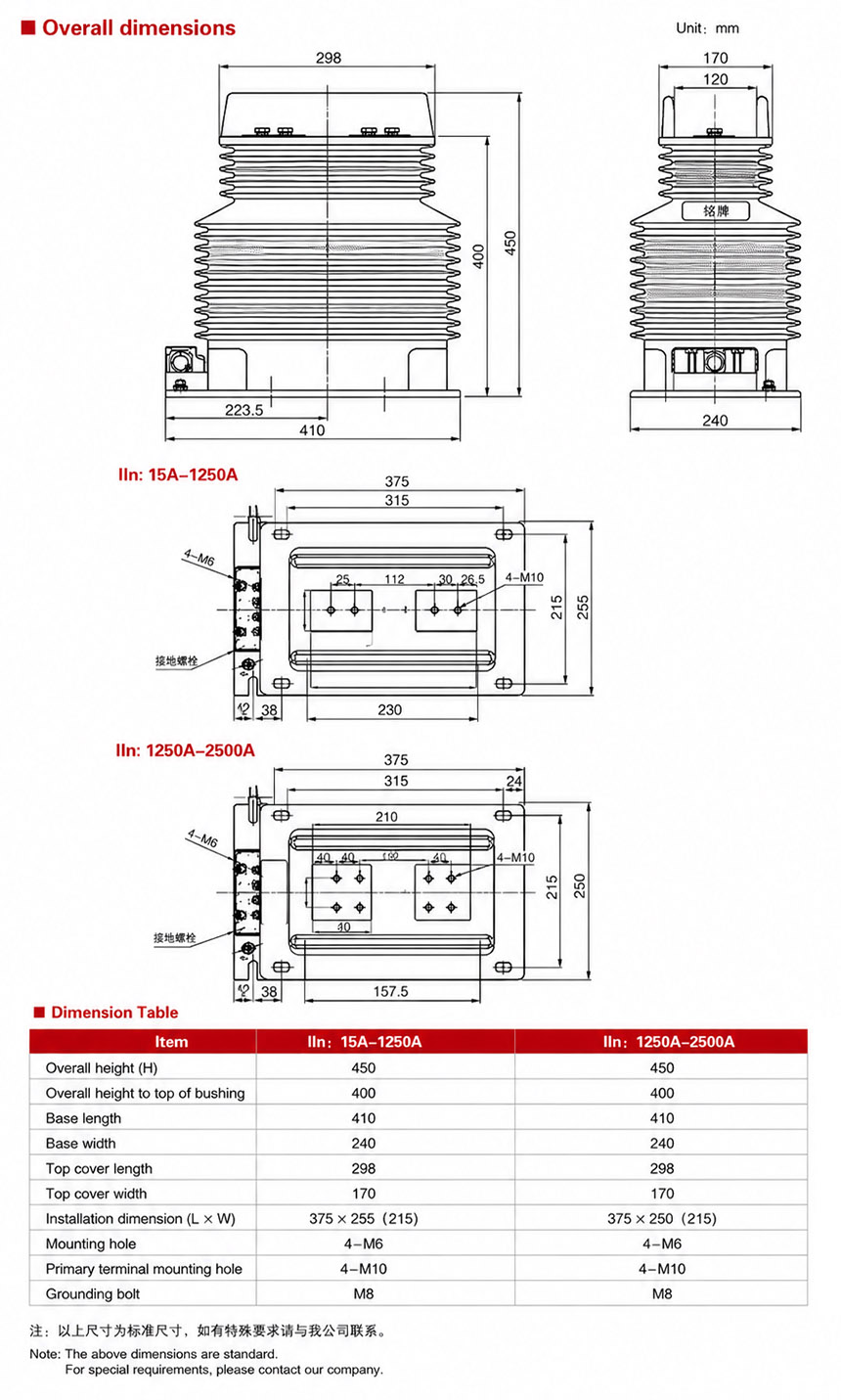
The LZZB8 / LZZBJ9-35/250(III) is installed inside 35kV-class switchgear or indoor distribution cabinets. Because the 250mm code represents the casting body width, cabinet matching should focus on body width, primary terminal spacing, secondary terminal box access and required insulation clearance. The base shall be fixed according to the approved outline drawing, and the secondary terminal box must remain accessible after cabinet assembly.
| Installation Item | Recommended Check Point |
|---|---|
| Cast body width | Confirm 250mm product body width against cabinet space and insulation layout. |
| Mounting base | Confirm base dimensions, fixing holes and support strength before installation. |
| Primary terminals | Check P1 / P2 direction, conductor connection method and insulation clearance. |
| Secondary terminal box | Reserve access space for wiring, testing, inspection and sealing. |
| Switchgear clearance | Confirm phase-to-phase and phase-to-ground clearance inside the cabinet. |
| Grounding | Ground one point of the secondary circuit according to the project grounding design. |
| Drawing confirmation | Use the approved outline drawing and terminal diagram for final production and installation. |
Windings & Marking
The primary outlet terminals are identified as P1 and P2. Secondary winding terminals are marked according to the number of secondary outputs, such as 1S1 / 1S2 for the first secondary winding and 2S1 / 2S2 for the second secondary winding. Multi-core versions may include additional secondary groups for independent metering, monitoring or protection circuits.
| Terminal | Function | Application Note |
|---|---|---|
| P1 / P2 | Primary terminals | Used for primary current direction and polarity reference. |
| S1 / S2 | Single secondary winding | Used when one secondary output is specified. |
| 1S1 / 1S2 | First secondary winding | Usually assigned to metering or current measurement. |
| 2S1 / 2S2 | Second secondary winding | Usually assigned to relay protection. |
| 3S1 / 3S2 | Additional secondary winding when specified | Used for backup protection, independent measurement or monitoring circuit. |
| Grounding point | Secondary circuit grounding reference | One point of the secondary circuit should be grounded according to project practice. |
Standards and Compliance
For international product pages, the LZZB8 / LZZBJ9-35/250(III) should be specified according to IEC 61869-1 and IEC 61869-2. GB-based documentation can refer to GB/T 20840.1 and GB/T 20840.2. Older catalogue references such as IEC 60044-1:2003, GB1208 and JJG 1021 may be retained for comparison or tender compatibility, but modern product documentation should use IEC 61869 and GB/T 20840 series as the preferred standard language.
Safety Notes
- Confirm voltage class, rated insulation level, current ratio, secondary current, accuracy class and rated output before installation.
- Confirm that the 250mm cast body width matches cabinet space, insulation distance and terminal access requirements.
- Check that the selected CT matches the switchgear insulation distance and system short-circuit level.
- Verify P1 / P2 polarity and secondary terminal marking before connecting meters, relays or test equipment.
- Ensure the CT is firmly fixed in the cabinet and that all primary conductor connections are tightened according to project requirements.
- Ground one point of the secondary circuit according to the switchgear grounding design.
- The CT secondary circuit must not be open-circuited while primary current is flowing.
- Before disconnecting meters, relays or test devices, short-circuit the secondary circuit with an approved shorting device.
- Keep the epoxy resin surface clean and dry to reduce tracking and insulation risk.
- Do not use the CT in environments with severe condensation, corrosive gas, explosive atmosphere or abnormal vibration beyond design limits.
- Installation, testing and commissioning shall be performed by qualified medium-voltage electrical personnel.